
BuddhistCatholicContemplativeEvangelicalGeneral ChristianHinduJewishLatter-day SaintMuslimNew VisionsProgressive Christian
Beliefs
- Buddhist
- Catholic
- Contemplative
- Evangelical
- General Christian
- Hindu
- Jewish
- Latter-day Saint
- More Voices
- Muslim
- New Visions
- Pagan
- Progressive Christian
Topics
- Religion News
- Food and Religion
- Sports and Religion
- Religious Art
- Religious Music and Entertainment
- Religious Events
- History and Religion
- Style and Religion
- Politics and Religion
- Women in Religion
- Recreation Outdoors and Religion
- Business Finance and Religion
- Careers Workplace and Religion
- Education and Religion
- Family Parenting and Religion
- Health Fitness and Religion
- Home and Religion
- Relationships and Religion
- Technology and Religion
- Travel and Religion
Columnists
- Buddhist Columnists
- Business Finance and Religion Columnists
- Careers Workplace and Religion Columnists
- Catholic Columnists
- Contemplative Columnists
- Education and Religion Columnists
- Evangelists Columnists
- Family Parenting and Religion Columnists
- General Christian Columnists
- Health Fitness and Religion Columnists
- Hindu Columnists
- History and Religion Columnists
- Home and Religion Columnists
- Jewish Columnists
- More Voices Columnists
- Latter Day Columnists
- Muslim Columnists
- New Visions Columnists
- Nonreligious Columnists
- Pagan Columnists
- Politics and Religion Columnists
- Progressive Columnists
- Recreation Outdoors and Religion Columnists
- Relationships and Religion Columnists
- Religion News Columnists
- Religious Art Columnists
- Religious Events Columnists
- Religious Music and Entertainment Columnists
- Sports and Religion Columnists
- Style and Religion Columnists
- Technology and Religion Columnists
- Travel and Religion Columnists
- Women in Religion Columnists
Resource Library
- 2026 Calendar
- Library of World Religions
- The 100 Most Holy Places on Earth
- Patheos Answers
- Podcasts
- Videos
- Faith Leaders Database
- Anglican Episcopalian
- Bahai
- Baptist
- Buddhism
- Christianity
- Confucianism
- Eastern Orthodoxy
- Hinduism
- Holiness and Pentecostal
- ISKCON
- Islam
- Judaism
- Lutheran
- Methodist
- The Church of Jesus Christ of Latter-day Saints
- New Age
- Paganism
- Presbytarian and Reformed
- Protestantism
- Religion Behind the Scenes
- Roman Catholic
- Scientology
- Shia Islam
- Sikhism
- Sufism
- Sunni Islam
- Taoism
- Zen
- See all religions
Research Tools
 Ad-Free & Subscriber Log-In Subscription Support
Ad-Free & Subscriber Log-In Subscription Support
Follow Patheos 

- Trending:
- Forgiveness
- |
- Marriage
- |
- Consciousness
- |
- Death Penalty
- |
- Election
- |
- Halloween
Public Square
Letting Go and Actualizing Good
April 13, 2016 by Derek Koehl
Editors' Note: This article is part of the Patheos Public Square on Sacrifice: Religions and the Role of the Scapegoat. Read other perspectives here.
The three Abrahamic religions — Judaism, Christianity, and Islam — all share a common narrative of blood sacrifice in their foundation myths:
And when he reached with him [the age of] exertion, he said, "O my son, indeed I have seen in a dream that I [must] sacrifice you, so see what you think." He said, "O my father, do as you are commanded. You will find me, if Allah wills, of the steadfast." And when they had both submitted and he put him down upon his forehead, We called to him, "O Abraham, You have fulfilled the vision." Indeed, We thus reward the doers of good. Indeed, this was the clear trial. (Quran 37:102-106)
And He said, Take now thy son, thine ben yachid (only son) Yitzchak, whom thou lovest, and get thee into eretz Moriah; and offer him there for a burnt offering upon one of the mountains which I will tell thee of. […] And they came to the place which G-d had told him of; and Avraham built a mizbe'ach there, and laid the wood in order, and made the akedah (binding) of Yitzchak his son, and laid him on the mizbe'ach upon the wood. And Avraham stretched forth his hand, and took the knife to slay his son. […] And he said, Lay not thine hand upon the young man, neither do thou any thing unto him: for now I know that thou fearest G-d, seeing thou hast not withheld thy son, thine ben yachid from Me. (Genesis 22:2, 9-10, 12, OJB)
In the several millennia over which this shared narrative has been told, rivers of ink have gone into interpreting, critiquing, and justifying the moral implications of the events portrayed in the narrative, not the least of which is the divine demand for a human sacrifice. These analyses are interesting in and of themselves as they expose how cultural perceptions of sacrifice differ across history and social groups. In our current cultural moment, one of the focusing questions of this Public Square topic strikes me as being particularly apropos: "Is the concept of [blood] sacrifice still meaningful, or is the concept a remnant of earlier primitive practices?"
In responding to this question, I move away from retreading through theological and hermeneutical territory already well explored by so many others. Rather I propose approaching from a narratological perspective and examining the common fabula — the abstracted story — that underlies the various narrative versions. This allows us to consider the actors as archetypes rather than as culturally or historically contextualized characters.
In this framing, the principal actor (Abraham) becomes the Every-Human, seeking to actualize the ideal of the Good in living and in doing. Toward this end, the actor actively seeks to hear, where hearing becomes a trope representing the quest for deeper understanding. The secondary actor (the son, denoted by different names in different traditions) becomes the Every-Object. While potentially its own subject, in this fabula the secondary actor is ultimately held as an object. The principal actor seeks to integrate the secondary actor into the principal actor's quest to actualize the Good in living and doing.
Into the equilibrium of this dynamic intrudes the transcendent actor (G-d/Allah), a personified universal reality imposing unexpected and unwanted change in the relationship between the principal actor and the secondary actor. The implicit question posed by the fabula is: "How ought the principal actor respond to the imposition of reality?" Subsumed in this question is a consideration of the extent to which the principal actor will hold tightly to the value the principal actor has invested in the secondary actor — in the specifics of this fabula, the value embodied in the parent-child relationship. The response of the principal actor determines whether it is commended in the fabula as having actualized the Good, whether the principal actor receives the "reward [for] the doers of good."
The potential act of sacrifice in the various narrative versions, at the fabula level, becomes rather an archetypical act in which the principal actor, responding to the demand of reality and despite the invested value, lets go of the secondary actor as a held object. In the fabula, reality is personified in the transcendent actor, but in our lived experience it manifests as sickness, accidents, separation, and even the process of growth. It is the principal actor's willingness to release its hold on the secondary actor that allows the principal actor to actualize the Good.
Perhaps a more helpful term than sacrifice at this point is the Eastern concept of nonattachment. In brief, suffering is seen as a direct result of an individual's attachment to externalities beyond the singularity of one's deepest Self. Only through realizing ever-increasing degrees of nonattachment is suffering mitigated and prevented. The work of nonattachment becomes a path toward actualizing the Good in life and action.
Here we arrive at one potential resolution of the posed question: insofar as ancient stories of sacrifice serve as instructive archetypes of what it means to assume a posture of nonattachment and of the internal work one must be willing to undertake to arrive at that posture, these stories continue to hold meaning for modern readers. Pushing further into the focusing questions for this topic, understanding stories of sacrifice — common in the traditions of numerous religions — in this light provides the modern spiritual seeker with guides that illuminate the arduous path that leads through the slaying and subjugation of the ego-self into deeper spiritual development.
4/13/2016 4:00:00 AM
Religion and Sacrifice
Public Square
Atonement
Progressive Christianity
Reconciliation
Sacred Texts
Sacrifice
Christianity
Islam
Judaism
more at patheos
1

Grace for the Weary: Speaking Life in Relationships
2
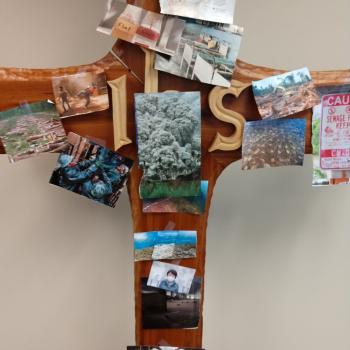
Estaciones Ecológicas del Vía Crucis, 2026
3

Spring Spiritual Cleaning: A Guide to Inner De-Cluttering
4

The SBC Helped Plant My Church. Now It May Expel Us.
About
Patheos Explore the world's faith through different perspectives on religion and spirituality! Patheos has the views of the prevalent religions and spiritualities of the world.
Ad-Free & Subscriber Log-In Subscription Support
- About Us
- 2026 Calendar
- Videos
- Podcasts
- Library of World Religions
- Faith In Media Tracker
- Advertise With Us
- Write for Us
- Privacy Policy
- Terms of Service
- Do Not Sell My Data
- Contact Us
- Radiant Digital
- Manage Newsletter Subscriptions
- Unsubscribe From Notifications
- Sitemap
Copyright 2008-2026, Patheos. All rights reserved.
Subscription Support Ad-Free & Subscriber Log-In
Follow Patheos