
BuddhistCatholicContemplativeEvangelicalGeneral ChristianHinduJewishLatter-day SaintMuslimNew VisionsProgressive Christian
Beliefs
- Buddhist
- Catholic
- Contemplative
- Evangelical
- General Christian
- Hindu
- Jewish
- Latter-day Saint
- More Voices
- Muslim
- New Visions
- Pagan
- Progressive Christian
Topics
- Religion News
- Food and Religion
- Sports and Religion
- Religious Art
- Religious Music and Entertainment
- Religious Events
- History and Religion
- Style and Religion
- Politics and Religion
- Women in Religion
- Recreation Outdoors and Religion
- Business Finance and Religion
- Careers Workplace and Religion
- Education and Religion
- Family Parenting and Religion
- Health Fitness and Religion
- Home and Religion
- Relationships and Religion
- Technology and Religion
- Travel and Religion
Columnists
- Buddhist Columnists
- Business Finance and Religion Columnists
- Careers Workplace and Religion Columnists
- Catholic Columnists
- Contemplative Columnists
- Education and Religion Columnists
- Evangelists Columnists
- Family Parenting and Religion Columnists
- General Christian Columnists
- Health Fitness and Religion Columnists
- Hindu Columnists
- History and Religion Columnists
- Home and Religion Columnists
- Jewish Columnists
- More Voices Columnists
- Latter Day Columnists
- Muslim Columnists
- New Visions Columnists
- Nonreligious Columnists
- Pagan Columnists
- Politics and Religion Columnists
- Progressive Columnists
- Recreation Outdoors and Religion Columnists
- Relationships and Religion Columnists
- Religion News Columnists
- Religious Art Columnists
- Religious Events Columnists
- Religious Music and Entertainment Columnists
- Sports and Religion Columnists
- Style and Religion Columnists
- Technology and Religion Columnists
- Travel and Religion Columnists
- Women in Religion Columnists
Resource Library
- 2026 Calendar
- Library of World Religions
- The 100 Most Holy Places on Earth
- Patheos Answers
- Podcasts
- Videos
- Faith Leaders Database
- Anglican Episcopalian
- Bahai
- Baptist
- Buddhism
- Christianity
- Confucianism
- Eastern Orthodoxy
- Hinduism
- Holiness and Pentecostal
- ISKCON
- Islam
- Judaism
- Lutheran
- Methodist
- The Church of Jesus Christ of Latter-day Saints
- New Age
- Paganism
- Presbytarian and Reformed
- Protestantism
- Religion Behind the Scenes
- Roman Catholic
- Scientology
- Shia Islam
- Sikhism
- Sufism
- Sunni Islam
- Taoism
- Zen
- See all religions
Research Tools
 Ad-Free & Subscriber Log-In Subscription Support
Ad-Free & Subscriber Log-In Subscription Support
Follow Patheos 

- Trending:
- Forgiveness
- |
- Marriage
- |
- Consciousness
- |
- Death Penalty
- |
- Election
- |
- Halloween
Catholic
A Patheos FAQ on Holy Week and Easter
March 25, 2015 by Kathleen A. Mulhern
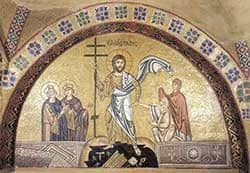
Harrowing of Hell, 11th c., via Wikimedia
What is Easter?
Easter is a Christian celebration of the resurrection of Jesus. Traditionally, Easter is not just Resurrection Sunday, but an entire fifty-day season of celebration that extends until Pentecost Sunday.
Two thousand years ago, Jesus was a Jewish rabbi whose teachings and actions threatened the authority of the religious leadership. He had gained a significant following among the people, enough that some of the Jewish leaders conspired to put him to death. The Roman governor, Pontius Pilate, wanted to avoid a political crisis, so when a riot seemed to be brewing, he condemned Jesus to death.
The Roman mode of execution for non-Roman citizens was often crucifixion, a protracted form of torture where the victim is nailed to a cross until he dies. Jesus, along with two criminals, was crucified. After his death, he was wrapped in linens and buried in a tomb.
Christians believe that early Sunday morning, Jesus rose from the dead. His new life is a sign from God that Jesus has defeated death, and opened up a new way to God through faith in him.
The story of the crucifixion and resurrection is in all four Gospels: Matthew 26-28; Mark 14-16; Luke 22-24; John 18-21.
Where does the word "Easter" come from?
The word Easter has pagan roots. The word never appears in Scripture. Many Christian communities around the world call the holiday Pasch, which comes from the word Passover. Jesus was crucified on the Jewish Passover holiday. Some scholars think that, at some point in Western Christian history, the Church absorbed the word "Easter" from its pagan contexts, since the goddess Eostre was celebrated around the same time that Passover, and thus the Resurrection, was usually celebrated—on or near the spring equinox.
Why does Easter include symbols like dyed eggs and rabbits?
Just as the word Easter was taken from pagan contexts, so were other symbols of spring. Some German traditions of spring included a rabbit that would bring eggs dyed red. Eggs are frequently symbols of fertility, and thus associated with springtime and new life. These motifs have been absorbed into Western celebrations of the Easter season but have no intrinsic relationship with the Christian holiday.
Why is Easter so important to Christians?
The meaning of Easter is tied to the meaning of Christmas and the teaching of the Incarnation. Christianity has taught that Jesus was fully human and fully divine. His life, therefore, was more than the sum of his teachings and actions. He was more than a rabbi. Thus, when Jesus died on the cross and then was raised on Easter morning, a new way opened into relationship with God. In some way, though many explanations exist, Jesus' death atoned for human sin and brokenness; his resurrection gave hope that God has something more for humanity than suffering and death.
What kinds of traditions does Holy Week include?
Nearly all Christian communities celebrate Palm Sunday, the Sunday before Easter Sunday. On this day, scriptures tell of Jesus' triumphal entry into Jerusalem, a story told in all four gospels (Mt. 21:1-11; Mk. 11:1-11; Lk. 19:28-44; Jn. 12:12-19). This is the beginning of Holy Week, the most central time of Easter preparations.
The Thursday of Holy Week is called Holy Thursday or, sometimes, Maundy Thursday. Maundy comes from the Latin word mandatum, which means commandment. On Maundy Thursday, Christians remember Jesus' Last Supper with his disciples, at which he gave them his great commandment: "A new command I give you: Love one another. As I have loved you, so you must love one another" (Jn. 13:34). Many Christians remember Jesus' last meal by washing one another's feet, something Jesus did for the disciples (Jn. 13:1-17). After the footwashing, many churches strip the altar of candles, linens, and sacred vessels, and wash the altar. Some churches hold an all night prayer vigil from the time of the evening service until 9:00 the next morning, the time at which Christ was crucified.
The Friday of Holy Week is called Good Friday. Though it is the day of Christ's crucifixion and death, it is considered good because on that day God's love triumphed over the powers of sin and evil that had held the world in bondage. Christians honor this day with fasting and prayer. According to the gospel accounts, Jesus was crucified at 9:00 in the morning; from noon to 3:00 p.m., the sun eclipsed as Jesus suffered and then died. Many churches hold noontime services, and traditionally there is no Eucharist at that service. While crosses throughout the church building have been covered with purple cloth from the beginning of Lent, on Good Friday they are covered with black cloth.
Article Continued On Next Page
Page: 1 of 2
3/25/2015 4:00:00 AM
Engaging Easter
Easter
Good Friday
History
Holy Week
Lent
Maundy Thursday
Palm Sunday
Resurrection
Christianity
more at patheos
1
The Illusion Of Perfection And The Path To True Holiness
2
Catholic Salvation: Explanation for Protestants
3
Americans Now Favor Palestinians Over Israelis
4
A Witch Honors Dolly Parton among the Mighty Dead

About Kathleen A. Mulhern
Kathleen Mulhern teaches in the areas of Church History and Spiritual Formation at Denver Seminary and blogs at Dry Bones.
Patheos Explore the world's faith through different perspectives on religion and spirituality! Patheos has the views of the prevalent religions and spiritualities of the world.
Ad-Free & Subscriber Log-In Subscription Support
- About Us
- 2026 Calendar
- Videos
- Podcasts
- Library of World Religions
- Faith In Media Tracker
- Advertise With Us
- Write for Us
- Privacy Policy
- Terms of Service
- Do Not Sell My Data
- Contact Us
- Radiant Digital
- Manage Newsletter Subscriptions
- Unsubscribe From Notifications
- Sitemap
Copyright 2008-2026, Patheos. All rights reserved.
Subscription Support Ad-Free & Subscriber Log-In
Follow Patheos