
BuddhistCatholicContemplativeEvangelicalGeneral ChristianHinduJewishLatter-day SaintMuslimNew VisionsProgressive Christian
Beliefs
- Buddhist
- Catholic
- Contemplative
- Evangelical
- General Christian
- Hindu
- Jewish
- Latter-day Saint
- More Voices
- Muslim
- New Visions
- Pagan
- Progressive Christian
Topics
- Religion News
- Food and Religion
- Sports and Religion
- Religious Art
- Religious Music and Entertainment
- Religious Events
- History and Religion
- Style and Religion
- Politics and Religion
- Women in Religion
- Recreation Outdoors and Religion
- Business Finance and Religion
- Careers Workplace and Religion
- Education and Religion
- Family Parenting and Religion
- Health Fitness and Religion
- Home and Religion
- Relationships and Religion
- Technology and Religion
- Travel and Religion
Columnists
- Buddhist Columnists
- Business Finance and Religion Columnists
- Careers Workplace and Religion Columnists
- Catholic Columnists
- Contemplative Columnists
- Education and Religion Columnists
- Evangelists Columnists
- Family Parenting and Religion Columnists
- General Christian Columnists
- Health Fitness and Religion Columnists
- Hindu Columnists
- History and Religion Columnists
- Home and Religion Columnists
- Jewish Columnists
- More Voices Columnists
- Latter Day Columnists
- Muslim Columnists
- New Visions Columnists
- Nonreligious Columnists
- Pagan Columnists
- Politics and Religion Columnists
- Progressive Columnists
- Recreation Outdoors and Religion Columnists
- Relationships and Religion Columnists
- Religion News Columnists
- Religious Art Columnists
- Religious Events Columnists
- Religious Music and Entertainment Columnists
- Sports and Religion Columnists
- Style and Religion Columnists
- Technology and Religion Columnists
- Travel and Religion Columnists
- Women in Religion Columnists
Resource Library
- 2026 Calendar
- Library of World Religions
- The 100 Most Holy Places on Earth
- Patheos Answers
- Podcasts
- Videos
- Faith Leaders Database
- Anglican Episcopalian
- Bahai
- Baptist
- Buddhism
- Christianity
- Confucianism
- Eastern Orthodoxy
- Hinduism
- Holiness and Pentecostal
- ISKCON
- Islam
- Judaism
- Lutheran
- Methodist
- The Church of Jesus Christ of Latter-day Saints
- New Age
- Paganism
- Presbytarian and Reformed
- Protestantism
- Religion Behind the Scenes
- Roman Catholic
- Scientology
- Shia Islam
- Sikhism
- Sufism
- Sunni Islam
- Taoism
- Zen
- See all religions
Research Tools
 Ad-Free & Subscriber Log-In Subscription Support
Ad-Free & Subscriber Log-In Subscription Support
Follow Patheos 

- Trending:
- Forgiveness
- |
- Marriage
- |
- Consciousness
- |
- Death Penalty
- |
- Election
- |
- Halloween
patheos presents

The 100 Most Holy Places On Earth
number
12
Varanasi
Varanasi, India 


By Alonzo Gaskill | Updated: March 19, 2026 | Published: March 23, 2023
Associated Faiths:
Hinduism
While mostly Hindus hold Varanasi and its many temples as “holy,” it is not uncommon to find Jain and Buddhist worshipers visit Varanasi’s various “sacred sites.” For Christians, it is a tourist attraction, but wouldn’t typically be considered “holy.” Nevertheless, for those in the various dharmic religions, this most important city has something to offer—even if one is not Hindu.
Accessibility:
The city is open to visitors, though many of its temples and shrines are closed to non-Hindus.
Annual visitors: 2,500,000
History
Varanasi is one of India’s oldest cities, and the most sacred of Hindu municipalities. Historical records suggest that Varanasi has been inhabited for some 3,000 years. Ironically, one might expect a place that has been inhabited since at least 1,000 BCE would feel advanced, and even culturally “highbrowed.” However, that it not Varanasi. Spiritually advanced it is. However, its narrow and weaving streets remain a “chaotic muddle” of ashrams, bullock-pulled wagons and rickshaws, and merchants peddling jewelry and silks. Visitors often find it hard to believe that this city has existed 3,000 years. It looks ancient, and sometimes feels primitive for a 3,000-year-old holy site.
Beyond its religious significance (as a place of pilgrimage and religious study), Varanasi is also famous for its arts and textiles—including the production of valuable rugs, silks, and traditional Indian clothing items. It has long been the home to many great Indian musicians and is seen as a sort of “city of the musical.” Additionally, it boasts “some of the world’s greatest astrologers” as its residents. Thus, many residents of Varanasi and its surrounding area will flock there to have their horoscope read or their fortune told—believing that, of all places, Varanasi will give one the most accurate read on their future.
Because it is one of India’s most holy cities, it is said to be a “city of many temples and many legends.” Indeed, visitors often come away claiming that Varanasi has a temple “every ten steps.” The most important of those is the Vishwanath Temple of Varanasi—with its golden dome and its ancient lingam. This “sign” or “distinguishing symbol” (i.e., “lingam”) within the temple of Varanasi is the phallic symbol of Lord Shiva. Suggestive of the god’s presence in the temple, it also highlight’s Shiva’s creative powers—one of his dual attributes; the other being his destructive powers.
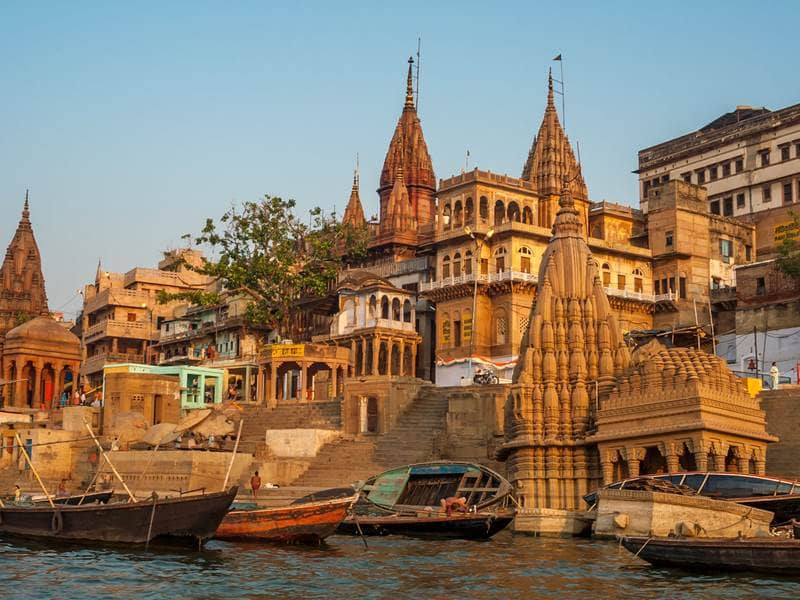
Because of the Ganges, the city’s multitude of temples, and other legends about this sacral location, Varanasi has for hundreds of years been considered a “auspicious” place to die. Many Hindus move to Varanasi when they age or on their deathbeds, believing that there is benefit in making that the location of their passing. On the banks of the Ganges—in designated locations—there are funeral pyres constantly burning, cremating the remains of those fortunate enough to have died in the holy city. Indeed, some of the ghats (or stairs) leading down to the Ganges (in Varanasi) are reserved specifically for those who cremate the bodies. Having reduced the deceased and its wooden funeral pyre to ashes, those assigned such duties will then descend the ghats to sprinkle the ashes in the river; an auspicious end to what is hoped to have been a holy life.
Religious Significance
The city of Varanasi—and the spot on which the Kashi Vishwanath Temple stands—are said to be the very place at which Lord Shiva and one of his wives (Parvati) stood when “time began.” Today, the city is believed to be the location at which the Hindu gods descend to earth, and a place where humans can more readily access the divine. Indeed, the Kashi Khanda (an ancient sacred text) claims that in Varanasi “all the gods once lived” many years ago. Thus, pilgrims flock to the city in the belief that their spirituality will be heightened, their connection to the divine increased, and their number of incarnations reduced. A “sacred space” indeed. To walk in Varanasi is to walk where time began, and to step on the very spot where the gods first descended to the earth.
Part of Varanasi’s appeal as a holy city is its access to the Ganges river—the most sacred river of India. Varanasi has several ghats—or sets of stone stairs—which lead down into the Ganges, and which devotees are constantly descending to engage with the river and its goddess, in acts of puja (or worship). Because the water of the Ganges is believed almost universally in India to be sacred, Hindus traditionally hold that it is a holy water with powers beyond almost any other religious sacramental or item. Bathing in the river can remit karma and drinking the water can cure ailments. Thus, much as Christian sacraments enable the parishioner to access the grace of God and Christ, the ghats of Varanasi are the vehicles to the grace available through the Ganges, its waters, and its associated goddess. While people visit the Ganges and its various banks throughout the parts of India through which it flows, the portion of the River that passes through Varanasi is considered particularly sacred. Indeed, tradition has it that a visit to the Kashi Vishwanath Temple (in Varanasi), coupled with bathing in that part of the Ganges River, can actually guarantee that you experience moksha (or liberation), thereby ensuring samsara (i.e., freedom from the cycle of rebirths and the achievement of Nirvana) at the conclusion of this life. Thus, like Muslims who seek to make at least one hajj (or pilgrimage) to Mecca in their lifetime, faithful Hindus see Varanasi, the Ganges, and Kashi Vishwanath Temple as the ideal location to conclude one’s life. To make this trek, to experience these sacred sites, and to be cremated on the ghats (or stone steps) near the temple—having your ashes sprinkled in the Ganges River—is seen as the most auspicious of endings for a Hindu.
The most common means of disposing of a body in India is through cremation and, in Hinduism, some believe that creation is the necessary means of freeing one’s ātman (or “animating power”) from one’s deceased body. Thus, cremation tends to be a sacred and important rite of passage, necessary for the deceased’s ability to move to his or her next existence, even if that next existence is merging into Brahman and Nirvana. However, for some Hindus, passing from this life to one’s next existence is best done in Varanasi. Because this is perhaps the most sacred site on the face of the planet, and because the Ganges has karma-remitting powers, to be cremated on the steps of the sacred River, and to have one’s ashes then sprinkled into the Ganges (at the site of this sacred city), is believed to increase the likelihood of either a higher next incarnation or quite possibly release from the cycle of reincarnation.
Hindu lore teaches that the Ganges descends from heaven to earth—through the grace of Ganga and also Shiva. Because it is the place where the sacred waters come down to the earth, many Hindus also believe it is the “vehicle of ascent” which can convey the deceased from earth back to heaven. Thus, in places like Varanasi, bodies are cremated and sprinkled in the water, ideally sending them heavenward—hopefully for eternity. In times past, sometimes bodies were washed in the Ganges, wrapped in cloth, and floated down the sacred river—theoretically sending the ātman (i.e., “breath” or “animating power”) of the deceased heavenward.
Thus, for these—and many other reasons—Varanasi is one of the holiest places in the world. It is an important and even necessary place of pilgrimage for many Hindus. It is as auspicious of a place to die as any. It is a karma-remitting local with temples (for puja) everywhere. And there is most likely nowhere else upon the face of this earth that one has a greater chance of escaping the cycle of rebirths and merging with Brahman—the ultimate goal of all Hindus. Holy, holy, holy is Varanasi!
Related
Indigenous Peoples’ Day and the Church
Faith Shines Through Halloween Darkness
Did Jesus Fear God's Wrath in Gethsemane?

Kamsutra Hindi Book: Free PDF Download

Kamasutra PDF Book Download: English & Hindi

Kamasutra Hindi (without pictures)
Kamasutra English (Positions with sculptures)
Faiz's Aaj Baazaar Mein - Translated and Explained

Indian Hindu pilot’s valor in line of duty makes him a hero
Patheos Explore the world's faith through different perspectives on religion and spirituality! Patheos has the views of the prevalent religions and spiritualities of the world.
Ad-Free & Subscriber Log-In Subscription Support
- About Us
- 2026 Calendar
- Videos
- Podcasts
- Library of World Religions
- Faith In Media Tracker
- Advertise With Us
- Write for Us
- Privacy Policy
- Terms of Service
- Do Not Sell My Data
- Contact Us
- Radiant Digital
- Manage Newsletter Subscriptions
- Unsubscribe From Notifications
- Sitemap
Copyright 2008-2026, Patheos. All rights reserved.
Subscription Support Ad-Free & Subscriber Log-In
Follow Patheos