
BuddhistCatholicContemplativeEvangelicalGeneral ChristianHinduJewishLatter-day SaintMuslimNew VisionsProgressive Christian
Beliefs
- Buddhist
- Catholic
- Contemplative
- Evangelical
- General Christian
- Hindu
- Jewish
- Latter-day Saint
- More Voices
- Muslim
- New Visions
- Pagan
- Progressive Christian
Topics
- Religion News
- Food and Religion
- Sports and Religion
- Religious Art
- Religious Music and Entertainment
- Religious Events
- History and Religion
- Style and Religion
- Politics and Religion
- Women in Religion
- Recreation Outdoors and Religion
- Business Finance and Religion
- Careers Workplace and Religion
- Education and Religion
- Family Parenting and Religion
- Health Fitness and Religion
- Home and Religion
- Relationships and Religion
- Technology and Religion
- Travel and Religion
Columnists
- Buddhist Columnists
- Business Finance and Religion Columnists
- Careers Workplace and Religion Columnists
- Catholic Columnists
- Contemplative Columnists
- Education and Religion Columnists
- Evangelists Columnists
- Family Parenting and Religion Columnists
- General Christian Columnists
- Health Fitness and Religion Columnists
- Hindu Columnists
- History and Religion Columnists
- Home and Religion Columnists
- Jewish Columnists
- More Voices Columnists
- Latter Day Columnists
- Muslim Columnists
- New Visions Columnists
- Nonreligious Columnists
- Pagan Columnists
- Politics and Religion Columnists
- Progressive Columnists
- Recreation Outdoors and Religion Columnists
- Relationships and Religion Columnists
- Religion News Columnists
- Religious Art Columnists
- Religious Events Columnists
- Religious Music and Entertainment Columnists
- Sports and Religion Columnists
- Style and Religion Columnists
- Technology and Religion Columnists
- Travel and Religion Columnists
- Women in Religion Columnists
Resource Library
- 2026 Calendar
- Library of World Religions
- The 100 Most Holy Places on Earth
- Patheos Answers
- Podcasts
- Videos
- Faith Leaders Database
- Anglican Episcopalian
- Bahai
- Baptist
- Buddhism
- Christianity
- Confucianism
- Eastern Orthodoxy
- Hinduism
- Holiness and Pentecostal
- ISKCON
- Islam
- Judaism
- Lutheran
- Methodist
- The Church of Jesus Christ of Latter-day Saints
- New Age
- Paganism
- Presbytarian and Reformed
- Protestantism
- Religion Behind the Scenes
- Roman Catholic
- Scientology
- Shia Islam
- Sikhism
- Sufism
- Sunni Islam
- Taoism
- Zen
- See all religions
Research Tools
 Ad-Free & Subscriber Log-In Subscription Support
Ad-Free & Subscriber Log-In Subscription Support
Follow Patheos 

- Trending:
- Forgiveness
- |
- Marriage
- |
- Consciousness
- |
- Death Penalty
- |
- Election
- |
- Halloween
patheos presents

The 100 Most Holy Places On Earth
number
62
Uluru
Near Alice Springs, in the Uluru-Kata Tjuta National Park, Australia 


By Alonzo Gaskill | Updated: March 19, 2026 | Published: March 23, 2023
Associated Faiths:
Indigenous Anangu Tribes of Australia
Also visited by religious people of many traditions, but even more so by tourists (for non-religious reasons).
Accessibility:
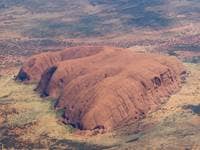
The base is open to visitors, but you are not supposed to clime Ayers Rock. Setting foot upon the rock is reserved for ceremonial occasions, and the area around the rock is closed during the performance of those rituals. While some climb anyway, it is a great offence to the indigenous Anangu people (who have had legal possession of the rock since 1985) and infringements are punishable by fines. There is a Ulura-Kata Tjuta Cultural Center in the park that tourists can visit.
Annual visitors: 500,000
History
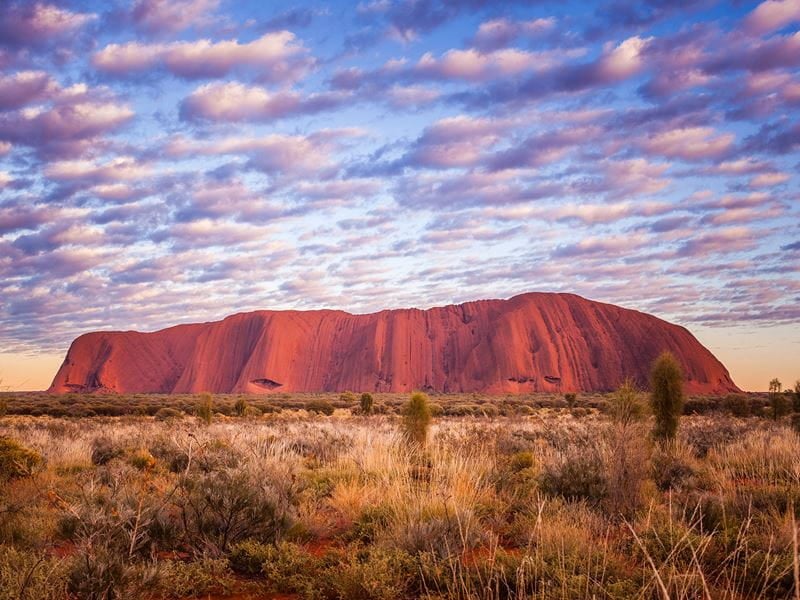
Uluru—nicked named “Ayers Rock” (after a 19th century premier of South Australia, Sir Henry Ayers)—is an approximately 600-million-year-old 1,142-foot-high sandstone monolith in Australia’s dessert center. With a circumference of 5.8 miles, this massive red monolithic red rock mesa has been sacred to the indigenous Anangu aboriginal tribe for some 10,000 years. In the Anangu language, “Uluru” means “abode of the ancestors.” This name was attributed to the rock because, according to one version of the Anangu creation account, their ancestors entered the land of Australia when sacred beings came up out of the depths of the earth and created all things—including humans and the various animals. As they did so, they created the area’s landscape in the process. So, Uluru (or Ayers Rock) is the first abode of the first people to dwell upon the face of the Australian continent.
The Uluru monolith is the second largest in the world. Mount Augustus, in Western Australia, is the only one larger than Ayres Rock. That being said, Mount Augustus does not have the same sacred mystique as Uluru and, thus, is much less famous than its “little sister.”
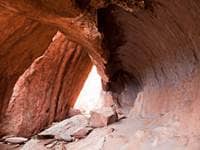
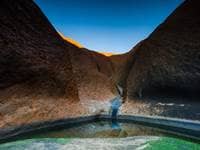
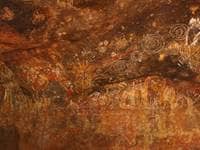
Ayres Rock has various sites which are sacred to the indigenous aborigines of the area. Some are reserved for men, and rites associated with the male gender. Others are reserved for use by women and for the performance of decidedly female rituals. In addition, there are some spots along the monolith which are used for more general rites, which include men and women. The Anangu hold that the various caves on the monolith each have a divine meaning and purpose—and specific rituals that are only performed in a given cave set aside for that very purpose. Because of the sacral nature of these caves and what takes place in them, photography in them is prohibited and entrance by non-Aboriginals is restricted. The caves have wall drawings which date back as early as 1,000 BCE. These drawings depict the various rites associated with the temple in which they are performed.
Because the Anangu people are the “possessors” of the rock, and because it is extremely holy to them, even they do not traverse the rock other than when engaging sacred rituals. During those rituals, the park is officially closed and, thus, non-abiogenies are not to touch or traverse Uluru. Sadly, many do anyway, climbing the rock and seeking access to the sacred caves. The Anangus feel that the “ants” (which is how they refer to “white tourists”) have a “disdain” for their culture, religion, and sacred sites—as evidenced by the fact that they visit when they should not and climb where they should not.
Religious Significance
Ancient mountains were the place one often went in order to get closer to God. The concept of the “sacred mountain” is common in many ancient traditions. Mount Sanai (in Judaism), Mount Kailash (in Hinduism), and even Mount Olympus (in Greek Mythology)—each of these stands as a testament to the doctrine of the “sacred mountain” and its widespread acceptance in cultures and religions of antiquity. Atop a mountain peak, one was perceivably closer to the divine, or to the divine realms. One was removed from the world and, thus, removed from the temptations which kept one from communion with the higher power. The numerous ancient worship sites “dotted” along the Uluru monolith serve to prove that for millennia the aboriginal Anangu have understood this to be a “sacred site.” As the center of creation for them, it is no less than their “Garden of Eden” and the former abode of the first humans and first animals ever to grace the earth. Consequently, the Aboriginals hold the site to be “sacred space” and a place in need of their protection—lest it be defiled by tourists who generally do not get the Uluru’s culture, religion, or reverence for this hallowed spot.
In addition to mountains as symbols, caves—such as those which dot the landscape of Ayres Rock—have their own ancient symbolism which is at play among those who occupy this “sacred site.” Whereas Mountains represent the masculine (or male) principle, caves represent the feminine. The cave was believed by the ancients to be the “womb of Mother Earth.” Thus, caves were traditionally the sites of initiation—as these caves are for the Anangu people. Initiates would enter a cave to receive “hidden” or “secret” knowledge. In doing so, they would symbolically let their old self “die,” as they were “reborn” through the sacred rites—leaving the cave as new person just as a baby leaves the womb as a new human.
Caves and their associated mountains were also seen by some ancient peoples as being associated with the universe. They were the cosmic center of all things; the heart of human existence; the omphalos. They were the place where gods and saviors were born or rose up. Ultimately, they were symbols for the center of God’s creative work. Thus, to be—as the Anangu people are—the possessors of these mountain caves is to be God’s “chosen people,” God’s “covenant people,” the center of the attention of the Divine. As a consequence, what happens there is “sacred” and the people who do the ritual work there are “holy,” set apart and chosen of God.
The Aboriginal Anangu people speak of the “Dreamtime.” This is their ancient “golden age”—the era when the earth’s inhabitants were created. According to the legend, the face of the planet was empty, dark, and flat. However, sacred beings (sleeping underneath the surface of the earth) awoke and made their way through the earth’s crust. As they roamed about, they created the various features of the landscape, including Uluru (or Ayers Rock). In addition, they created humans, animals, and all which sustain their life. Thus, for the Indigenous Anangu people, Uluru is a testament to creationism, and a monument to the existence of God. It stands as evidence of the divine origins of all things. Thus, they seek to protect the “sacred site” from the encroachment of “ants” who treat it in secular ways; and they are saddened that the message that we are all God’s creations is missed by so many who visit this site.
Related
The Golden Rule Demands More than We Think
Spooky Judaism: Did Adam Father Demons?
The Reality of Satanic Ritual Abuse: A Call for Awareness
Why The Clark Art Institute Should Be on Your Travel List

Hijab: A Visible Symbol of Faith and Devotion

Embracing Togetherness: The Warmth of the Winter Solstice

Embracing Healthier Foods Inspired by the Holy Land
Louis Kahn's Role in Shaping Modern Urban Landscapes
Patheos Explore the world's faith through different perspectives on religion and spirituality! Patheos has the views of the prevalent religions and spiritualities of the world.
Ad-Free & Subscriber Log-In Subscription Support
- About Us
- 2026 Calendar
- Videos
- Podcasts
- Library of World Religions
- Faith In Media Tracker
- Advertise With Us
- Write for Us
- Privacy Policy
- Terms of Service
- Do Not Sell My Data
- Contact Us
- Radiant Digital
- Manage Newsletter Subscriptions
- Unsubscribe From Notifications
- Sitemap
Copyright 2008-2026, Patheos. All rights reserved.
Subscription Support Ad-Free & Subscriber Log-In
Follow Patheos