
BuddhistCatholicContemplativeEvangelicalGeneral ChristianHinduJewishLatter-day SaintMuslimNew VisionsProgressive Christian
Beliefs
- Buddhist
- Catholic
- Contemplative
- Evangelical
- General Christian
- Hindu
- Jewish
- Latter-day Saint
- More Voices
- Muslim
- New Visions
- Pagan
- Progressive Christian
Topics
- Religion News
- Food and Religion
- Sports and Religion
- Religious Art
- Religious Music and Entertainment
- Religious Events
- History and Religion
- Style and Religion
- Politics and Religion
- Women in Religion
- Recreation Outdoors and Religion
- Business Finance and Religion
- Careers Workplace and Religion
- Education and Religion
- Family Parenting and Religion
- Health Fitness and Religion
- Home and Religion
- Relationships and Religion
- Technology and Religion
- Travel and Religion
Columnists
- Buddhist Columnists
- Business Finance and Religion Columnists
- Careers Workplace and Religion Columnists
- Catholic Columnists
- Contemplative Columnists
- Education and Religion Columnists
- Evangelists Columnists
- Family Parenting and Religion Columnists
- General Christian Columnists
- Health Fitness and Religion Columnists
- Hindu Columnists
- History and Religion Columnists
- Home and Religion Columnists
- Jewish Columnists
- More Voices Columnists
- Latter Day Columnists
- Muslim Columnists
- New Visions Columnists
- Nonreligious Columnists
- Pagan Columnists
- Politics and Religion Columnists
- Progressive Columnists
- Recreation Outdoors and Religion Columnists
- Relationships and Religion Columnists
- Religion News Columnists
- Religious Art Columnists
- Religious Events Columnists
- Religious Music and Entertainment Columnists
- Sports and Religion Columnists
- Style and Religion Columnists
- Technology and Religion Columnists
- Travel and Religion Columnists
- Women in Religion Columnists
Resource Library
- 2026 Calendar
- Library of World Religions
- The 100 Most Holy Places on Earth
- Patheos Answers
- Podcasts
- Videos
- Faith Leaders Database
- Anglican Episcopalian
- Bahai
- Baptist
- Buddhism
- Christianity
- Confucianism
- Eastern Orthodoxy
- Hinduism
- Holiness and Pentecostal
- ISKCON
- Islam
- Judaism
- Lutheran
- Methodist
- The Church of Jesus Christ of Latter-day Saints
- New Age
- Paganism
- Presbytarian and Reformed
- Protestantism
- Religion Behind the Scenes
- Roman Catholic
- Scientology
- Shia Islam
- Sikhism
- Sufism
- Sunni Islam
- Taoism
- Zen
- See all religions
Research Tools
 Ad-Free & Subscriber Log-In Subscription Support
Ad-Free & Subscriber Log-In Subscription Support
Follow Patheos 

- Trending:
- Forgiveness
- |
- Marriage
- |
- Consciousness
- |
- Death Penalty
- |
- Election
- |
- Halloween
patheos presents

The 100 Most Holy Places On Earth
number
64
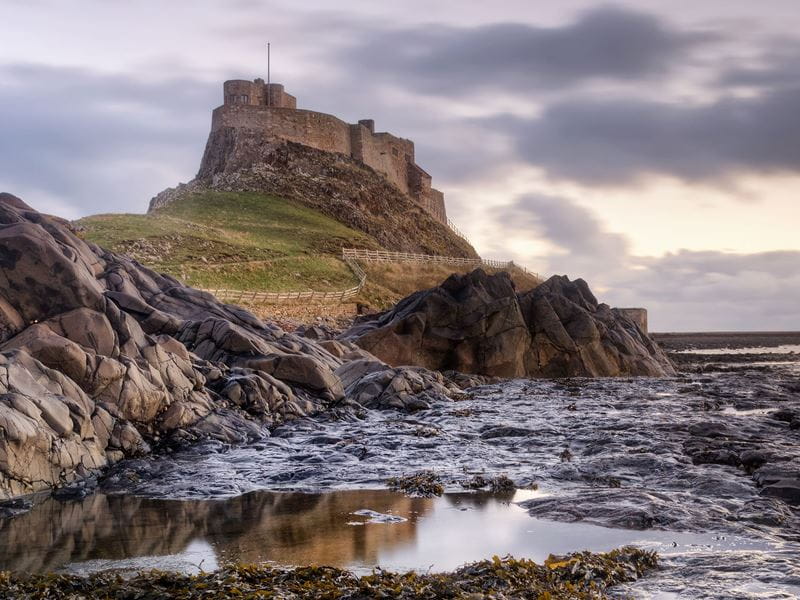
The Holy Island
Northumberland, on the Northeast Coast of England 


By Alonzo Gaskill | Updated: March 19, 2026 | Published: March 23, 2023



Also Known As:
Lindisfarne/ Medcaut/ Medicata Insula
Associated Faiths:
Church of England
Originally associated with Celtic Christianity, and perceivably a “sacred space” for any in the Christian tradition—though formally Anglicanism
Accessibility:
Open to visitors.
Annual visitors: 650,000
History
Historically speaking, the 1,000-acre island of Lindisfarne—most often known today as “The Holy Island of Lindisfarne”—is first mentioned in extant records in the 6th century AD. It was an early center of Celtic Christianity and is believed to have been founded by a handful of early Celtic Saints—most notably, Saint Aidan (d. AD 651). Aidan of Lindisfarne was an Irish missionary and monastic who came to the island to proselytize. He is said to have converted to Christianity those inhabiting the island (and those living throughout Northumbria). He established a priory on Lindisfarne and became the first bishop of the region. Often called the “Apostle of Northumbria,” his status as a saint is acknowledge by the three major High-Church traditions—Roman Catholicism, Eastern Orthodoxy, and the Church of England (or Anglican Communion).
In circa AD 634, Aidan founded a monastery on the island, and had a priory to house the monks later in that same year. Aidan remained there until his passing (in AD 651). A wooden structure—a church—was constructed, which served as the seat of the Northumbria bishop. However, that building later had its thatch roof removed—and the walls and roof were covered in lead.
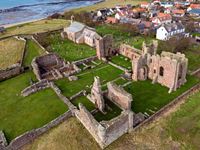
On June 8, AD 793, Vikings raided Lindisfarne. At that time, many of the monks who dwelt on the island were either murdered or enslaved. In AD 873, a Danish army ravished Northumbria—and those left on the “Holy Island” had to flee for their lives (taking with them the bones of Saint Cuthbert, who had been buried there). It would be more than 200 years before the priory would function again, and monks would return to their home on Lindisfarne. Today, there are visible remains which date from the era of Aiden—and a stone parish church is built on the site of the island’s original wooden structure.
While the Celtic Christian tradition was the prominent faith on the island after Saint Aidan introduced Christianity there, it did not last. In the last quarter of the 7th century its allegiance turned to Rome. However, in 1536, Henry VIII squelched the work of the Benedictine monastics on the island, and in 1613 ownership of the island and its properties—including its church and associated resources—were taken over by the British monarch. Consequently, today it is run by the Church of England, rather than the Roman Catholic tradition.
Religious Significance
As with any Christian church, the stone chapel on Lindisfarne is “sacred” for the rites performed therein—and as a monument to the God whom its parishioners worship. Its two sacramental and redemptive rites, and its five non-salvific ordinances, hallow the ground, making it a “sacred space” for the worshiper who wishes to connect to and commune with the divine.
Because of its connection with Celtic Christianity, the island’s original name was apparently “Medicata Insula” (or the “Healing Island”). While historians are not 100 percent certain if this is due to the “medicinal herbs” found on the island, or because Saint Aidan is said to have spiritually “healed” the islands’ residents of their pagan beliefs, the latter is the preferred tradition. Lindisfarne was the seat of Christian evangelism in Northern England, and the location from which missionaries left to convert the masses to the Gospel of Jesus Christ. Thus, it stands as a monument to the spread of Christianity throughout England—and to those who were instrumental in bringing to pass that event. Indeed, the “Holy Island” is aptly named, since believing Christians cannot help but perceive as “holy” the introduction and spread of the Christian faith throughout the land.
As the home of no less than three saints (Saints Aidan, Cuthbert, Eadfrith, and Eadberh), Lindisfarne’s 1,000 acres are unique. Perhaps no plot so small has produced so many saints in the history of the Christian tradition. And, as is common in the High-Church traditions, where the saints have walked, the spaced is sacred—and the “Holy Island” is no exception to this rule.
While today officially associated with the Church of England, Lindisfarne has a place of significance for at least three traditions. For Celtic Christianity in its various forms (mostly present in Ireland, but in the form of independent congregations as well), the “Holy Island” is a monument to their history—and how Christianity was introduced in to England via their tradition. For Roman Catholics, Lindisfarne is a reminder of how Roman Catholicism suffered greatly (in England) during the Protestant Reformation; and how Catholics were viciously persecuted under Henry VIII and his daughter, Elizabeth. For those affiliated with the Church of England, this “sacred site” is a monument to that tradition’s history and influence in England, in addition to it being the current source of the sacraments for Christians in that region. Thus, as unknown as Lindisfarne may be to many, its history is rich, its influence has been broad, and its impact has been nothing shy of elevating and sacral.
Related
Is Christianity Declining in Numbers?
What Are The Abrahamic Religions?
What Religions Believe in Hell?

Indigenous Peoples’ Day and the Church
Faith Shines Through Halloween Darkness
Did Jesus Fear God's Wrath in Gethsemane?

8 things Jesus never said that you might think he said
Arianism Is Still Here: Ancient Errors in the Modern World
Patheos Explore the world's faith through different perspectives on religion and spirituality! Patheos has the views of the prevalent religions and spiritualities of the world.
Ad-Free & Subscriber Log-In Subscription Support
- About Us
- 2026 Calendar
- Videos
- Podcasts
- Library of World Religions
- Faith In Media Tracker
- Advertise With Us
- Write for Us
- Privacy Policy
- Terms of Service
- Do Not Sell My Data
- Contact Us
- Radiant Digital
- Manage Newsletter Subscriptions
- Unsubscribe From Notifications
- Sitemap
Copyright 2008-2026, Patheos. All rights reserved.
Subscription Support Ad-Free & Subscriber Log-In
Follow Patheos