
BuddhistCatholicContemplativeEvangelicalGeneral ChristianHinduJewishLatter-day SaintMuslimNew VisionsProgressive Christian
Beliefs
- Buddhist
- Catholic
- Contemplative
- Evangelical
- General Christian
- Hindu
- Jewish
- Latter-day Saint
- More Voices
- Muslim
- New Visions
- Pagan
- Progressive Christian
Topics
- Religion News
- Food and Religion
- Sports and Religion
- Religious Art
- Religious Music and Entertainment
- Religious Events
- History and Religion
- Style and Religion
- Politics and Religion
- Women in Religion
- Recreation Outdoors and Religion
- Business Finance and Religion
- Careers Workplace and Religion
- Education and Religion
- Family Parenting and Religion
- Health Fitness and Religion
- Home and Religion
- Relationships and Religion
- Technology and Religion
- Travel and Religion
Columnists
- Buddhist Columnists
- Business Finance and Religion Columnists
- Careers Workplace and Religion Columnists
- Catholic Columnists
- Contemplative Columnists
- Education and Religion Columnists
- Evangelists Columnists
- Family Parenting and Religion Columnists
- General Christian Columnists
- Health Fitness and Religion Columnists
- Hindu Columnists
- History and Religion Columnists
- Home and Religion Columnists
- Jewish Columnists
- More Voices Columnists
- Latter Day Columnists
- Muslim Columnists
- New Visions Columnists
- Nonreligious Columnists
- Pagan Columnists
- Politics and Religion Columnists
- Progressive Columnists
- Recreation Outdoors and Religion Columnists
- Relationships and Religion Columnists
- Religion News Columnists
- Religious Art Columnists
- Religious Events Columnists
- Religious Music and Entertainment Columnists
- Sports and Religion Columnists
- Style and Religion Columnists
- Technology and Religion Columnists
- Travel and Religion Columnists
- Women in Religion Columnists
Resource Library
- 2026 Calendar
- Library of World Religions
- The 100 Most Holy Places on Earth
- Patheos Answers
- Podcasts
- Videos
- Faith Leaders Database
- Anglican Episcopalian
- Bahai
- Baptist
- Buddhism
- Christianity
- Confucianism
- Eastern Orthodoxy
- Hinduism
- Holiness and Pentecostal
- ISKCON
- Islam
- Judaism
- Lutheran
- Methodist
- The Church of Jesus Christ of Latter-day Saints
- New Age
- Paganism
- Presbytarian and Reformed
- Protestantism
- Religion Behind the Scenes
- Roman Catholic
- Scientology
- Shia Islam
- Sikhism
- Sufism
- Sunni Islam
- Taoism
- Zen
- See all religions
Research Tools
 Ad-Free & Subscriber Log-In Subscription Support
Ad-Free & Subscriber Log-In Subscription Support
Follow Patheos 

- Trending:
- Forgiveness
- |
- Marriage
- |
- Consciousness
- |
- Death Penalty
- |
- Election
- |
- Halloween
patheos presents

The 100 Most Holy Places On Earth
number
40
The Blue Mosque
Istanbul, Turkey 


By Alonzo Gaskill | Updated: March 19, 2026 | Published: March 23, 2023
Also Known As:
Sultan Ahmed Mosque, The Blue Mosque, Sultan Ahmet Cami.
Associated Faiths:
Also frequently visited by those of other religious traditions—particularly Christianity (but mostly for tourist treasons rather than religious reasons)
Accessibility:
Open to visitors, except during salah (or prayer) five times each day.
Annual visitors: 5,000,000
History
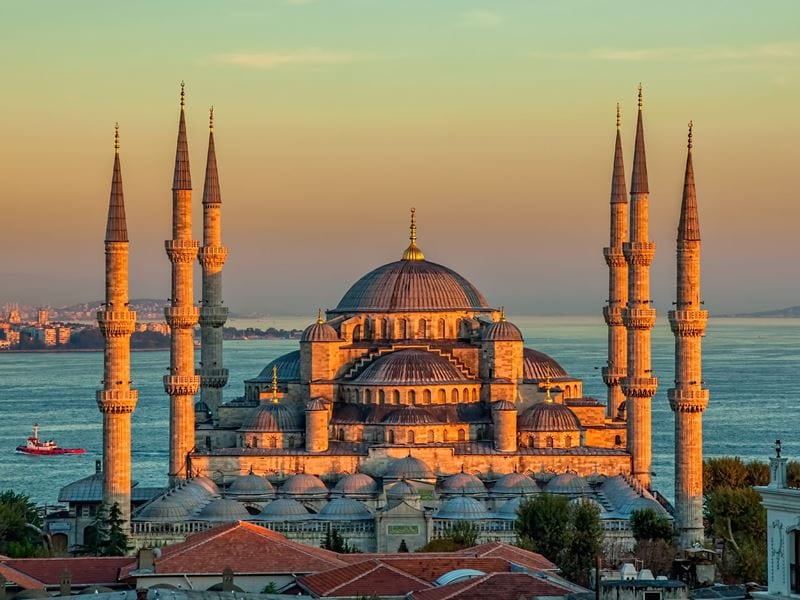
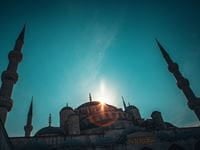
Istanbul’s “Blue Mosque”—or Sultan Ahmed Mosque—is an early 17th century jewel, built by order of Sultan Ahmed I (dating from around 1609-1617 CE). This six-minaret multi-domed mosque is almost unparalleled in its beauty and design. Indeed, it is so large, so elaborate, and so beautiful, that some felt that it was an afront to the most important mosque in all of Islam—the one which houses the Kaaba (in Mecca). In an effort to squelch the controversy, Ahmed funded the construction of an additional minaret in Mecca, so that mosque would have seven, whereas the Blue Mosque has six. Regardless, the Sultan Ahmed Mosque is one of the most remarkable religious structures ever built.
At the conclusion of a couple of lengthy conflicts, Ahmed I sought to symbolically reassert the Ottoman Empire’s power by building an Imperial mosque. It was constructed on the site of the former place of the Byzantine emperors, and only a stone’s throw from the Hagia Sophia (which had been the center of Eastern Orthodoxy until AD 1453). The location and grandness of the new mosque sent an unmistakable message about the strength of the Ottoman empire and Islam.
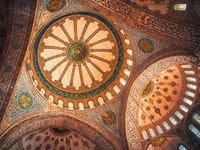
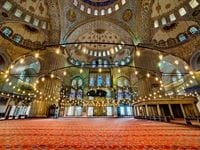
The Sultan Ahmed Mosque is massive. It sports thirteen domes (five main ones, and eight secondary domes). As one approaches the mosque, these almost look like a waterfall of domes, trickling down from the largest and getting smaller as they flow forth. The mosque also has six minarets—something unusual, even for large mosques. Its nickname, the “Blue Mosque,” comes from its more than 20,000 interior tiles, hand painted, blue in tint, and crated in western Anatolia. Having some 260 stained-glass windows, the interior lightshow in the mosque can be quite spectacular at various stages of the day. Finally, the “Blue Mosque” is also said to have imbedded into its mihrab (or prayer niche) a piece of the sacred black stone that is part of the Kaaba—in Mecca.
Beyond the seeming competition with the Great Mosque (or “Prophet’s Mosque”) in Mecca, the Blue Mosque was also a controversial build because of the cost. Typically, Sultan’s built using money captured in war. However, Ahmet I lost more often than he won and, thus, used money from the treasury to fund the building of this most elaborate mosque. This greatly upset the Islamic jurists and ulama, and placed the Sultan in “hot water” with the Islamic leaders of his day. As tragic as his premature death (at 27) was, including the fact that he did not live to see the Blue Mosque 100% completed, it did end the hostilities he was up against for his losses in war, his excessive spending, and his afront to the Meccan Mosque. However, he was buried inside of the mosque that bears his name.
Religious Significance
One obvious reason why the Sultan Ahmed Mosque constitutes “sacred space” is because believers go there to “prostrate” themselves before God. (The word “mosque” means “place of prostration.”) To prostrate oneself before God is an act of submission. It symbolizes that one is giving oneself and one’s will over to the divine, preferring His will over one’s own. That is always a sacral act, and doing so will always hallow the ground on which such sincere submission takes place.
On a related note, the moniker, “Blue Mosque,” is descriptive of the color of the more than 20,000 tiles which line much of the interior of the mosque. However, just as a mosque is where you go to “submit” yourself to God, blue has long been the ancient color which represents the heavens and the presence of the divine. Thus, symbolically speaking, the unique color of the Blue Mosque is a reminder to visitors of that “higher authority” to which all—Muslims and non-Muslims alike—must submit their lives and their personal wills. In Islam, Paradise is the desired destination of every practicing Muslim, and blue is the symbolic color of that divine abode. Thus, in some ways, the Blue Mosque feels a bit like one has briefly arrived in paradise, simply by being present in this “sacred site.”
Finally, on this same theme, when you enter the Sultan Ahmed Mosque, there is a covering that blocks the upper half of the doorway. As a consequence, in order to enter, you must bow. Of course, the posture of bowing has long been a symbol of humility and submission. The fact that one is forced to bow down in order to enter is one more important symbol of submissiveness that the worshiper is called to exhibit—in worship, but also in life.
Significantly, Pope Benedict XVI visited the Blue Mosque in 2006. As the leader of the largest denomination of Christianity in the world, his actions there sent a significant message. Of course, as is required, he removed his shoes before entering. But he also paused for two minutes and engaged in silent mediation. He “thanked divine providence” for the experience of visiting the mosque, encouraging the world, “May all believers identify themselves with the one God and bear witness to true brotherhood.” Likewise, in 2014, Pope Francis visited the Sultan Ahmed Mosque, removing his shoes, facing Mecca, and bowing his head in prolonged prayer. Thus, the 21st centuries first two popes have evidenced their own sense of the “sacred space” constituted by the Sultan Ahmet Camii. While not all Catholics were thrilled by this, perhaps it is a message as to how Christians should look upon their brothers and sisters in the other Abrahamic faiths.
Related
What is the One Unforgivable Sin in Islam?
How Muslim Prayer Rugs Are Made and Used
Tara Citinkaya
Muslim Funeral Rites and the Islamic Society that Performs Them
Dr. Salman Masud
Do Muslims Believe in Jesus Christ?

Do Muslims Celebrate Christmas?
Alonzo L. Gaskill, PH.D.
Do Muslims Get Excommunicated?
What Are The Abrahamic Religions?
Alonzo L Gaskill, PH.D.
Patheos Explore the world's faith through different perspectives on religion and spirituality! Patheos has the views of the prevalent religions and spiritualities of the world.
Ad-Free & Subscriber Log-In Subscription Support
- About Us
- 2026 Calendar
- Videos
- Podcasts
- Library of World Religions
- Faith In Media Tracker
- Advertise With Us
- Write for Us
- Privacy Policy
- Terms of Service
- Do Not Sell My Data
- Contact Us
- Radiant Digital
- Manage Newsletter Subscriptions
- Unsubscribe From Notifications
- Sitemap
Copyright 2008-2026, Patheos. All rights reserved.
Subscription Support Ad-Free & Subscriber Log-In
Follow Patheos