
BuddhistCatholicContemplativeEvangelicalGeneral ChristianHinduJewishLatter-day SaintMuslimNew VisionsProgressive Christian
Beliefs
- Buddhist
- Catholic
- Contemplative
- Evangelical
- General Christian
- Hindu
- Jewish
- Latter-day Saint
- More Voices
- Muslim
- New Visions
- Pagan
- Progressive Christian
Topics
- Religion News
- Food and Religion
- Sports and Religion
- Religious Art
- Religious Music and Entertainment
- Religious Events
- History and Religion
- Style and Religion
- Politics and Religion
- Women in Religion
- Recreation Outdoors and Religion
- Business Finance and Religion
- Careers Workplace and Religion
- Education and Religion
- Family Parenting and Religion
- Health Fitness and Religion
- Home and Religion
- Relationships and Religion
- Technology and Religion
- Travel and Religion
Columnists
- Buddhist Columnists
- Business Finance and Religion Columnists
- Careers Workplace and Religion Columnists
- Catholic Columnists
- Contemplative Columnists
- Education and Religion Columnists
- Evangelists Columnists
- Family Parenting and Religion Columnists
- General Christian Columnists
- Health Fitness and Religion Columnists
- Hindu Columnists
- History and Religion Columnists
- Home and Religion Columnists
- Jewish Columnists
- More Voices Columnists
- Latter Day Columnists
- Muslim Columnists
- New Visions Columnists
- Nonreligious Columnists
- Pagan Columnists
- Politics and Religion Columnists
- Progressive Columnists
- Recreation Outdoors and Religion Columnists
- Relationships and Religion Columnists
- Religion News Columnists
- Religious Art Columnists
- Religious Events Columnists
- Religious Music and Entertainment Columnists
- Sports and Religion Columnists
- Style and Religion Columnists
- Technology and Religion Columnists
- Travel and Religion Columnists
- Women in Religion Columnists
Resource Library
- 2026 Calendar
- Library of World Religions
- The 100 Most Holy Places on Earth
- Patheos Answers
- Podcasts
- Videos
- Faith Leaders Database
- Anglican Episcopalian
- Bahai
- Baptist
- Buddhism
- Christianity
- Confucianism
- Eastern Orthodoxy
- Hinduism
- Holiness and Pentecostal
- ISKCON
- Islam
- Judaism
- Lutheran
- Methodist
- The Church of Jesus Christ of Latter-day Saints
- New Age
- Paganism
- Presbytarian and Reformed
- Protestantism
- Religion Behind the Scenes
- Roman Catholic
- Scientology
- Shia Islam
- Sikhism
- Sufism
- Sunni Islam
- Taoism
- Zen
- See all religions
Research Tools
 Ad-Free & Subscriber Log-In Subscription Support
Ad-Free & Subscriber Log-In Subscription Support
Follow Patheos 

- Trending:
- Forgiveness
- |
- Marriage
- |
- Consciousness
- |
- Death Penalty
- |
- Election
- |
- Halloween
patheos presents

The 100 Most Holy Places On Earth
number
17
St. Peter's Basilica
The Vatican 


By Alonzo Gaskill | Updated: March 19, 2026 | Published: March 23, 2023
Associated Faiths:
Though a small number of non-Catholic Christians are also drawn to the site.
Accessibility:
Open to visitors.
Annual visitors: 10,000,000
History
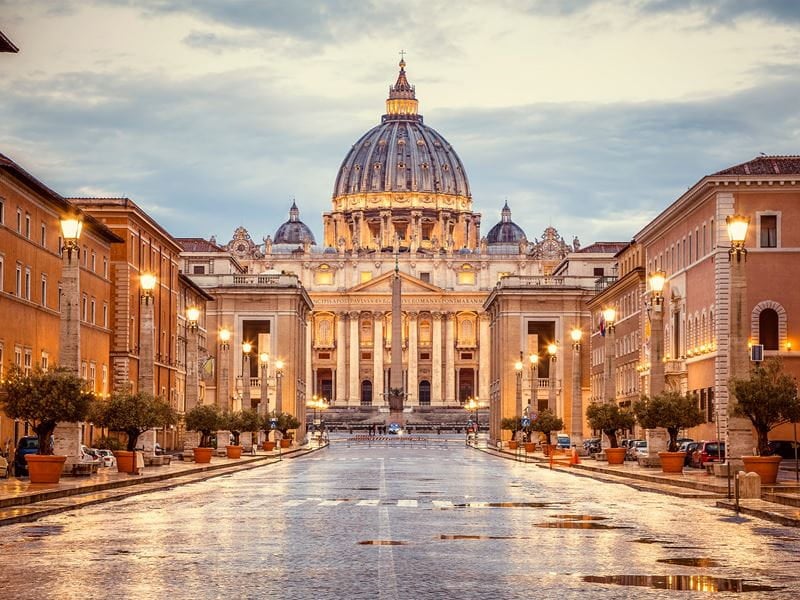
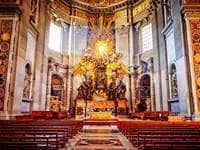
Vatican City is the world’s smallest sovereign state (or nation). Gaining its independence from Italy in 1929, it covers less than a quarter of a square mile. And yet, ironically, it is home to Saint Peter’s Basilica, which has been called the “largest and most awe-inspiring Church” in all of Christendom. (The Basilica has sufficient space for 100,000 worshipers at any given time.) Built during the Italian Renaissance (AD 1506-1626), Saint Peter’s is said to have been built on the very spot where the original 4th century Saint Peter’s Basilica once stood—built by Constantine. When that church was in decline because of a series of fires, Pope Nicholas V (d. AD 1455) determined to replace it with a new and more spectacular edifice—and, from that inspiration, came this wondrous “sacred site.”
The development of this most famous of all Christian basilicas has a long history. As noted, its first iteration (under Constantine) was started just prior to the First Council at Nicaea (circa AD 319). However, the current edifice was begun in 1506. As was the custom in antiquity, much of the stone to build the new basilica was taken from other buildings. In the case of Saint Peter’s, rock from the Colosseum, the Forum Romanum, and even marble from ruined pagan temples, was used to construct the new sacred edifice.
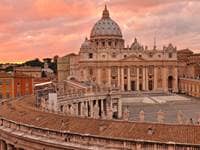
As it relates to other aspects of the basilica and its surrounding environ, several details are worth noting. For example, the Piazza San Pietro—where pilgrims gather to await the announcement of a new pope—was created between 1656-1657. Under Pope Pius XII, archaeological excavations were conducted (1939-1949) beneath the crypt of Saint Peter’s—in an area which had been inaccessible since the 9th century AD. Among other things, the remains of an individual—enfolded in royal purple cloth with gold decorations—was discovered. Though it is impossible to say who the remains belonged to, the rarity of the items buried with it suggests someone of great importance. Pope Pius XII declared there were the remains of Saint Peter. That pronouncement served to solidify (in the minds of many) the long-standing Catholic tradition that Peter was buried beneath the original basilica.
The famous controversy of selling indulgences, which largely sparked the protestant reformation, is intimately connected to Saint Peter’s Basilica. In need of funding for the massive project, the Vatican sent out the German Dominican, Johann Tetzel, to raise funds through selling indulgences. However, his clash with Martin Luther lit the fire that would provoke the reformation and, ultimately, the birth of Protestantism. Indeed, it was the efforts to raise the funds to build the new Saint Peter’s Basilica that would lead Luther not only to write his famous 95 Thesis, but also this legendary line: “Everything is allowed in Rome, except an honest man!”
There are more than 100 tombs within Saint Peter’s Basilica. 91 of those are former popes—though several belong to former emperors and saints. In January of 2023, Pope Bennedict XVI was interred within the basilica, as was Saint Pope John Paul II. The Papal Basilica of Saint Peter in Vatican City may be the most revered cemetery in all of Christianity—and it is certainly the most exclusive one.
Religious Significance
Reliquaries are common in Catholic churches. They are the thing which often sets a space apart as “holy” or “sacred.” The incomparable dome of Saint Peter’s—designed by Michelangelo, though finished a quarter of a century after his death—is supported by four massive pillars, pentagonal in shape. Those gilded columns are actually reliquaries, each containing various sacred relics of the Church. In addition, Saint Peter’s is the burial site of many popes of the past; their remains reverently interred in this temple-church’s catacomb.
While historians may beg to differ, Catholic tradition says that Saint Peter himself is buried just under the Basilica’s high altar. The 1st century BCE obelisk—standing at the center of St. Peter’s Square and brought to Rome from Alexandria in 37 BCE—rests on “blood-soaked ground.” During the period of Nero’s persecution of Christians, thousands were tortured and martyred on that very spot, making it a pseudo-reliquary, and certainly hallowed ground.
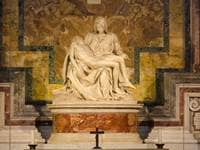
The Papal Basilica of Saint Peter in the Vatican is not simply a church, it is also an art gallery, of sorts. It contains some of the most beautiful and important pieces of art anywhere in the world. A kind of history lesson in marble and canvas, it tells the story of the Catholic Church through its various famed sculptures and paintings. Statues of Ignatius of Loyola and Francis Xaviar (the founders of the Society of Jesus), and Saint John of the Cross (the 16th century mystic)—remind us of some of the Church’s most important events and personalities. Michelangelo’s famed Pietà stands as a testament to the central message of the Church—that Jesus died for the sins and fallenness of humanity.
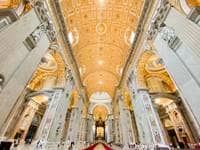
The statue of the seated Apostle Peter (in the Church’s central nave) is a reminder of the papacy, to whom Catholics believe Jesus entrusted the care of the Church. There are quite literally thousands of pieces of art in the halls, on the walls, and even in the floors of this famous basilica, testifying to various events in human history, and in the history of the Church. Thus, to walk the halls of Saint Peter’s is to walk the history of the faith—and to be reminded of what matters most in life and in eternity. Being there is a sacred and impactful experience.
Except when the pope is traveling, the pontiff recites the Angelus Prayer each Sunday (at noon)—reminding us of Christ’s incarnation and passion. Catholics and tourists alike will gather in St.
Peter’s Square (or the Piazza San Pietro), to experience this weekly event. On Wednesday mornings, crowds of the faithful assemble for the “papal audience,” to receive the pope’s blessing. And from the high altar—front and center in Saint Peter’s Basilica—the Pope celebrates the Mass. Thus, the Papal Basilica of Saint Peter is the hub for the various activities performed by the Bishop of Rome. Christianity’s holiest man engages in his holiest works, making Saint Peter’s a “sacred site” for believing Catholics.
For each of these reasons, and so many others, the Vatican, they Sistine Chapel, and the Basilica of Saint Peter are set apart sites. One of the most popular pilgrimage sites for Roman Catholics, it is also one of the most popular places to visit for non-Catholics and even the non-religious. Because of its history and art, even those who do not embrace the teachings of the Church sense that they are on hallowed ground when they walk the halls of this most remarkable building.
Related
Indigenous Peoples’ Day and the Church
Faith Shines Through Halloween Darkness
Did Jesus Fear God's Wrath in Gethsemane?

Kathleen Mulhern, PH.D.
Kathleen Mulhern, PH.D.
Do Christians Celebrate Passover?
Alonzo L. Gaskill PH.D.
Is Christianity Declining in Numbers?
Alonzo L. Gaskill PH.D.
What Do Catholics Believe About Death and the Afterlife?
Alonzo L. Gaskill, PH.D.
What Do Catholics Believe About Purgatory?
Patheos Explore the world's faith through different perspectives on religion and spirituality! Patheos has the views of the prevalent religions and spiritualities of the world.
Ad-Free & Subscriber Log-In Subscription Support
- About Us
- 2026 Calendar
- Videos
- Podcasts
- Library of World Religions
- Faith In Media Tracker
- Advertise With Us
- Write for Us
- Privacy Policy
- Terms of Service
- Do Not Sell My Data
- Contact Us
- Radiant Digital
- Manage Newsletter Subscriptions
- Unsubscribe From Notifications
- Sitemap
Copyright 2008-2026, Patheos. All rights reserved.
Subscription Support Ad-Free & Subscriber Log-In
Follow Patheos