
BuddhistCatholicContemplativeEvangelicalGeneral ChristianHinduJewishLatter-day SaintMuslimNew VisionsProgressive Christian
Beliefs
- Buddhist
- Catholic
- Contemplative
- Evangelical
- General Christian
- Hindu
- Jewish
- Latter-day Saint
- More Voices
- Muslim
- New Visions
- Pagan
- Progressive Christian
Topics
- Religion News
- Food and Religion
- Sports and Religion
- Religious Art
- Religious Music and Entertainment
- Religious Events
- History and Religion
- Style and Religion
- Politics and Religion
- Women in Religion
- Recreation Outdoors and Religion
- Business Finance and Religion
- Careers Workplace and Religion
- Education and Religion
- Family Parenting and Religion
- Health Fitness and Religion
- Home and Religion
- Relationships and Religion
- Technology and Religion
- Travel and Religion
Columnists
- Buddhist Columnists
- Business Finance and Religion Columnists
- Careers Workplace and Religion Columnists
- Catholic Columnists
- Contemplative Columnists
- Education and Religion Columnists
- Evangelists Columnists
- Family Parenting and Religion Columnists
- General Christian Columnists
- Health Fitness and Religion Columnists
- Hindu Columnists
- History and Religion Columnists
- Home and Religion Columnists
- Jewish Columnists
- More Voices Columnists
- Latter Day Columnists
- Muslim Columnists
- New Visions Columnists
- Nonreligious Columnists
- Pagan Columnists
- Politics and Religion Columnists
- Progressive Columnists
- Recreation Outdoors and Religion Columnists
- Relationships and Religion Columnists
- Religion News Columnists
- Religious Art Columnists
- Religious Events Columnists
- Religious Music and Entertainment Columnists
- Sports and Religion Columnists
- Style and Religion Columnists
- Technology and Religion Columnists
- Travel and Religion Columnists
- Women in Religion Columnists
Resource Library
- 2026 Calendar
- Library of World Religions
- The 100 Most Holy Places on Earth
- Patheos Answers
- Podcasts
- Videos
- Faith Leaders Database
- Anglican Episcopalian
- Bahai
- Baptist
- Buddhism
- Christianity
- Confucianism
- Eastern Orthodoxy
- Hinduism
- Holiness and Pentecostal
- ISKCON
- Islam
- Judaism
- Lutheran
- Methodist
- The Church of Jesus Christ of Latter-day Saints
- New Age
- Paganism
- Presbytarian and Reformed
- Protestantism
- Religion Behind the Scenes
- Roman Catholic
- Scientology
- Shia Islam
- Sikhism
- Sufism
- Sunni Islam
- Taoism
- Zen
- See all religions
Research Tools
 Ad-Free & Subscriber Log-In Subscription Support
Ad-Free & Subscriber Log-In Subscription Support
Follow Patheos 

- Trending:
- Forgiveness
- |
- Marriage
- |
- Consciousness
- |
- Death Penalty
- |
- Election
- |
- Halloween
patheos presents

The 100 Most Holy Places On Earth
number
63
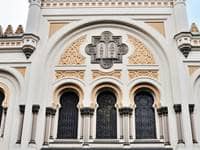
Spanish Synagogue
Prague, Czech Republic 


By Alonzo Gaskill | Updated: March 19, 2026 | Published: March 23, 2023
Associated Faiths:
Conservative Judaism
Also visited by Jews of other denominations, and religious tourists of various faith traditions
Accessibility:
Open to visitors.
Annual visitors: 725,000
History
The Spanish Synagogue is not the first synagogue to occupy this “sacred site” (in the Czech Republic). Completed in 1868, the current house of worship replaced the Altschule (or “old synagogue”). The previous structure was said to be the “oldest synagogue” in Prague’s “Jewish Town.” Now, the Spanish Synagogue is the “newest synagogue” in that same area. The latter was built to replace the former because the Altschule simply could no longer accommodate the number of worshipers utilizing the synagogue.
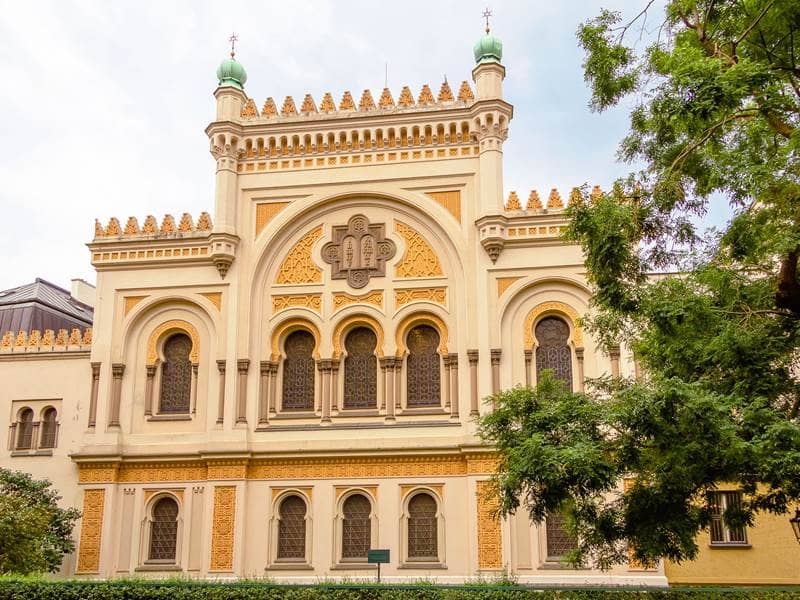
While the Spanish Synagogue is Czech, not Spain-affiliated, its name comes from its architectural style. The Ashkenazi Conservative Jewish congregation’s 19th century building was constructed in the Moorish Revival style (which was at its height of popularity right around the time that this synagogue was constructed). It was well after its 1868 construction that users began to call it the “Spanish Synagogue.” It was initially referred to as the “Temple in Holy Spirit Street.”
This 19th century house of worship was expanded in 1935. At that time, a sort of multipurpose space was added to the synagogue. Until the outbreak of the Second World War, that addition served the Jewish community’s medical needs. It was essentially a hospital for those of “Jewish Town.” The multipurpose space was also used by the congregation that worshiped in the main synagogue.
Post-WWII, the Spanish Synagogue was used by the government to store various items confiscated from the Czech Jewish community during the war. Though it was the recipient of a major renovation (in the late 1950s), buy the 1970s its neglect was evident and, in 1982, the synagogue was closed. A 1990s restoration brought the building back to its former glory, and it was reopened in 1998. Today, it functions as a sort of museum, telling the story of Jews in the Czech Republic.
Religious Significance
The synagogue has long been the center of Jewish religious life, and of Jewish communal activity. Synagogues serve as the beit k'nesset (meaning “House of Assembly”) for the community, but also as its “shul” (or “school”) for those seeking to understand their religion, God’s law, and even the Hebrew language. While Reform Jews most often refer to the synagogue as the “temple,” Orthodox Jews would be quite uncomfortable with this erroneous and (in their view) sacrilegious association. Unquestionably, the ancient Jewish Temple had a very different purpose from the modern Synagogue. And yet, because both were places for engagement in their respective sacraments, both had a sacral function and constituted “sacred space” for the worshiper who congregated there.
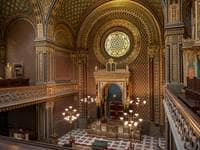
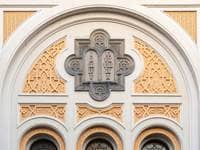
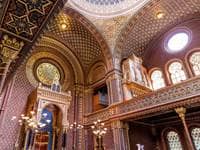
While synagogues throughout the world will vary in architectural style—and some, like the Czech Republic’s Spanish Synagogue, are very unique architecturally speaking; nevertheless, there are certain components which tend to be present in every synagogue, and which facilitate its qualification as “sacred space.” For example, the “Ark” (in which the Torah Scrolls are stored) is a common feature and, just as the place where Moses received that Law was declared holy by God, so the place in the synagogue in which that law (in its current form) is stored is perceived as holy. (The “Ark” or storage place of the scrolls takes its name from the ancient temple’s “Ark of the Covenant.”) The candelabra or menorah that is kept burning constantly in the synagogue represents the Shekinah (or glory of God), symbolic of the Lord’s constant presence in His holy house. While synagogues do not display representations of God (as this is forbidden in the Decalogue), most synagogues will have on display some kind of replica of the “tables of stone” on which the original ten commandments were written (by the finger of God). Each of these consistently displayed symbols, and many others traditionally found in synagogues, remind the worshiper of God’s word, its place in the life of a faithful Jew, and its sacral nature. Thus, the edifice which houses that holy word is itself sacred ground.
The predecessor to the Spanish Synagogue—the Altschule (or “old synagogue”)—was built on the very site of the original settlement of Sephardic Prague Jews—dating back to the 12th century. In the many years that this lot has housed the community of Czech Jews, many challenges, attacks, and tragedies have befallen the people and the buildings which have rested on this hallowed site. Numerous fires, physical attacks, pillaging, multiple reconstructions—these, and many other challenging events, have hallowed the ground on which the building and its successor have sat, and the people who have worshipped therein. It has been a hard history, thereby making a holy people and a “sacred site.”
The Spanish Synagogue is a monument to a people. Acting as a museum today, recounting the difficult history of Czech Jews, it is a reminder of all that has befallen a people who seem ever under attack and consistently marginalized. And yet, just as the Spanish Synagogue seems to not fit the traditional landscape of Prague, the Jewish people have consistently not “fit” the trends of the world, as they have sought to follow their God, with the consequence of grave persecution from many of the “godless.” With deep and abiding faith in the holy, the people of this community have sacralized this site through their suffering and faithfulness.
Related
What is the Jewish Holiday of Simchat Torah?
How and Why Jewish Mikvah’s Are Used
Sara Wolkenfeld
How Jewish Prayer Shawls Are Made and Used
Ori Faran
How Jewish Shomers ‘Guard’ Bodies Until They’re Buried
Sharon Bushman
How Torah Scroll Parchment Gets Made
Rabbi Linda Motzkin
How Torah Scrolls are Repaired and Preserved
Ronnie Sieger
Does Judaism Have Different Denominations?
Alonzo L. Gaskill, PH.D.
Patheos Explore the world's faith through different perspectives on religion and spirituality! Patheos has the views of the prevalent religions and spiritualities of the world.
Ad-Free & Subscriber Log-In Subscription Support
- About Us
- 2026 Calendar
- Videos
- Podcasts
- Library of World Religions
- Faith In Media Tracker
- Advertise With Us
- Write for Us
- Privacy Policy
- Terms of Service
- Do Not Sell My Data
- Contact Us
- Radiant Digital
- Manage Newsletter Subscriptions
- Unsubscribe From Notifications
- Sitemap
Copyright 2008-2026, Patheos. All rights reserved.
Subscription Support Ad-Free & Subscriber Log-In
Follow Patheos