
BuddhistCatholicContemplativeEvangelicalGeneral ChristianHinduJewishLatter-day SaintMuslimNew VisionsProgressive Christian
Beliefs
- Buddhist
- Catholic
- Contemplative
- Evangelical
- General Christian
- Hindu
- Jewish
- Latter-day Saint
- More Voices
- Muslim
- New Visions
- Pagan
- Progressive Christian
Topics
- Religion News
- Food and Religion
- Sports and Religion
- Religious Art
- Religious Music and Entertainment
- Religious Events
- History and Religion
- Style and Religion
- Politics and Religion
- Women in Religion
- Recreation Outdoors and Religion
- Business Finance and Religion
- Careers Workplace and Religion
- Education and Religion
- Family Parenting and Religion
- Health Fitness and Religion
- Home and Religion
- Relationships and Religion
- Technology and Religion
- Travel and Religion
Columnists
- Buddhist Columnists
- Business Finance and Religion Columnists
- Careers Workplace and Religion Columnists
- Catholic Columnists
- Contemplative Columnists
- Education and Religion Columnists
- Evangelists Columnists
- Family Parenting and Religion Columnists
- General Christian Columnists
- Health Fitness and Religion Columnists
- Hindu Columnists
- History and Religion Columnists
- Home and Religion Columnists
- Jewish Columnists
- More Voices Columnists
- Latter Day Columnists
- Muslim Columnists
- New Visions Columnists
- Nonreligious Columnists
- Pagan Columnists
- Politics and Religion Columnists
- Progressive Columnists
- Recreation Outdoors and Religion Columnists
- Relationships and Religion Columnists
- Religion News Columnists
- Religious Art Columnists
- Religious Events Columnists
- Religious Music and Entertainment Columnists
- Sports and Religion Columnists
- Style and Religion Columnists
- Technology and Religion Columnists
- Travel and Religion Columnists
- Women in Religion Columnists
Resource Library
- 2026 Calendar
- Library of World Religions
- The 100 Most Holy Places on Earth
- Patheos Answers
- Podcasts
- Videos
- Faith Leaders Database
- Anglican Episcopalian
- Bahai
- Baptist
- Buddhism
- Christianity
- Confucianism
- Eastern Orthodoxy
- Hinduism
- Holiness and Pentecostal
- ISKCON
- Islam
- Judaism
- Lutheran
- Methodist
- The Church of Jesus Christ of Latter-day Saints
- New Age
- Paganism
- Presbytarian and Reformed
- Protestantism
- Religion Behind the Scenes
- Roman Catholic
- Scientology
- Shia Islam
- Sikhism
- Sufism
- Sunni Islam
- Taoism
- Zen
- See all religions
Research Tools
 Ad-Free & Subscriber Log-In Subscription Support
Ad-Free & Subscriber Log-In Subscription Support
Follow Patheos 

- Trending:
- Forgiveness
- |
- Marriage
- |
- Consciousness
- |
- Death Penalty
- |
- Election
- |
- Halloween
patheos presents

The 100 Most Holy Places On Earth
number
23
Shri Kashi Vishwanath Temple
Varanasi, India 


By Alonzo Gaskill | Updated: March 19, 2026 | Published: March 23, 2023

Also Known As:
Adi Vishveshwara Temple
Associated Faiths:
Accessibility:
Technically, non-Hindus are not allowed in this specific Hindu temple, though sometimes that is not enforced. However, out of respect for the tradition, it would be inappropriate for a non-Hindu to try to gain access.
Annual visitors: 2,000,000
History
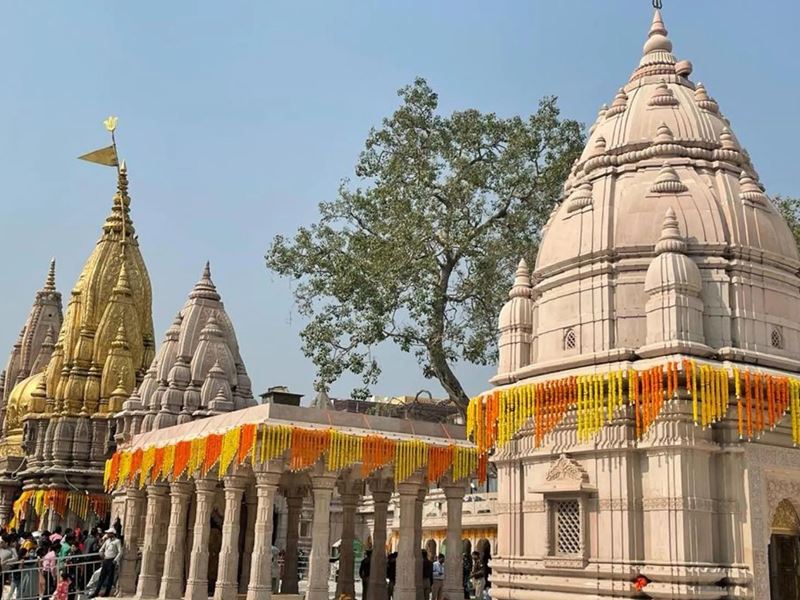
This Hindu temple is situated on the western bank of the Ganges river, in Varanasi—one of Inda’s oldest cities, and the most sacred of Hindu cities. The name “Kashi” means “luminous.” The name “Varanasi,” which is the name of the city the temple is found in, comes from the Varana and Asi rivers, which are tributaries of the Ganges which lie to the north and south of the city. Thus, the name essentially implies ‘luminous rivers.’
The date of the original temple’s construction is unknown. Because Varanasi has been inhabited for some 3,000 years, the original temple may have been constructed prior to the Common Era. Because the city has repeatedly been attacked, starting in the 12th century CE, the temple has been rebuilt numerous times (e.g., 13th, 16th & 18th centuries). The current structure dates to the year 1776, when Pandit Malaviya rebuilt it in the hopes that the Hindu Caste system would be done away with, and that Hindus of all castes would be allowed to come to the temple and worship therein.
Though the current temple is an 18th century structure, its gold exterior—for which it is known—dates to 1839, when the Punjabi ruler, Maharaja Ranju Singh, donated over two tons of gold to be used for the plating of the temple’s 50-foot spire. Just as “Kashi” means “luminous,” this temple (dedicated to Lord Shiva) is a “shining” monument which rests in the midst of a chaotic community. Amid the pilgrims, merchants, funeral pyres, and “a temple every ten steps,” is this singularly beautiful holy site, that stands out above all the rest. There is no more holy city in Hinduism, and no more sacred temple in a town “littered with shrines and temples.” Of the 108 temples in India which are dedicated to Lord Shiva, the Kashi Vishwanath Temple is said to be among the most important and most sacred.
Because of the theological significance of Shiva, this temple, the river Ganges (which runs through Varanasi), and other factors, millions visit this temple and city every year. It is auspicious and perceived as salvific, and there is hardly a site in India more precious and sacred to practicing Hindus. Though the original temple is ancient, and though this site has been sacred to Hindus for millennia, it really wasn’t until the 19th century that it emerged from its repeated attacks as the “national religious center” of India. Nevertheless, today it is perceived as exactly that, and most Hindus expect to visit the temple and city at least once in their lifetimes, ideally at the end of their lives.
Religious Significance
The spot on which the Kashi Vishwanath Temple stands is said to be the very spot on which Lord Shiva and one of his wives (Parvati) stood when “time began.” Today, the city which houses the temple is believed to be the location at which the Hindu gods descend to earth, and a place where humans can more readily access the divine. Thus, pilgrims flock to the city in the belief that their spirituality will be heightened, their connection to the divine increased, and their number of incarnations reduced.
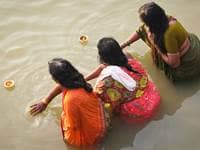
The Ganges River has been a “sacred site” for Hindus for untold centuries. The Ganges is a river, but it is also a goddess, and the lifeline of India. It is the life-giver, providing water to people and animals, and fertility to the land and its crops. Its waters are believed to be sanctifying. A singular dip in the Ganges is believed to remit massive amounts of karma—which is the very thing one needs in order to escape the cycle of reincarnation (or rebirth). People visit the Ganges and its various banks throughout the parts of India that it flows. However, the portion of the River that passes through Varanasi (and by the Kashi Vishwanath Temple) is considered particularly sacred.
Indeed, tradition has it that a visit to the Kashi Vishwanath Temple, coupled with bathing in the Ganges River (in Varanasi), can actually guarantee that you experience moksha (or liberation), thereby ensuring samsara (i.e., freedom from the cycle of rebirths) and the achievement of Nirvana (at the conclusion of this life). Thus, like Muslims who seek to make at least one hajj (or pilgrimage) to Mecca in their lifetime, faithful Hindus see Varanasi, the Ganges, and Kashi Vishwanath Temple, as the ideal location to conclude one’s life. To make this trek, to experience these sacred sites, and to be cremated on the ghats (or stone steps) near the temple—having your ashes sprinkled in the Ganges River—is seen as the most auspicious of endings for a Hindu.
While Hinduism has tens of thousands of gods, many castes, and multiple roads to salvation, nonetheless, the ultimate goal of all believing Hindus is “release.” It is the cessation of reincarnation. It is the ending of rebirth, life, suffering, and death. It is total absorption into the Ultimate—Brahman. The city of Varanasi, the sacred River Ganges, and the Kashi Vishwanath Temple are the locations where many Hindus believe these things are most likely to be achieved. Thus, this is one of the holiest temples and sites in all of India, and one of the most important places of pilgrimage on the entire subcontinent of India.
Related
The First Eucharistic Controversy: Christ’s Real Presence
How the author of the world's best hymn became a Christian
Do Not Rejoice When Your Enemy Falls: The Cheers for Death
22: Sanctuary of Our Lady of Lourdes



How to Prepare a Zen Dharma Talk: Thirteen Points
Movie on Neem Karoli Baba’s life is a miraculous success
Spiritual Long Beach: The Catholic Shrine to Mary Cared for by Buddhist Monks

The History of Budai, the Laughing Buddha
Patheos Explore the world's faith through different perspectives on religion and spirituality! Patheos has the views of the prevalent religions and spiritualities of the world.
Ad-Free & Subscriber Log-In Subscription Support
- About Us
- 2026 Calendar
- Videos
- Podcasts
- Library of World Religions
- Faith In Media Tracker
- Advertise With Us
- Write for Us
- Privacy Policy
- Terms of Service
- Do Not Sell My Data
- Contact Us
- Radiant Digital
- Manage Newsletter Subscriptions
- Unsubscribe From Notifications
- Sitemap
Copyright 2008-2026, Patheos. All rights reserved.
Subscription Support Ad-Free & Subscriber Log-In
Follow Patheos