
BuddhistCatholicContemplativeEvangelicalGeneral ChristianHinduJewishLatter-day SaintMuslimNew VisionsProgressive Christian
Beliefs
- Buddhist
- Catholic
- Contemplative
- Evangelical
- General Christian
- Hindu
- Jewish
- Latter-day Saint
- More Voices
- Muslim
- New Visions
- Pagan
- Progressive Christian
Topics
- Religion News
- Food and Religion
- Sports and Religion
- Religious Art
- Religious Music and Entertainment
- Religious Events
- History and Religion
- Style and Religion
- Politics and Religion
- Women in Religion
- Recreation Outdoors and Religion
- Business Finance and Religion
- Careers Workplace and Religion
- Education and Religion
- Family Parenting and Religion
- Health Fitness and Religion
- Home and Religion
- Relationships and Religion
- Technology and Religion
- Travel and Religion
Columnists
- Buddhist Columnists
- Business Finance and Religion Columnists
- Careers Workplace and Religion Columnists
- Catholic Columnists
- Contemplative Columnists
- Education and Religion Columnists
- Evangelists Columnists
- Family Parenting and Religion Columnists
- General Christian Columnists
- Health Fitness and Religion Columnists
- Hindu Columnists
- History and Religion Columnists
- Home and Religion Columnists
- Jewish Columnists
- More Voices Columnists
- Latter Day Columnists
- Muslim Columnists
- New Visions Columnists
- Nonreligious Columnists
- Pagan Columnists
- Politics and Religion Columnists
- Progressive Columnists
- Recreation Outdoors and Religion Columnists
- Relationships and Religion Columnists
- Religion News Columnists
- Religious Art Columnists
- Religious Events Columnists
- Religious Music and Entertainment Columnists
- Sports and Religion Columnists
- Style and Religion Columnists
- Technology and Religion Columnists
- Travel and Religion Columnists
- Women in Religion Columnists
Resource Library
- 2026 Calendar
- Library of World Religions
- The 100 Most Holy Places on Earth
- Patheos Answers
- Podcasts
- Videos
- Faith Leaders Database
- Anglican Episcopalian
- Bahai
- Baptist
- Buddhism
- Christianity
- Confucianism
- Eastern Orthodoxy
- Hinduism
- Holiness and Pentecostal
- ISKCON
- Islam
- Judaism
- Lutheran
- Methodist
- The Church of Jesus Christ of Latter-day Saints
- New Age
- Paganism
- Presbytarian and Reformed
- Protestantism
- Religion Behind the Scenes
- Roman Catholic
- Scientology
- Shia Islam
- Sikhism
- Sufism
- Sunni Islam
- Taoism
- Zen
- See all religions
Research Tools
 Ad-Free & Subscriber Log-In Subscription Support
Ad-Free & Subscriber Log-In Subscription Support
Follow Patheos 

- Trending:
- Forgiveness
- |
- Marriage
- |
- Consciousness
- |
- Death Penalty
- |
- Election
- |
- Halloween
patheos presents

The 100 Most Holy Places On Earth
number
21
Sensō-ji Temple
Asakusa, Tokyo, Japan 


By Alonzo Gaskill | Updated: March 19, 2026 | Published: March 23, 2023
Also Known As:
Sensō-ji Temple
Asakusa Kannon Temple
Associated Faiths:
Also frequented by practitioners of Shinto, since (in Japan) it is often difficult to separate Buddhism and Shinto (many Japanese practicing both)
Accessibility:
Open to visitors.
Annual visitors: 30,000,000
History
The Sensō-ji Temple—sometimes referred to as the Asakusa Kannon Temple—was founded in 645 CE and is Tokyo’s oldest temple. According to tradition, it was founded by three local fishermen (Hinokuma Hamanari, Hinokuma Takenari, and Hajino Nakatomo). The story tells of how the three were out fishing (in 628 CE) and caught in their net a statue of the goddess, Kannon. (Kannon is the goddess of mercy, and the feminine equivalent of the Mahayana Buddhist god, Avalokiteshvara.) They threw the statue back into the Sumida River, but it kept getting recaught (no matter where in the river they fished). Recognizing divine influences at play, the three men commissioned the construction of the Sensō-ji Buddhist temple to house the sacred statue.
As a consequence of the miraculous finding of the statue and owing to the popularity of the matsuri (or festival) associated with it, these three fishermen have gained legendary status in Tokyo. Indeed, they have achieved a status of “holiness” in the minds of many in central Japan. For some, that status has risen to the point of deification—where the three are perceived as Shinto kami (or divine spirits).
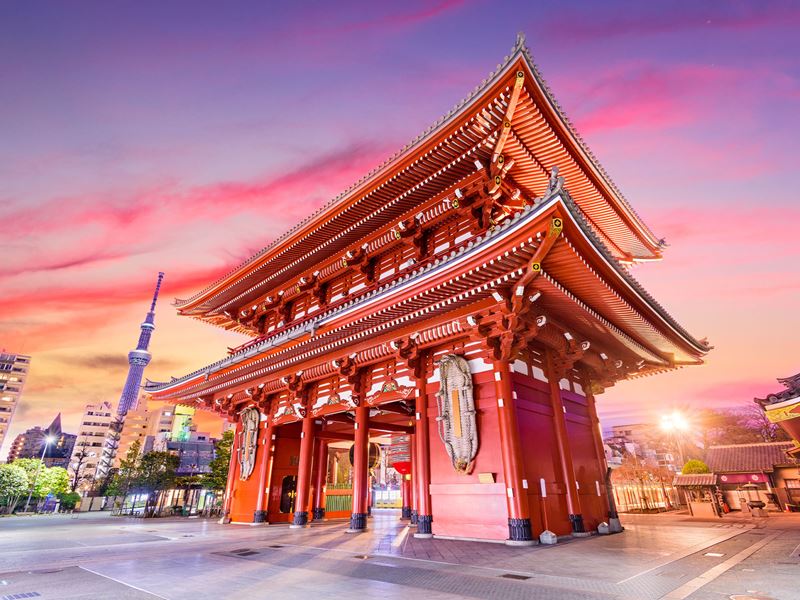
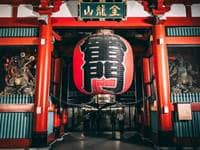
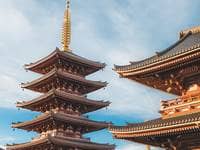
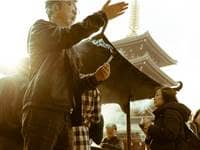
The “Thunder Gate” (or “kaminarimon”) marks the outer parameters of the Sensō-ji Temple—and starts the path leading to “Hozomon” (or the temple’s “second gate”). Between those two gates are shops and eateries which have lined the path for centuries. Just beyond the “second gate” is the temple’s “main hall,” which consists of a five-story pagoda. Adjacent to that is the Asakusa Shinto shrine—evidencing the blending of Buddhism and Shinto, not only at this location, but throughout Japan. The buildings on the site are fairly modern—as the original complex was destroyed in the battle of Sekigahara (circa 1,600 CE) and was rebuilt mid-century.
Religious Significance
While the Sensō-ji Temple is Buddhist, the influence of Shinto cannot be denied. (In Japan, Buddhism, Shinto, Taoism and Confucianism are often hard to distinguish—with two or more of these traditions frequently blending together into one.) Thus, the Asakusa Kannon Temple is a Buddhist temple, but its best known and perhaps most popular matsuri (or festival) is the Sanja Matsuri festival, which is a Shinto commemoration. Among other things, the festival acknowledges sacred events in Tokyo’s history—holy events which caused the creation of a “sacred space” (in the form of the Sensō-ji Temple).
This 7th century CE temple is considered holy for a number of reasons. First, it is a sacred site because of the statue of Kannon (the goddess of mercy) which is housed therein. Her presence in the temple is believed to bring mercy and blessings to Tokyo and its inhabitants. Those who venerate her can provoke her blessings (or “good luck”) upon their families, their businesses, or in their personal lives. The temple is also a “sacred site” because of the miraculous way in which the Kannon’s statue was discovered. Some have interpreted her insistence on being discovered—and, when thrown back into the Sumida River, rediscovered—as evidence of her desire to bring “luck” or blessings to the people of Tokyo. Finally, the Asakusa Kannon Temple is sacral because of the three “holy men” who commissioned its creation—brining the blessings of Kannon (and Avalokiteshvara) upon Tokyo, its residents, and its visitors.
The Sanja Matsuri festival is celebrated annually on the third Friday, Saturday, and Sunday of May. For Buddhists, commemorating it keeps Kannon pleased and causes her to pour out good luck upon the community and people. For practitioners of Shinto, commemorating the annual festival ensures that all of the kami (or spirits)—not just Kannon—are kept happy and, thus, the community and its residents are protected from the negative consequences of neglecting to appease the kami.
During the three-day festival—which honors Kannon and the three fishermen who found her statue—there is a very celebratory spirit. Part of that is attributed to the fact that this matsuri represents an annual outpouring of blessings and good luck on the community. Brightly gilded and lacquered portable shrines (or mikoshi) are carried about on the shoulders of worshipers, with the belief that the gods and kami ride within. On the second day of the festival, the mikoshi are carried to the temple precinct to be purified. On the last day of the festival, the three shrines representing the three founding fishermen are carried about—with the sense that, as they pass through the streets, their luck and blessings flow to the people. People jostle to gain control of the poles on which the shrines are borne, as it is considered a particularly strong blessing to bear the shrine of one of these divine beings. One source pointed out that “the more tipsy” the procession, “the more luck” is believed to “spill out” upon the onlookers.
The Sensō-ji Temple is unique in that it is a place of holiness, but also its mikoshi enable it to send out its “sacred space” into the community and its streets. Thus, rather than being an example of an isolated sacred shrine (as so many Buddhist temples and Shinto shrines are), its mikoshi are extensions of that holiness, which leave the temple each year, to scatter the blessings of visiting a sacred space among those who are not at the actual temple, but to whom a holy portion of the temple itself comes. In a way, the Sensō-ji Temple is a bit like the statue it houses. Just as the fishermen could not get rid of it (as she kept coming into their nets over and over again), so it is with the temple and its goddess today. Each year she comes back to her people, spreading good luck and blessings upon all—even those who might not anxiously pursue those themselves.
Related
The First Eucharistic Controversy: Christ’s Real Presence
How the author of the world's best hymn became a Christian
Do Not Rejoice When Your Enemy Falls: The Cheers for Death



How to Prepare a Zen Dharma Talk: Thirteen Points

Movie on Neem Karoli Baba’s life is a miraculous success
Spiritual Long Beach: The Catholic Shrine to Mary Cared for by Buddhist Monks

The History of Budai, the Laughing Buddha
Patheos Explore the world's faith through different perspectives on religion and spirituality! Patheos has the views of the prevalent religions and spiritualities of the world.
Ad-Free & Subscriber Log-In Subscription Support
- About Us
- 2026 Calendar
- Videos
- Podcasts
- Library of World Religions
- Faith In Media Tracker
- Advertise With Us
- Write for Us
- Privacy Policy
- Terms of Service
- Do Not Sell My Data
- Contact Us
- Radiant Digital
- Manage Newsletter Subscriptions
- Unsubscribe From Notifications
- Sitemap
Copyright 2008-2026, Patheos. All rights reserved.
Subscription Support Ad-Free & Subscriber Log-In
Follow Patheos