
BuddhistCatholicContemplativeEvangelicalGeneral ChristianHinduJewishLatter-day SaintMuslimNew VisionsProgressive Christian
Beliefs
- Buddhist
- Catholic
- Contemplative
- Evangelical
- General Christian
- Hindu
- Jewish
- Latter-day Saint
- More Voices
- Muslim
- New Visions
- Pagan
- Progressive Christian
Topics
- Religion News
- Food and Religion
- Sports and Religion
- Religious Art
- Religious Music and Entertainment
- Religious Events
- History and Religion
- Style and Religion
- Politics and Religion
- Women in Religion
- Recreation Outdoors and Religion
- Business Finance and Religion
- Careers Workplace and Religion
- Education and Religion
- Family Parenting and Religion
- Health Fitness and Religion
- Home and Religion
- Relationships and Religion
- Technology and Religion
- Travel and Religion
Columnists
- Buddhist Columnists
- Business Finance and Religion Columnists
- Careers Workplace and Religion Columnists
- Catholic Columnists
- Contemplative Columnists
- Education and Religion Columnists
- Evangelists Columnists
- Family Parenting and Religion Columnists
- General Christian Columnists
- Health Fitness and Religion Columnists
- Hindu Columnists
- History and Religion Columnists
- Home and Religion Columnists
- Jewish Columnists
- More Voices Columnists
- Latter Day Columnists
- Muslim Columnists
- New Visions Columnists
- Nonreligious Columnists
- Pagan Columnists
- Politics and Religion Columnists
- Progressive Columnists
- Recreation Outdoors and Religion Columnists
- Relationships and Religion Columnists
- Religion News Columnists
- Religious Art Columnists
- Religious Events Columnists
- Religious Music and Entertainment Columnists
- Sports and Religion Columnists
- Style and Religion Columnists
- Technology and Religion Columnists
- Travel and Religion Columnists
- Women in Religion Columnists
Resource Library
- 2026 Calendar
- Library of World Religions
- The 100 Most Holy Places on Earth
- Patheos Answers
- Podcasts
- Videos
- Faith Leaders Database
- Anglican Episcopalian
- Bahai
- Baptist
- Buddhism
- Christianity
- Confucianism
- Eastern Orthodoxy
- Hinduism
- Holiness and Pentecostal
- ISKCON
- Islam
- Judaism
- Lutheran
- Methodist
- The Church of Jesus Christ of Latter-day Saints
- New Age
- Paganism
- Presbytarian and Reformed
- Protestantism
- Religion Behind the Scenes
- Roman Catholic
- Scientology
- Shia Islam
- Sikhism
- Sufism
- Sunni Islam
- Taoism
- Zen
- See all religions
Research Tools
 Ad-Free & Subscriber Log-In Subscription Support
Ad-Free & Subscriber Log-In Subscription Support
Follow Patheos 

- Trending:
- Forgiveness
- |
- Marriage
- |
- Consciousness
- |
- Death Penalty
- |
- Election
- |
- Halloween
patheos presents

The 100 Most Holy Places On Earth
number
13
Sarnath
Uttar Pradesh, India 


By Alonzo Gaskill | Updated: March 19, 2026 | Published: March 23, 2023
Also Known As:
Sarnath
Sarangnath
Isipatana
Rishipattana
Migadaya
Mrigadava
Associated Faiths:
To a much lesser extent, Hinduism. While there are Jains that also visit, this is uncommon.
Accessibility:
Open to visitors.
Annual visitors: 330,000
History
Not long after becoming enlightened in Bodhgaya (circa 528 BCE) and learning—through that enlightenment experience—the “middle path,” Sidhartha Gautama gave a discourse in a place called “Deer Park.” Indeed, it was his first public discourse since becoming enlightened. That discourse not only solidified the commitment of his first five disciples, but it also set into motion the wheel of sublime religious truth that we would today call Buddhism. That park is at the heart of Sarnath.
Though the Buddha did not stay in Sarnath long—only one rainy season, so far as we know; because of the events which transpired here, the Buddha commanded his disciples to make it one of the “four main towns” associated with the life of the Buddha and, therefore, an important place of pilgrimage for practicing Buddhist and spiritually contemplative non-Buddhists. It was around the 3rd century BCE that Sarnath became a significant site of Buddhists. The reason for this is wrapped up in the fact that India’s first Buddhist emperor, Ashoka, ruled Sarnath. Additionally, as he did with other sites significant to Buddhism, Ashoka raised a pillar—this one having a lion capital.
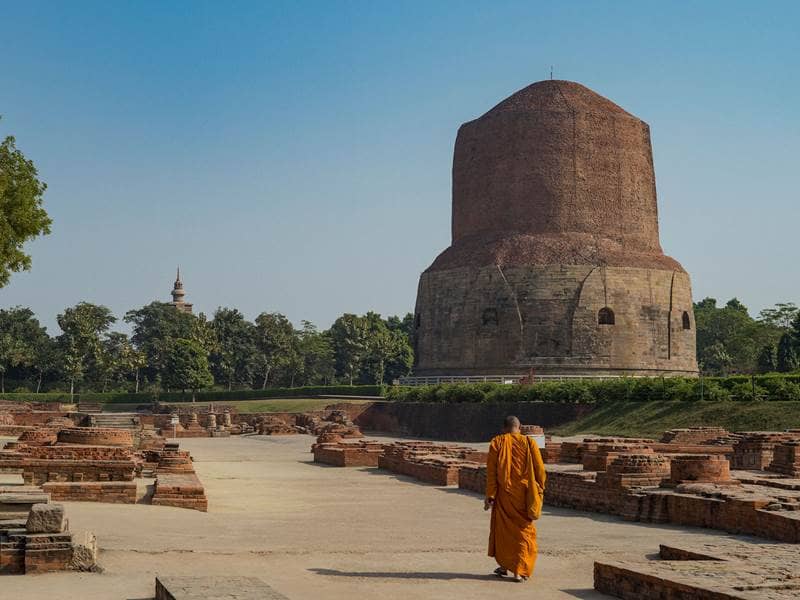
As a site of significance for Buddhist from the 3rd down to the 7th centuries, Sarnath (during its heyday) had as many as 1,500 priests function in the various temples on site. However, by the 10th century, so much neglect of the sight had taken place that it was no longer drawing pilgrims as it once had. Then, in the 11th and 12th centuries, invaders practically destroyed Sarnath, leaving mostly ruins. Many of those ruins can be seen on-site today.
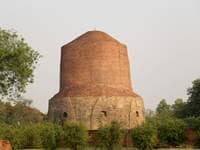
Among the many sites worth seeing (during a visit to Sarnath) would be the Chaukhandi Stupa—which dates from the second or third century BCE. There is also a museum which houses relics discovered on the site during excavations. Across the road from the stupa as a Jain Temple, which dates to the first quarter of the 19th century. Behind that Jain temple are several excavation sites, including the remains of old temples and monasteries—together with the Temple of Kumara Devi. Of course, on site is “Dear Park,” where the actual discourse was given. And next to the temple is a life-sized diorama of the Buddha giving his first sermon.
Religious Significance
Sidhartha Gautama achieved enlightenment at Bodh Gaya—approximate 150 miles east of Sarnath. In the six years leading up to his enlightenment, he lived to torment and torture his body. According to tradition, he subsisted off of 1 bean, one grain of rice, or one sesame seed per day. He fasted so vigorously that he nearly starved himself to death. On the verge death because of malnutrition, a woman who saw him insisted that he eat some food she had on her person. He did, and it saved his life, but his five disciples were so disappointed that he broke his dietary vow that they abandoned him, no longer walking with Sidhartha as their teacher. A short time later, Shakyamuni (as Mahayana Buddhist call him) had an enlightenment experience—while sitting under a bodhi tree. Through that experience, he leaned that extremism isn’t the path to enlightenment. (He had not become enlightened during his princely stage, when he lived an opulent existence. Nor had he gained enlightenment when he lived a life of strict asceticism. No, Sidharth learned that there was a “middle path” that all must follow if they hopped to gain enlightenment.)
Having traveled from Bodh Gaya to Sarnath, the Buddha ran into his five former disciples. As they spoke, the five very quickly came to the realization that Sidhartha had achieved enlightenment—and they followed him the rest of their lives. Thus, Sarnath is important in the Buddhist tradition. Yes, Bodh Gaya was where he was when he gained enlightenment. However, none of that would matter if he had not chosen to teach what he had discovered. Thus, Bodh Gaya is not held as the beginning of Buddhism. Rather, his discourse in Deer Park is. For it was there that he “set into motion the wheel of subline religious truth.” And for all Buddhists, living anciently or today, this site is sacred because it is where the truth was conveyed for the first time—thereby offing enlightenment and salvation to all of humanity.
The name Sarnath means “Lord of the Deer.” It refers to an ancient deer sanctuary in which the Buddha spent some time. One of Sanath’s other names, Isipatana, is a Pali term, and corresponds to the Sanskrit word Rishipattanan—both of which mean the “place where holy men descend.” Each of these name-titles speak of the sacred events which happened at Sarnath in the 6th century BCE. It is certainly the case that many Buddhists believe that Sarnath is the location where “holiness…descended” in the form of an awakening—making Sidhartha now a Buddha (or one who is “awake”).
The Buddha’s enlightened teachings also descended from the heavens to distill upon the mind and heart of the Buddha.
Anytime a person is privileged to walk where some miracle took place, they have the opportunity to ponder the holiness of the site and the divine intervention associated with that very local. Such experiences can be lifechanging for the pilgrim. The spirit felt by the “in-tune” traveler often solidifies his or her commitment to live the principles of the faith. And, in many ways, their time in a sacred site (like Sarnath) opens the door for their own enlightenment.
Related
Indigenous Peoples’ Day and the Church
Faith Shines Through Halloween Darkness
Did Jesus Fear God's Wrath in Gethsemane?



How to Prepare a Zen Dharma Talk: Thirteen Points
Movie on Neem Karoli Baba’s life is a miraculous success

The History of Budai, the Laughing Buddha
Spiritual Long Beach: The Catholic Shrine to Mary Cared for by Buddhist Monks
Patheos Explore the world's faith through different perspectives on religion and spirituality! Patheos has the views of the prevalent religions and spiritualities of the world.
Ad-Free & Subscriber Log-In Subscription Support
- About Us
- 2026 Calendar
- Videos
- Podcasts
- Library of World Religions
- Faith In Media Tracker
- Advertise With Us
- Write for Us
- Privacy Policy
- Terms of Service
- Do Not Sell My Data
- Contact Us
- Radiant Digital
- Manage Newsletter Subscriptions
- Unsubscribe From Notifications
- Sitemap
Copyright 2008-2026, Patheos. All rights reserved.
Subscription Support Ad-Free & Subscriber Log-In
Follow Patheos