
BuddhistCatholicContemplativeEvangelicalGeneral ChristianHinduJewishLatter-day SaintMuslimNew VisionsProgressive Christian
Beliefs
- Buddhist
- Catholic
- Contemplative
- Evangelical
- General Christian
- Hindu
- Jewish
- Latter-day Saint
- More Voices
- Muslim
- New Visions
- Pagan
- Progressive Christian
Topics
- Religion News
- Food and Religion
- Sports and Religion
- Religious Art
- Religious Music and Entertainment
- Religious Events
- History and Religion
- Style and Religion
- Politics and Religion
- Women in Religion
- Recreation Outdoors and Religion
- Business Finance and Religion
- Careers Workplace and Religion
- Education and Religion
- Family Parenting and Religion
- Health Fitness and Religion
- Home and Religion
- Relationships and Religion
- Technology and Religion
- Travel and Religion
Columnists
- Buddhist Columnists
- Business Finance and Religion Columnists
- Careers Workplace and Religion Columnists
- Catholic Columnists
- Contemplative Columnists
- Education and Religion Columnists
- Evangelists Columnists
- Family Parenting and Religion Columnists
- General Christian Columnists
- Health Fitness and Religion Columnists
- Hindu Columnists
- History and Religion Columnists
- Home and Religion Columnists
- Jewish Columnists
- More Voices Columnists
- Latter Day Columnists
- Muslim Columnists
- New Visions Columnists
- Nonreligious Columnists
- Pagan Columnists
- Politics and Religion Columnists
- Progressive Columnists
- Recreation Outdoors and Religion Columnists
- Relationships and Religion Columnists
- Religion News Columnists
- Religious Art Columnists
- Religious Events Columnists
- Religious Music and Entertainment Columnists
- Sports and Religion Columnists
- Style and Religion Columnists
- Technology and Religion Columnists
- Travel and Religion Columnists
- Women in Religion Columnists
Resource Library
- 2026 Calendar
- Library of World Religions
- The 100 Most Holy Places on Earth
- Patheos Answers
- Podcasts
- Videos
- Faith Leaders Database
- Anglican Episcopalian
- Bahai
- Baptist
- Buddhism
- Christianity
- Confucianism
- Eastern Orthodoxy
- Hinduism
- Holiness and Pentecostal
- ISKCON
- Islam
- Judaism
- Lutheran
- Methodist
- The Church of Jesus Christ of Latter-day Saints
- New Age
- Paganism
- Presbytarian and Reformed
- Protestantism
- Religion Behind the Scenes
- Roman Catholic
- Scientology
- Shia Islam
- Sikhism
- Sufism
- Sunni Islam
- Taoism
- Zen
- See all religions
Research Tools
 Ad-Free & Subscriber Log-In Subscription Support
Ad-Free & Subscriber Log-In Subscription Support
Follow Patheos 

- Trending:
- Forgiveness
- |
- Marriage
- |
- Consciousness
- |
- Death Penalty
- |
- Election
- |
- Halloween
patheos presents

The 100 Most Holy Places On Earth
number
72
Santuario de Chimayo
Chimayó, New Mexico, USA 


By Alonzo Gaskill | Updated: March 19, 2026 | Published: March 23, 2023
Associated Faiths:
Roman Catholicism
Also ocassionally visited by Christians of other High and Low-Church traditions
Accessibility:
Open to visitors. Modest dress expected.
Annual Visitors: 300,000
History
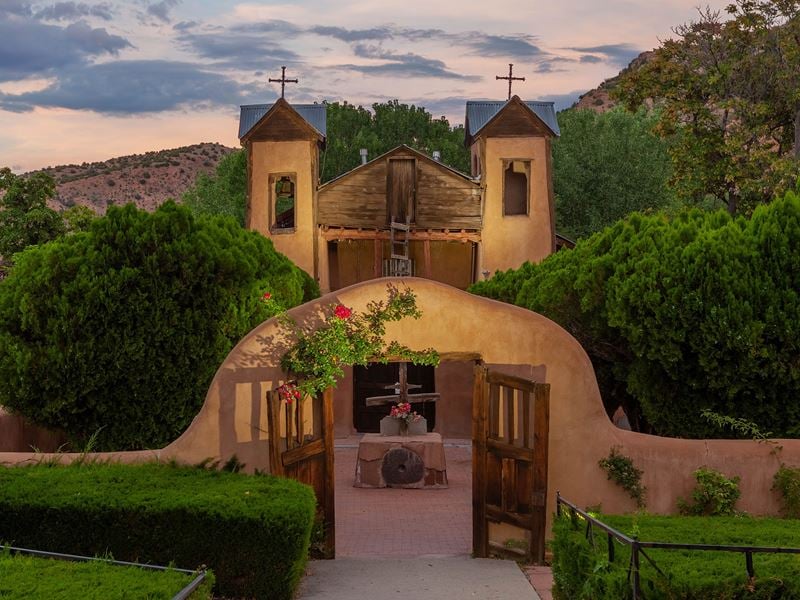
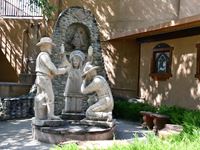
While this is formally a Roman Catholic church and “sacred site” for practitioners of that faith, it is worth noting that the chapel is build atop a spot that the indigenous Tewa Pueblo Indians perceived as sacred long before Spanish Catholics constructed a church upon the heavily venerated place. Thus, the Sanctuary of Chimayó is “holy ground” for more than one tradition. Christians and non-Christians alike have perceived it as “sacred space” for many centuries.
This site was used as holy ground by the Tewa people at least as early as the 12th century, and until around 1400 CE when (for whatever reason) they withdrew from the site, leaving it vacant and unused for nearly 300 years. Around AD 1692, Catholic Spaniards arrived, became aware that the Tewa believed the site to be holy and having healing properties, and built the first Christian church on the spot. That edifice stood for approximately 100-years but was replaced (in 1810) with a small church dedicated to the Christ of Esquipulas. However, within three years, so many pilgrims were flocking to the site that Bernardo Abeyta requested that the Catholic Church allow a larger chapel to be built on the spot—so that more people could participate in the Mass, and so that all who came on pilgrimages could be accommodated. Permission was granted (in 1814) and by 1816 the current El Santuario de Chimayó Church was built on the same site as the previous smaller chapel.
For several generations the land and church building remained in the family of Bernardo Abeyta. However, when Abeyta’s granddaughter ran into financial troubles (preventing her from maintaining the church), it was sold to the Spanish Colonial Arts Society, who then donated it to the Archdiocese of Santa Fe. Since leaving private hands, it has been well maintained by the Church; something the Abeyta family had been unable to do because of the cost of maintenance when thousands of people were visiting the church each year.
In the 21st century, a number of skeptics expressed discomfort at the growing popularity of The Sanctuary of Chimayó, including doubts about the plethora of miraculous healing stories. For example, in 2013, the Skeptical Inquirer magazine wrote a piece attacking the claims of miracles at the site—saying that the “claims” of “holy dirt” are “unwarranted.” Similarly, in 2014, the book Mysterious New Mexico insisted that there was “little evidence to corroborate claims of miraculous cures.” Thus, like any “sacred site,” its “holiness” will be questioned by “outsiders” or “non-believers.” El Santuario de Chimayó certainly proves the truth that, like “beauty,” sacred space truly is “in the eyes of the beholder”—though that can be “beholders” of many faith traditions, as in the case of the Lourdes of America.
Religious Significance
It would be surprising to meet a practicing Roman Catholic who was not familiar with Lourdes of France. However, many have never heard of The Sanctuary of Chimayó. This small adobe church is often referred to as the “Lourdes of America” since—much like its’ sister shrine in Southwestern France—this New Mexico site is known to be a place of healing, where pilgrims come to petition Heaven’s help, often with some major health crisis. The history of miracles taking place on this site dates to well before Christians arrived at the location—though it is decidedly a Roman Catholic church today.
The name “Chimayó” comes from tsi mayoh, which is Tewa Pueblo for good “flaking stone” or “obsidian stone.” Of course, obsidian was often used by indigenous peoples in making tools and weapons. However, it is claimed that a volcano in the area erupted, spewing obsidian and ash throughout the location. The Tewa would gather the obsidian-laced soil and mix it with water, and then eat it or apply it to a wound or to the skin generally—in the hopes of a miraculous healing from sickness. Hence the location was known as Chimayó—essentially good “place of healing” stone.
Even before the church was built (in 1816), people were known to travel to the location of the former Tewa Pueblo healing ground and claimed miracles as a result of their visit. Indeed, an 1813 letter from a local friar to the Episcopal See of Durango chronicles (for the Catholic Bishop) that this was a place of pilgrimage and a haven of healing. All of that likely solidified the Church’s conviction that this was the “sacred site” on which a church should be built.
One of the most important parts of the traditional pilgrimage to this bit of holy ground is a room which adjoins the sanctuary. The room is called the “Little Well Room” (El Pocito or El Pozo Pequeño). It is also often referred to as the “Room of Miracles.” In the floor of the room is a good sized hole into which one can reach to capture some of the “sacred soil.” As with the indigenous Tewa, pilgrims today will apply it to their bodies or eat it.
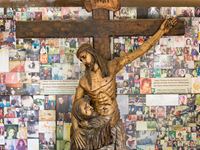
Some will apply it to pictures of their ill or afflicted loved ones—in the hopes of a miracle for them (even if they were not well enough to make the pilgrimage on their own). Those who maintain the shrine are said to truck in (from the nearby hillsides) approximately 60,000 pounds of soil a year in order to keep the “Little Well” full for those who want to capture some from the hole in the floor. Another room in the church is filled with canes, braces, and crutches of those who have been healed, in addition to letters of gratitude and various votive offerings.
With these and other miracles filling the chronicles of El Santuario de Chimayó, it is understandable why this place has become an important pilgrimage site for Catholics and non-Catholics alike. For centuries, people of many faith traditions insist that, on the spot where the Sanctuary of Chimayó stands, God has manifested Himself through healings and other recorded miracles. Those many miracles have hallowed this otherwise unnoteworthy space.
Related
The First Eucharistic Controversy: Christ’s Real Presence
Top Three Anti-Catholic Lies About Catholicism

Kathleen Mulhern, PH.D.
Kathleen Mulhern, PH.D.
What are the Cardinal Virtues in Catholicism?
What Do Catholics Believe About Death and the Afterlife?
Alonzo L. Gaskill, PH.D.
What Do Catholics Believe About Purgatory?
What is the Christian Holiday of Pentecost?
Patheos Explore the world's faith through different perspectives on religion and spirituality! Patheos has the views of the prevalent religions and spiritualities of the world.
Ad-Free & Subscriber Log-In Subscription Support
- About Us
- 2026 Calendar
- Videos
- Podcasts
- Library of World Religions
- Faith In Media Tracker
- Advertise With Us
- Write for Us
- Privacy Policy
- Terms of Service
- Do Not Sell My Data
- Contact Us
- Radiant Digital
- Manage Newsletter Subscriptions
- Unsubscribe From Notifications
- Sitemap
Copyright 2008-2026, Patheos. All rights reserved.
Subscription Support Ad-Free & Subscriber Log-In
Follow Patheos