
BuddhistCatholicContemplativeEvangelicalGeneral ChristianHinduJewishLatter-day SaintMuslimNew VisionsProgressive Christian
Beliefs
- Buddhist
- Catholic
- Contemplative
- Evangelical
- General Christian
- Hindu
- Jewish
- Latter-day Saint
- More Voices
- Muslim
- New Visions
- Pagan
- Progressive Christian
Topics
- Religion News
- Food and Religion
- Sports and Religion
- Religious Art
- Religious Music and Entertainment
- Religious Events
- History and Religion
- Style and Religion
- Politics and Religion
- Women in Religion
- Recreation Outdoors and Religion
- Business Finance and Religion
- Careers Workplace and Religion
- Education and Religion
- Family Parenting and Religion
- Health Fitness and Religion
- Home and Religion
- Relationships and Religion
- Technology and Religion
- Travel and Religion
Columnists
- Buddhist Columnists
- Business Finance and Religion Columnists
- Careers Workplace and Religion Columnists
- Catholic Columnists
- Contemplative Columnists
- Education and Religion Columnists
- Evangelists Columnists
- Family Parenting and Religion Columnists
- General Christian Columnists
- Health Fitness and Religion Columnists
- Hindu Columnists
- History and Religion Columnists
- Home and Religion Columnists
- Jewish Columnists
- More Voices Columnists
- Latter Day Columnists
- Muslim Columnists
- New Visions Columnists
- Nonreligious Columnists
- Pagan Columnists
- Politics and Religion Columnists
- Progressive Columnists
- Recreation Outdoors and Religion Columnists
- Relationships and Religion Columnists
- Religion News Columnists
- Religious Art Columnists
- Religious Events Columnists
- Religious Music and Entertainment Columnists
- Sports and Religion Columnists
- Style and Religion Columnists
- Technology and Religion Columnists
- Travel and Religion Columnists
- Women in Religion Columnists
Resource Library
- 2026 Calendar
- Library of World Religions
- The 100 Most Holy Places on Earth
- Patheos Answers
- Podcasts
- Videos
- Faith Leaders Database
- Anglican Episcopalian
- Bahai
- Baptist
- Buddhism
- Christianity
- Confucianism
- Eastern Orthodoxy
- Hinduism
- Holiness and Pentecostal
- ISKCON
- Islam
- Judaism
- Lutheran
- Methodist
- The Church of Jesus Christ of Latter-day Saints
- New Age
- Paganism
- Presbytarian and Reformed
- Protestantism
- Religion Behind the Scenes
- Roman Catholic
- Scientology
- Shia Islam
- Sikhism
- Sufism
- Sunni Islam
- Taoism
- Zen
- See all religions
Research Tools
 Ad-Free & Subscriber Log-In Subscription Support
Ad-Free & Subscriber Log-In Subscription Support
Follow Patheos 

- Trending:
- Forgiveness
- |
- Marriage
- |
- Consciousness
- |
- Death Penalty
- |
- Election
- |
- Halloween
patheos presents

The 100 Most Holy Places On Earth
number
95
Newgrange
Newgrange, Ireland 


By Alonzo Gaskill | Updated: March 19, 2026 | Published: March 23, 2023
Associated Faiths:
Visited by people of many faiths—but particularly those who identify as “New Age” or “progressive Christian.” It also draws non-religious tourists.
Accessibility:
Open to visitors. Newgrange welcomes about 200,000 visitors a year.
History
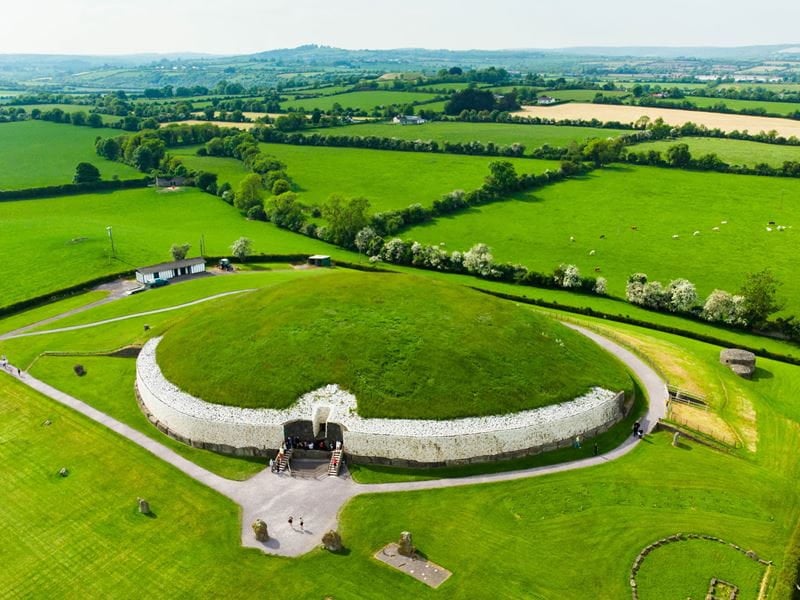
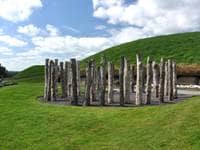
Newgrange (whose Irish name, An Liamh Greine, means “Cavern of the Sun”) is an ancient Neolithic burial mound and astrological temple. Typically dated to around 3,200 BCE, Newgrance—and its two sister mounds, Knowth and Dowth—predate the building of the Great Pyramids of Giza or Stonehenge by about 500 years. Prior to 1699, it was assumed to be nothing more than a large, kidney-shaped hill. However, it was accidentally discovered, and deemed to be an ancient burial site based on the charred human remains deposited within.
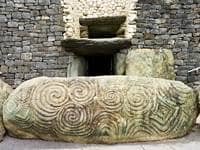
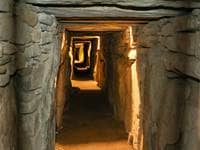
The hill covers approximately 1 acre and stands more than forty feet high. A tunnel extends into the center of the mound some 62-feet, until it reaches a chamber which is cruciform in shape, and which has a corbeled vaulted ceiling which is 23 feet high. The interior and exterior have carved into them a plethora of symbols. Evidence indicates that the internal chamber of this temple-tomb has remained watertight for an incomprehensible 5,200 years. Estimates suggest that the project would have taken 300 men some 20-years to create.
It is believed by some that the Beaker People (or the people of the Bell Beaker Culture) were the builders of this remarkable edifice. Others believe that these same people entered Ireland around 2,500 BEC and discovered the already extant but abandoned Newgrange and simply adopted it as their own. Part of the challenge of assuming that the burial mound-temple of Newgrange is Bell Beaker Culture in origin is the belief of many historians the Bell Beakers post-date Newgrange by no less than 400 years, and probably more like 700 years. Consequently, the builders of the mound may never be known. On the other hand, the fact that the same designs carved at Newgrange have also been found on the Mediterranean islands of Malta and Gonzo suggest that whoever build this remarkable temple-mound certainly “got around.”
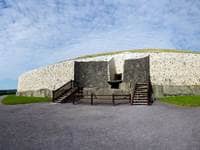
Newgrange has been referred to as a “place of astrological ritual.” There is no question, whoever the builders of this unique sacred structure were, they understood planetary alignment and felt a deep connection to it. As evidence of that, the mound is situated so perfectly that—for about a week before and after the winter solstice (December 21)—the entrance passage is perfectly aligned with the rising sun. As a consequence, during that approximately two-week window, a shaft of light (from the sun) penetrates the mound’s interior, traveling some 62-feet into the bowels of the temple-tomb, and casting sunlight directly on a stone decorated with carved spirals. Thus, the site marks the annual turning point in the sun’s cycle, and the beginning of the return of warmth, crops, and longer days. All evidence points to the belief that Newgrange was a temple used for solar veneration by whomever built it.
Religious Significance
Much like the Giza’s pyramids and Stonehenge’s monument, scholars do not all agree on the primary purpose of Newgrange. The idea that it was a burial site and also somehow associated with reverence for (or worship of) the sun, seems evident—by the bones found within, the mound’s alignment with the winter solstice sun, and the carving within and without the edifice. Thus, it is clear that those who built it felt like it was sacred, and that the rites or rituals performed therein somehow endowed them with power. But beyond that, many of the details are sketchy.
The plethora of spirals that appear inside and outside of the temple are believed to be symbolic representations of the sun. Indeed, from an arial view, the mound itself may have that same symbolic design. Because of the sun’s association with rebirth, some have conjectured that the temple-mound (specifically its central cavern with an opening and shaft leading to it) represents the womb of the earth. The light that enters the shaft and reaches the central chamber each winter solstice has been interpreted as a symbolic representation of the male sun god impregnating mother earth, causing the coming of spring and new life.
There are three stone basins in the branches of the cruciform central chamber. While not all agree on what these were used for, the most likely suggestion is for ritual washings for those participating in the temple’s rites. Secondarily, it is possible that they were used for washing the bodies of the deceased (whose bones have been discovered in the temple). Less likely is the theory that these basins were for the purpose of holding funerary offerings.
While Newgrange is not a “sacred space” in the sense of a modern Muslim mosque, Christian cathedral, or Hindu temple, nevertheless, this is definitely a site once held to be sacred to those who used it. It seems clear that its builders believed that the edifice could provoke the return of life lost during the winter months. It is clear that those who used it believed in a god (possibly Dagda) and in an afterlife of some sort. Newgrange has all of the earmarks of religion, prehistoric as it is. And it is clear that the ancients went to great lengths to sanctify this space, to offer it to their god as a temple, and to reverence and petition something higher than themselves in this sacred site. Those who visit Newgrange and know a bit of its history will find it hard to not “feel something” when walking around this once holy site.
Related
The Time I Visited The Underworld
Rock crystals: an ancient gateway to the healing spirit world

Water: the original shape-shifter and precursor of the ancient gods

Patheos Explore the world's faith through different perspectives on religion and spirituality! Patheos has the views of the prevalent religions and spiritualities of the world.
Ad-Free & Subscriber Log-In Subscription Support
- About Us
- 2026 Calendar
- Videos
- Podcasts
- Library of World Religions
- Faith In Media Tracker
- Advertise With Us
- Write for Us
- Privacy Policy
- Terms of Service
- Do Not Sell My Data
- Contact Us
- Radiant Digital
- Manage Newsletter Subscriptions
- Unsubscribe From Notifications
- Sitemap
Copyright 2008-2026, Patheos. All rights reserved.
Subscription Support Ad-Free & Subscriber Log-In
Follow Patheos