
BuddhistCatholicContemplativeEvangelicalGeneral ChristianHinduJewishLatter-day SaintMuslimNew VisionsProgressive Christian
Beliefs
- Buddhist
- Catholic
- Contemplative
- Evangelical
- General Christian
- Hindu
- Jewish
- Latter-day Saint
- More Voices
- Muslim
- New Visions
- Pagan
- Progressive Christian
Topics
- Religion News
- Food and Religion
- Sports and Religion
- Religious Art
- Religious Music and Entertainment
- Religious Events
- History and Religion
- Style and Religion
- Politics and Religion
- Women in Religion
- Recreation Outdoors and Religion
- Business Finance and Religion
- Careers Workplace and Religion
- Education and Religion
- Family Parenting and Religion
- Health Fitness and Religion
- Home and Religion
- Relationships and Religion
- Technology and Religion
- Travel and Religion
Columnists
- Buddhist Columnists
- Business Finance and Religion Columnists
- Careers Workplace and Religion Columnists
- Catholic Columnists
- Contemplative Columnists
- Education and Religion Columnists
- Evangelists Columnists
- Family Parenting and Religion Columnists
- General Christian Columnists
- Health Fitness and Religion Columnists
- Hindu Columnists
- History and Religion Columnists
- Home and Religion Columnists
- Jewish Columnists
- More Voices Columnists
- Latter Day Columnists
- Muslim Columnists
- New Visions Columnists
- Nonreligious Columnists
- Pagan Columnists
- Politics and Religion Columnists
- Progressive Columnists
- Recreation Outdoors and Religion Columnists
- Relationships and Religion Columnists
- Religion News Columnists
- Religious Art Columnists
- Religious Events Columnists
- Religious Music and Entertainment Columnists
- Sports and Religion Columnists
- Style and Religion Columnists
- Technology and Religion Columnists
- Travel and Religion Columnists
- Women in Religion Columnists
Resource Library
- 2026 Calendar
- Library of World Religions
- The 100 Most Holy Places on Earth
- Patheos Answers
- Podcasts
- Videos
- Faith Leaders Database
- Anglican Episcopalian
- Bahai
- Baptist
- Buddhism
- Christianity
- Confucianism
- Eastern Orthodoxy
- Hinduism
- Holiness and Pentecostal
- ISKCON
- Islam
- Judaism
- Lutheran
- Methodist
- The Church of Jesus Christ of Latter-day Saints
- New Age
- Paganism
- Presbytarian and Reformed
- Protestantism
- Religion Behind the Scenes
- Roman Catholic
- Scientology
- Shia Islam
- Sikhism
- Sufism
- Sunni Islam
- Taoism
- Zen
- See all religions
Research Tools
 Ad-Free & Subscriber Log-In Subscription Support
Ad-Free & Subscriber Log-In Subscription Support
Follow Patheos 

- Trending:
- Forgiveness
- |
- Marriage
- |
- Consciousness
- |
- Death Penalty
- |
- Election
- |
- Halloween
patheos presents

The 100 Most Holy Places On Earth
number
80
Naritasan Shinsho-ji
Chiba, Narita, Japan 


By Alonzo Gaskill | Updated: March 19, 2026 | Published: March 23, 2023
Associated Faiths:
Shingon Buddhism
Accessibility:
Open to visitors.
Annual Visitors: 10,000,000
History
Founded by Kanchō Daisōjō, the Narita-san Shinshō-ji Temple is a mid-10th century temple dedicated to Fudō Myō-ō, a central deity in Shingon Buddhism. More often known as Myō-ō Fudō (which means “immovable”), he is believed to have been “immovable” in his faith and commitment to Buddhism. The shrine houses (at its center) a statue of Myō-ō Fudō, said to have been carved by Kōbō Daishi, the founder of the Shingon Buddhist tradition (and spiritual master of the shrine’s founder).
The temple was built in order to commemorate the suppression of a revolt by samurai warriors from the Kantō region. In order to stop the rebels, Kōbō Daishi carved the statue of Myō-ō Fudō and then Kanchō Daisōjō engaged in three-week homa (or “sacred fire rituals”) in the hopes of thwarting the samurais’ success. Being a priest, Kanchō Daisōjō is said to have brought Kōbō Daishi’s statue to the battle. By the end of the battle, the image of the god had become so heavy that it could not be moved. Thus, the Narita-san Shinshō-ji Temple was built around the statue. The temple is sometimes called the “New Victory Temple” because it commemorates this victory over the samurai.
While the temple dates to 940 CE, and the statue is supposedly from that same era, historians do not believe that the image—which is sometimes displayed in the Main Hall—is any older than the 13th century. Of course, limitations placed on access to the statue prevent a more accurate dating of the statue. Nevertheless, its style has led many to assume that it is a more modern replacement of the original, which was likely damaged or destroyed at some point.
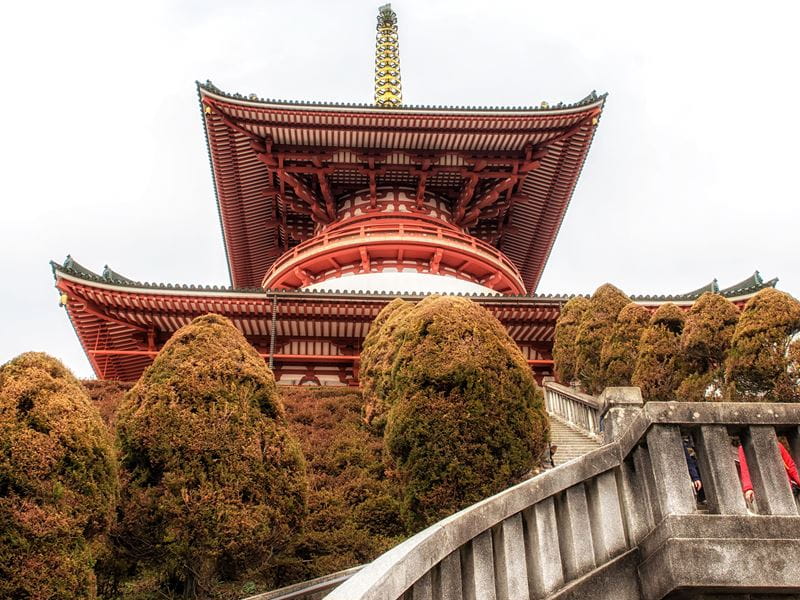
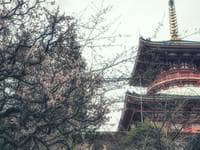
The Narita-san Shinshō-ji Temple complex houses numerous buildings. In addition to the main shrine, it has two “main halls”—the original and a more recently constructed one (dating to 1968). There is a three-story pagoda (built in 1701), and a tahōtō (or “many-jeweled”) eleven-story pagoda, typically referred to as the “Great Pagoda of Peace.” The complex also has a Shinto-influenced garden, which includes some European elements incorporated into it. There are other structures as well on the site.
The old Edo-period street which leads to the temple complex is called the “Omotesando” (meaning “front approach”)—and is a half-mile long road staring at the train station and leading to the temple. Lined with more than 150 restaurants and shops, it is both a popular tourist attraction and a pilgrimage path to this popular Buddhist temple.
Religious Significance
While not one of the most important temples in Buddhism, generally speaking, the Narita-san Shinshō-ji Temple is certainly the most important temple in the Chisan branch of Shingon Buddhism. Originally, Buddhist pagodas—like Roman Catholic and Eastern Orthodox churches—housed a relic and, thus, served as a “sacred space.” For some Buddhists, the relic—in whatever form it may be—holds the powers of the deceased holy person to whom the relic is attached. Thus, visits to a relic holding pagoda can activate the power of the deceased in the life of the believer. This is particularly true of the pagoda if somehow connected to a Buddha or a divine being (such as Myō-ō Fudō).
The New Victory Temple is a popular tourist attraction for locals because of its association with the successful overcoming of the attacking samurai warriors. But it is also a place of pilgrimage for practicing Buddhists—most particularly those of the Chisan branch of Shingon Buddhism. Not all Buddhists believe in a god (or gods). However, Shingon Buddhism does, and this specific temple houses an image of Myō-ō Fudō—the most significant of the Myō-ō class of Buddhist deities.
Myō-ō Fudō is a fierce looking deity, with a glaring, angry appearing face—depicted as such (according to some) because of his connection to destroying the samurai. Because of his daunting appearance, some believe that he has the power to “frighten” people into accepting the teachings of Buddhism. Others hold that his frightening appearance acts as a protection for the Buddha’s teachings, removing obstacles to enlightenment that practitioners might run up against. He is often depicted carrying what is called the “devil-subduing sword” (or kurikara). With it, he uses wisdom to destroy ignorance and transforms anger into salvation. Usually surrounded by flames, he has the power to purge the mind of unworthy, material, and false thoughts. He is often depicted as holding a rope in his hands with which he binds demons (for those humans who petition his aid to do so). He is said to have the power to force demons to surrender. He is also omniscient and is often depicted sitting upon a rock—symbolic of his unchanging immovability (as the name Myō-ō Fudō implies).
Though he is the god that Chisan sect Shingon Buddhists petition to overcome false belief, ignorance, and the influence of the devil—he has powers which go beyond that. He is often petitioned for financial success. And, as one of the thirteen deities of the Shingon tradition, he is also associated with death—being present at and presiding over funeral rites for those of that tradition.
Because of the popularity of this temple in Narita, large crowds often assemble there to participate in the various matsuri (or festivals)—pretty much every month other than March, June, and September. Additionally, temple “fairs” are held at the Narita-san Shinshō-ji Temple on the 1st, 15th, and 28th of each month. Each day, several wooden amulets are ceremonially burned in Goma fire rituals—which are believed to destroy desires and attachments (which the Buddha taught are at the root of suffering).
While Buddhist temples are common places of pilgrimage and meditation, the Narita-san Shinshō-ji Temple is in many ways unique as a “sacred space.” Because of the denomination it is associated with, it has a focus on a god, which is somewhat uncommon in other Buddhist traditions—particularly if compared to mainstream Theravada Buddhism. The focus on worship stands out, as do the fire rituals (which evidence some Hindu influence on this temple and its governing sect).
Related
Meeting Suffering With Gentleness
How to Handle our Internal Cookie Monster
How Are Buddhist Monastic Robes Made and Used
Bhante Subhūti
What is a Buddhist Church Called?
Kathleen Mulhern, PH.D.

Alonzo L. Gaskill
Patheos Explore the world's faith through different perspectives on religion and spirituality! Patheos has the views of the prevalent religions and spiritualities of the world.
Ad-Free & Subscriber Log-In Subscription Support
- About Us
- 2026 Calendar
- Videos
- Podcasts
- Library of World Religions
- Faith In Media Tracker
- Advertise With Us
- Write for Us
- Privacy Policy
- Terms of Service
- Do Not Sell My Data
- Contact Us
- Radiant Digital
- Manage Newsletter Subscriptions
- Unsubscribe From Notifications
- Sitemap
Copyright 2008-2026, Patheos. All rights reserved.
Subscription Support Ad-Free & Subscriber Log-In
Follow Patheos