
BuddhistCatholicContemplativeEvangelicalGeneral ChristianHinduJewishLatter-day SaintMuslimNew VisionsProgressive Christian
Beliefs
- Buddhist
- Catholic
- Contemplative
- Evangelical
- General Christian
- Hindu
- Jewish
- Latter-day Saint
- More Voices
- Muslim
- New Visions
- Pagan
- Progressive Christian
Topics
- Religion News
- Food and Religion
- Sports and Religion
- Religious Art
- Religious Music and Entertainment
- Religious Events
- History and Religion
- Style and Religion
- Politics and Religion
- Women in Religion
- Recreation Outdoors and Religion
- Business Finance and Religion
- Careers Workplace and Religion
- Education and Religion
- Family Parenting and Religion
- Health Fitness and Religion
- Home and Religion
- Relationships and Religion
- Technology and Religion
- Travel and Religion
Columnists
- Buddhist Columnists
- Business Finance and Religion Columnists
- Careers Workplace and Religion Columnists
- Catholic Columnists
- Contemplative Columnists
- Education and Religion Columnists
- Evangelists Columnists
- Family Parenting and Religion Columnists
- General Christian Columnists
- Health Fitness and Religion Columnists
- Hindu Columnists
- History and Religion Columnists
- Home and Religion Columnists
- Jewish Columnists
- More Voices Columnists
- Latter Day Columnists
- Muslim Columnists
- New Visions Columnists
- Nonreligious Columnists
- Pagan Columnists
- Politics and Religion Columnists
- Progressive Columnists
- Recreation Outdoors and Religion Columnists
- Relationships and Religion Columnists
- Religion News Columnists
- Religious Art Columnists
- Religious Events Columnists
- Religious Music and Entertainment Columnists
- Sports and Religion Columnists
- Style and Religion Columnists
- Technology and Religion Columnists
- Travel and Religion Columnists
- Women in Religion Columnists
Resource Library
- 2026 Calendar
- Library of World Religions
- The 100 Most Holy Places on Earth
- Patheos Answers
- Podcasts
- Videos
- Faith Leaders Database
- Anglican Episcopalian
- Bahai
- Baptist
- Buddhism
- Christianity
- Confucianism
- Eastern Orthodoxy
- Hinduism
- Holiness and Pentecostal
- ISKCON
- Islam
- Judaism
- Lutheran
- Methodist
- The Church of Jesus Christ of Latter-day Saints
- New Age
- Paganism
- Presbytarian and Reformed
- Protestantism
- Religion Behind the Scenes
- Roman Catholic
- Scientology
- Shia Islam
- Sikhism
- Sufism
- Sunni Islam
- Taoism
- Zen
- See all religions
Research Tools
 Ad-Free & Subscriber Log-In Subscription Support
Ad-Free & Subscriber Log-In Subscription Support
Follow Patheos 

- Trending:
- Forgiveness
- |
- Marriage
- |
- Consciousness
- |
- Death Penalty
- |
- Election
- |
- Halloween
patheos presents

The 100 Most Holy Places On Earth
number
67
Mont Saint-Michel
Normandy, France 


By Alonzo Gaskill | Updated: March 19, 2026 | Published: March 23, 2023


Also Known As:
Mont-Saint-Michel/Abbaye du Mont-Saint-Michel
Associated Faiths:
Roman Catholicism
Also frequented by Christians of other High and Low-Church traditions.
Accessibility:
Open to visitors.
Annual visitors: 2,500,000
History
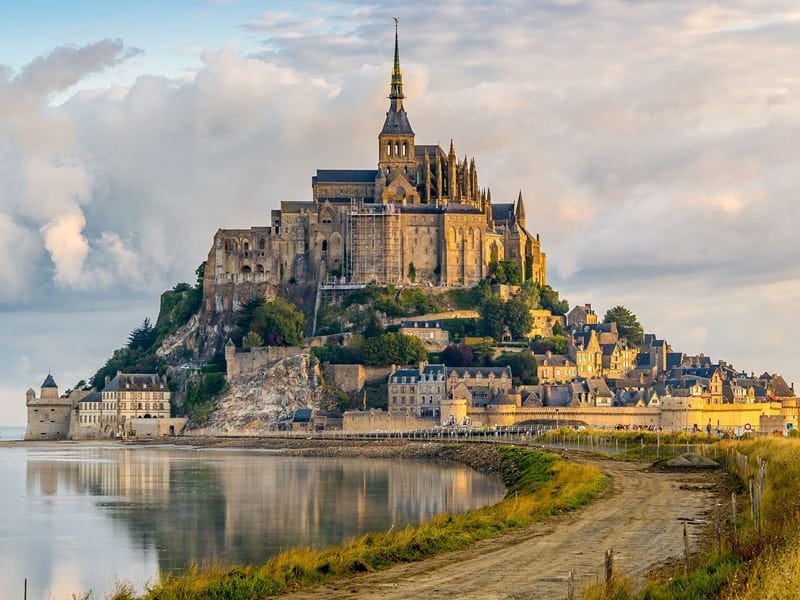
The Abbey of Mont-Saint-Michel is the most famous site on France’s Normandy coast. Inhabited at least as early as the early 6th century CE, and a place of pilgrimage since the 10th century, this small island of less than 2/3 of a mile has been a “sacred space” for more than a millennium. With only a few dozen permanent residents, today the once busy Abbey and island serve almost exclusively as a tourist destinations. As early as the 6th century, the island had two small private chapels (or oratories) and a handful of hermetic monks living in isolation on this rocky islet off the northern coast of France.
A priest from the mainland frequented the island to provide sacraments to the hermits who had taken up residence there. At the time, it was called Mont Tombe. In the early 8th century, Bishop Aubert of Avranches constructed a shrine to the Archangel Michael on the island, and its name was changed at that time to Mont-Saint-Michel. Then, in the first quarter of the 11th century, the construction of a larger Romanesque church was begun, replacing the earlier and smaller shrine. A fire destroyed the abbey early in the 13th century. Thus, a three-tiered complex known as La Merveille (or “The Marvel”) was added to the site as part of the reconstruction. A cloister and refectory were added.
However, the choir portion of the chancel collapsed and was thus reconstructed staring in 1446. As a result of the Protestant Reformation—which grew quickly in France during its early years—Catholicism and the Benedictine order that ran Mont-Saint-Michel lost their position of influence within the country. As a result, in 1789 (with the outbreak of the French Revolution), the church-abbey was stripped of is sacred status and was actually transformed into a prison. In 1863, no longer needed as a prison, the monastery as “officially” closed and became nothing more than a historical monument and tourist attraction.
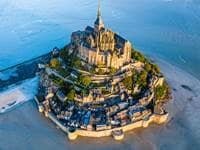
Access to the island was for centuries only by crossing a natural land bridge. Thus, when the tide came in, the land bridge was completely submerged. Amazingly, Mont-Saint-Michel has the highest and fastest tides in Europe, raising some 49 feet at high tide, and racing toward the shore at 210 feet per minute. As a result, prior to the building of a causeway to the island, many people lost their lives trying to make their way to or from the abbey-church, which is approximately two miles from France’s shore. While the abbey-church today is not the religious center that it once was—and though it probably draws way more tourists than it does pilgrims--nevertheless, currently the Monastic Communities of Jerusalem reside in the abbey and lead services each day of the week (other than Mondays). And, on September 29th (the Feast Day of St. Michael), thousands of pilgrims do come to Mont-Saint-Michel, often avoiding the causeway, instead wading through the muddy low-tide of this former functioning abbey-church.
Religious Significance
According to tradition, in 708 CE, Bishop Aubert of Avranches (now “Saint Aubert”) had a vision of the Archangel Michael, who commanded him to build a Church on the rocky isle of Mont Tombe. The bishop, perhaps doubting the genuineness of his own vision, ignored the command. Thus, St. Michael appeared to him again and, placing his thumb on the Bishop’s head, burned a hole in his skull. Convinced by this painful but miraculous happening, Bishop Aubert began construction of a shrine dedicated to his angelic visitant, and the rocky islet was renamed, Mont-Saint-Michel. Since the 10th century, pilgrims have made the difficult journey to this “sacred site,” petitioning St. Michael for help with whatever spiritual struggles they are having. For centuries, this sacred edifice—once referred to as “the most wonderful Gothic dwelling ever made for God upon this earth”—was a Benedictine monastery, with numerous monks dwelling, praying, studying, and working, as they devoted their entire existence to God.
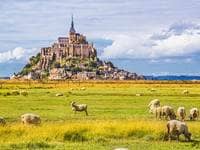
While such is no longer the case, the abbey-church of Mont-Saint-Michael is still majestic and inspiring. Sitting atop a granite island, in the midst of a natural blue pool, its majesty is as a castle from a fairytale, or as Sinai’s peak to which Moses climbed. Just looking at it from the French coast, one is inspired and has one’s thoughts and eyes directed heavenward. Its fortress like appearance seems appropriate, since it is dedicated to St. Michael, the “heavenly defender and guardian against Satan.” And, in the early years of its existence, pilgrims made their way to this holy site specifically to petition Michael to help them as they battled their demons and sought to overcome the world. While mostly a tourist attraction today, Mont-Saint-Michael is no less a sacred site. True, it was defiled during the French Revolution, and true it is that is no longer serves its once sacred monastic purpose.
However, as the Mass is celebrated within its walls each morning, and as the host is elevated while the priest consecrates the Body and Blood of Christ, the sacral nature of Mont-Saint-Michael returns daily to all who visit and to all who partake of the holy emblems of the sacrament of the Lord’s Supper. Just as this abbey-church survived her own defilement, she stands today as a reminder for all pilgrims that they too can overcome their own defilement—in whatever form that comes—and return to usefulness in the hands of God, as Mont-Saint-Michael has.
Related
How Low-Gluten Communion Wafers Get Made
What are the Cardinal Virtues in Catholicism?
Do Christians Believe in Evolution?
Alonzo L. Gaskill PH.D.
Why Do Christians Celebrate Good Friday?
What is Excommunication, and Who Gets Excommunicated?
Kathleen Mulhern, Ph.D.
How Are Christianity, Judaism, and Islam Connected?
Kathleen Mulhern, PH.D.
Kathleen Mulhern, PH.D.
Patheos Explore the world's faith through different perspectives on religion and spirituality! Patheos has the views of the prevalent religions and spiritualities of the world.
Ad-Free & Subscriber Log-In Subscription Support
- About Us
- 2026 Calendar
- Videos
- Podcasts
- Library of World Religions
- Faith In Media Tracker
- Advertise With Us
- Write for Us
- Privacy Policy
- Terms of Service
- Do Not Sell My Data
- Contact Us
- Radiant Digital
- Manage Newsletter Subscriptions
- Unsubscribe From Notifications
- Sitemap
Copyright 2008-2026, Patheos. All rights reserved.
Subscription Support Ad-Free & Subscriber Log-In
Follow Patheos