
BuddhistCatholicContemplativeEvangelicalGeneral ChristianHinduJewishLatter-day SaintMuslimNew VisionsProgressive Christian
Beliefs
- Buddhist
- Catholic
- Contemplative
- Evangelical
- General Christian
- Hindu
- Jewish
- Latter-day Saint
- More Voices
- Muslim
- New Visions
- Pagan
- Progressive Christian
Topics
- Religion News
- Food and Religion
- Sports and Religion
- Religious Art
- Religious Music and Entertainment
- Religious Events
- History and Religion
- Style and Religion
- Politics and Religion
- Women in Religion
- Recreation Outdoors and Religion
- Business Finance and Religion
- Careers Workplace and Religion
- Education and Religion
- Family Parenting and Religion
- Health Fitness and Religion
- Home and Religion
- Relationships and Religion
- Technology and Religion
- Travel and Religion
Columnists
- Buddhist Columnists
- Business Finance and Religion Columnists
- Careers Workplace and Religion Columnists
- Catholic Columnists
- Contemplative Columnists
- Education and Religion Columnists
- Evangelists Columnists
- Family Parenting and Religion Columnists
- General Christian Columnists
- Health Fitness and Religion Columnists
- Hindu Columnists
- History and Religion Columnists
- Home and Religion Columnists
- Jewish Columnists
- More Voices Columnists
- Latter Day Columnists
- Muslim Columnists
- New Visions Columnists
- Nonreligious Columnists
- Pagan Columnists
- Politics and Religion Columnists
- Progressive Columnists
- Recreation Outdoors and Religion Columnists
- Relationships and Religion Columnists
- Religion News Columnists
- Religious Art Columnists
- Religious Events Columnists
- Religious Music and Entertainment Columnists
- Sports and Religion Columnists
- Style and Religion Columnists
- Technology and Religion Columnists
- Travel and Religion Columnists
- Women in Religion Columnists
Resource Library
- 2026 Calendar
- Library of World Religions
- The 100 Most Holy Places on Earth
- Patheos Answers
- Podcasts
- Videos
- Faith Leaders Database
- Anglican Episcopalian
- Bahai
- Baptist
- Buddhism
- Christianity
- Confucianism
- Eastern Orthodoxy
- Hinduism
- Holiness and Pentecostal
- ISKCON
- Islam
- Judaism
- Lutheran
- Methodist
- The Church of Jesus Christ of Latter-day Saints
- New Age
- Paganism
- Presbytarian and Reformed
- Protestantism
- Religion Behind the Scenes
- Roman Catholic
- Scientology
- Shia Islam
- Sikhism
- Sufism
- Sunni Islam
- Taoism
- Zen
- See all religions
Research Tools
 Ad-Free & Subscriber Log-In Subscription Support
Ad-Free & Subscriber Log-In Subscription Support
Follow Patheos 

- Trending:
- Forgiveness
- |
- Marriage
- |
- Consciousness
- |
- Death Penalty
- |
- Election
- |
- Halloween
patheos presents

The 100 Most Holy Places On Earth
number
53
Meiji Jingu
Shibuya, Japan 


By Alonzo Gaskill | Updated: March 19, 2026 | Published: March 23, 2023
Associated Faiths:
Shinto
Also frequented by Buddhists, since (in Japan) it is often difficult to separate Buddhism and Shinto (many Japanese practicing both)
Accessibility:
Open to visitors. Ritual washing (at the temizuya or ablution pavilion) encouraged before entering.
Annual visitors: 3,000,000
History
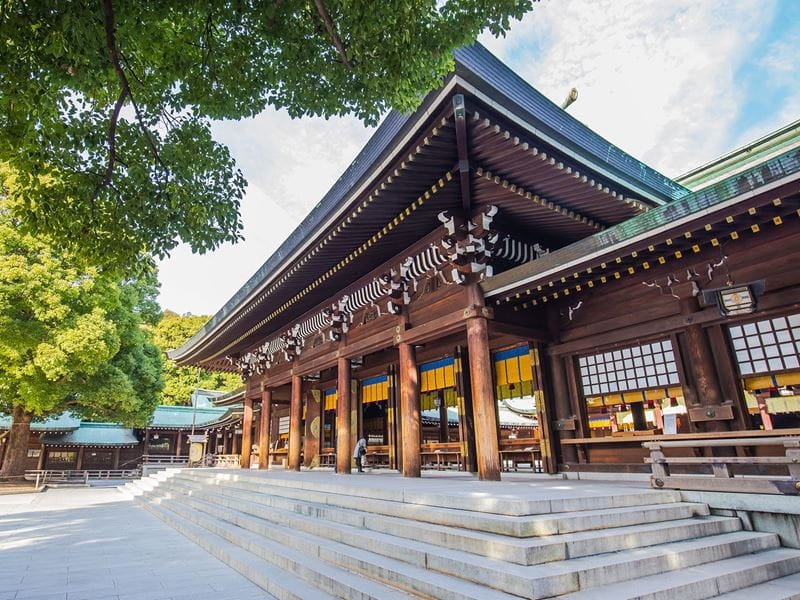
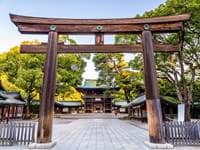
A chief doctrine of the Shinto tradition is the existence of kami—sometimes rendered as “spirits” or “gods”—which exist everywhere around us. kami can be “spirits” associated with nature (like kami of the trees or water). The kami can also be deceased members of one’s clan or family (who may preside over the family from the “other side,” blessing or correcting its members based on how they are living). And kami can be deified famed Japanese (such as deceased war heroes or political leaders). The Meiji shrine falls into this latter category. While it is not a tomb (containing remains), it is a shrine built to the memory of Japan’s former emperor, Meiji, and his wife, Empress Shōken—both of which practitioners believe have been deified.
Emperor Meiji is important in Japanese history because he is associated with what is typically referred to as the “Meiji Restoration” or the “Honorable Restoration.” Emperor Meiji restored functional imperial rule to Japan, meaning that while there had been emperors in the past, their powers were limited and, in some ways, their reign was more symbolic that powerful. Among the many changes that the “Honorable Restoration” brought was the industrialization of Japan, which included embracing many Western methods of production.
After the death of the emperor, Japan’s national legislature passed a resolution commemorating his role in the “Restoration” and the advancement of Japan. A shrine was built (in memory of the Emperor and Empress) in a garden formerly frequented by the royal couple. It was completed in 1921, and its grounds in 1926. That building was destroyed by air raids during World War II. Its replacement, which is the shrine that stands on the spot today, was completed in 1956.
The shrine is a popular attraction for tourists, residents, and even foreign dignitaries. While it contains articles belonging to the former Emperor and Empress, and nearly 100 murals depicting various events in their lives, the complex also contains a forest, sports facilities and stadiums, a Shinto wedding hall, and even restaurants. A popular site for the commemoration of matsuri (or Shinto festivals), millions visit the shrine complex each year.
Religious Significance
In Shinto tradition, it is believed that nearly everything has a kami (i.e., a “spirit” or “god”) in it. Trees, rocks, bodies of water, material possessions, and even people and nations, have kami associated with them or dwelling within them. They kami can bless or punish, based on their domain and the behavior of the people. For example, water kami are restricted to the water, but can bless the people of Japan with sufficient water for healthy crops (if the people have been good), or with floods or a tsunami (if the people have been bad). Thus, believers in the teachings of Shinto believe it is important to keep the kami happy. Making offerings, participating in the matsuri (or festivals), praising the kami—these and other behaviors please the kami and keep the people and nation blessed.
In the case of Japan’s former emperor and his wife, in Shinto, they are believed to have become deified. They now are kami whose responsibility is to watch over the nation of Japan; to keep it safe and prosperous. Thus, practitioners of Shinto might visit the Meiji Shrine to make offerings to the deceased emperor and empress, to pray to them, and to request special favors at their hands—on behalf of the nation or on behalf of oneself.
The Meiji Shrine constitutes “sacred space” in that it is believed to be a place where spirits or kami are intensely present and, in the case of this specific shrine, the spirits of two of the country’s most revered past leaders. Thus, the site is holy because their spirits are there, and their powers (on behalf of the nation and people of Japan) are accessible there, by practitioners visiting, petitioning them, and appeasing them (through offerings and also through making commitments to the deified emperor and empress). Thus, for those who believe, this is hallowed ground with living spirits that watch over the nation, and which can be contacted at and through this sacred shrine.
Related

How Tall Was Goliath? The Truth Revealed!

Christians Are Called To Resist Authoritarianism In America
The Demonization of the Catholic Church
Pope Leo Denounces "Christian Nationalism"

Palestinians in Gaza Are Uprising Against Hamas

God’s Answer to, “Why Don’t You Do Something About Evil?”
Why Christ’s Ascension is Greater Than the Resurrection

Christian Comic Reviewed: Analyzing Themes, Art, and Impact
What’s the Christian Response to the Current Culture?

Dear America: Do You Like What We've Become?
Patheos Explore the world's faith through different perspectives on religion and spirituality! Patheos has the views of the prevalent religions and spiritualities of the world.
Ad-Free & Subscriber Log-In Subscription Support
- About Us
- 2026 Calendar
- Videos
- Podcasts
- Library of World Religions
- Faith In Media Tracker
- Advertise With Us
- Write for Us
- Privacy Policy
- Terms of Service
- Do Not Sell My Data
- Contact Us
- Radiant Digital
- Manage Newsletter Subscriptions
- Unsubscribe From Notifications
- Sitemap
Copyright 2008-2026, Patheos. All rights reserved.
Subscription Support Ad-Free & Subscriber Log-In
Follow Patheos