
BuddhistCatholicContemplativeEvangelicalGeneral ChristianHinduJewishLatter-day SaintMuslimNew VisionsProgressive Christian
Beliefs
- Buddhist
- Catholic
- Contemplative
- Evangelical
- General Christian
- Hindu
- Jewish
- Latter-day Saint
- More Voices
- Muslim
- New Visions
- Pagan
- Progressive Christian
Topics
- Religion News
- Food and Religion
- Sports and Religion
- Religious Art
- Religious Music and Entertainment
- Religious Events
- History and Religion
- Style and Religion
- Politics and Religion
- Women in Religion
- Recreation Outdoors and Religion
- Business Finance and Religion
- Careers Workplace and Religion
- Education and Religion
- Family Parenting and Religion
- Health Fitness and Religion
- Home and Religion
- Relationships and Religion
- Technology and Religion
- Travel and Religion
Columnists
- Buddhist Columnists
- Business Finance and Religion Columnists
- Careers Workplace and Religion Columnists
- Catholic Columnists
- Contemplative Columnists
- Education and Religion Columnists
- Evangelists Columnists
- Family Parenting and Religion Columnists
- General Christian Columnists
- Health Fitness and Religion Columnists
- Hindu Columnists
- History and Religion Columnists
- Home and Religion Columnists
- Jewish Columnists
- More Voices Columnists
- Latter Day Columnists
- Muslim Columnists
- New Visions Columnists
- Nonreligious Columnists
- Pagan Columnists
- Politics and Religion Columnists
- Progressive Columnists
- Recreation Outdoors and Religion Columnists
- Relationships and Religion Columnists
- Religion News Columnists
- Religious Art Columnists
- Religious Events Columnists
- Religious Music and Entertainment Columnists
- Sports and Religion Columnists
- Style and Religion Columnists
- Technology and Religion Columnists
- Travel and Religion Columnists
- Women in Religion Columnists
Resource Library
- 2026 Calendar
- Library of World Religions
- The 100 Most Holy Places on Earth
- Patheos Answers
- Podcasts
- Videos
- Faith Leaders Database
- Anglican Episcopalian
- Bahai
- Baptist
- Buddhism
- Christianity
- Confucianism
- Eastern Orthodoxy
- Hinduism
- Holiness and Pentecostal
- ISKCON
- Islam
- Judaism
- Lutheran
- Methodist
- The Church of Jesus Christ of Latter-day Saints
- New Age
- Paganism
- Presbytarian and Reformed
- Protestantism
- Religion Behind the Scenes
- Roman Catholic
- Scientology
- Shia Islam
- Sikhism
- Sufism
- Sunni Islam
- Taoism
- Zen
- See all religions
Research Tools
 Ad-Free & Subscriber Log-In Subscription Support
Ad-Free & Subscriber Log-In Subscription Support
Follow Patheos 

- Trending:
- Forgiveness
- |
- Marriage
- |
- Consciousness
- |
- Death Penalty
- |
- Election
- |
- Halloween
patheos presents

The 100 Most Holy Places On Earth
number
52
Međugorje
Bosnia & Herzegovina 


By Alonzo Gaskill | Updated: March 19, 2026 | Published: March 23, 2023

Associated Faiths:
Roman Catholicism
Also frequented by Christians of other High and Low-Church traditions.
Accessibility:
Open to visitors.
Annual visitors: 1,000,000
History
The name Medjugorje means “between mountains.” Located in the former Communist country of Yugoslavia (now Bosnia and Herzegovina), Medjugorje rests just east of Croatia’s border. This Roman Catholic pilgrimage site is quite new, having only been a popular place of gathering for Catholics since the early 1980s.
In June of 1981, six children (ranging in age from 10 to 16) claimed to have several visions of the Virgin Mary. After the initial visions, others too claimed to see the Mother of the Son of God (often referred to as “Our Lady of Medjugorje” in Bosnia and Herzegovina). For example, one Catholic woman (Mirjana Soldo Dragičević) claims that the Virgin gives her a message on the 2nd of each month, and another woman in the area (Marija Lunetti Pavlović) claims that Mary appears to her on the 25th of every month. While Pope Francis suggested (in 2017) that he thought the original visions of the six children (back in 1981) might have merit, he expressed the “dubious value” of the other supposed Marian apparitions said to have been had by various people living in the area. Nevertheless, Catholics living in the area continue to claim that Mary regularly appears in Medjugorje.
At the time of the first visions of the Madona, the Roman Catholic bishop over the area (Bishop Pavao Žanić) was inclined to believe the claims about the visitations of Mary. However, in time he came to believe that the apparitions were most like a fabrication designed to damage his reputation and his authority over the diocese. Amid the tug-of-war over whether the supposed visions were real or made up, Bishop Žanić called for the cessation of pilgrimages to Medjugorje and the Vatican initially supported him in this decision. In 1991, the Yugoslav Bishops’ Conference also questioned the supposed visions, suggesting they could not be validated. For the next 28 years the visions continued, but so did the Church’s hesitancy to officially validate the apparitions. However, in 2019, the Vatican indicated that pilgrimages to Medjugorje are “authorized,” implying support for the validity of the visitations. Indeed, the 2019 Catholic Youth Festival (August 2-6), held in Medjugorje, brought together approximately 60,000 youth from around the world and also more than 700 priests. Based on this, it seems evident what the Church’s current position is on Our Lady of Medjugorje.
Religious Significance
Marian apparitions have always drawn attention and heightened devotion among Roman Catholics. While Pope Clement IV (AD 1265-1268) showed the first signs of Marian devotion, it wasn’t until Pope Pius X (1846-1878) that Mariology—as we know it today—was officially declared. This evolution in focus on Mary made the 1981 events of Medjugorje all the more inspiring and sacred for Roman Catholics throughout the world—and particularly for those who live in the former Yugoslavia.
While there are many things which some consider as constituting “sacred space,” the appearance of God, Christ, or an angel, are among the most significant. Any spot at which a divine being has appeared, of necessity is hallowed by that apparition, and becomes instantly sacred to believers. This is evidenced by the Medjugorje visions. Overnight, and without “proof” or the “approval” of the Church, that which had been a Communist country (fairly unfriendly to religion) was instantly turned into a sacral site and a government supported tourist attraction.
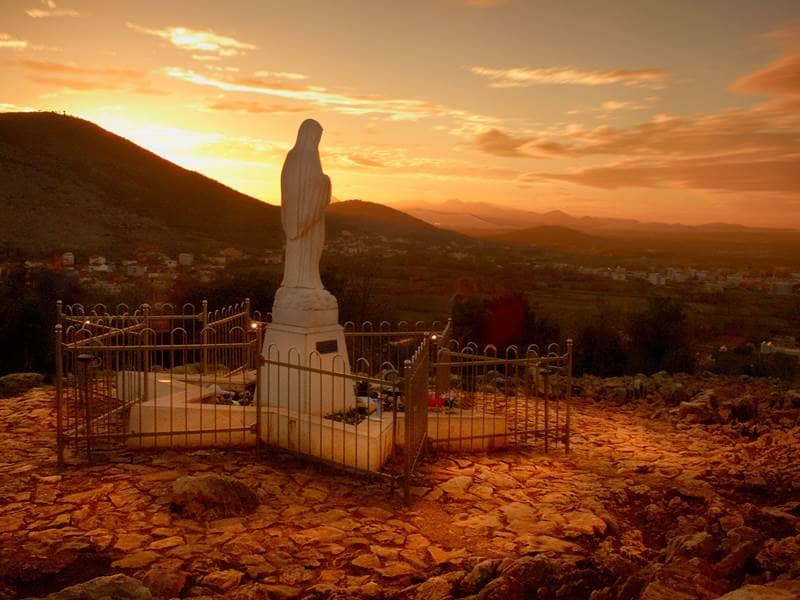
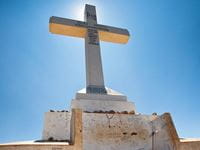
In addition to the Marian visions in the area, and the statue of the Virgin (at Podbrdo) which marks the spot of the first of the apparitions, Medjugorje is also the home to the “Cross at Križevac Hill.” In honor of the 1,900th anniversary of Jesus’ crucifixion, Pope Pius XI encouraged Roman Catholics worldwide to erect crosses in conspicuous places, such as prominent hills or mountains. Thus, in 1933, a massive fifteen-ton 33-foot-tall cross was built by local Catholics atop the 1,770-foot peak of “Mount Sipovac.” (Once the cross was erected the locals changed the hill’s name to “Mount Krizevac,” meaning “Mount of the Cross.”) This massive Christian symbol gives an air of holiness to the town, reminding visitors and residents alike of the “sacred space” which Medjugorje is.
Another thing to develop because of the apparitions believed to have happen in Medjugorje is “The Peace Rosary” (sometimes called the “Peace Chaplet of Medjugorje”). It is a form of Rosary beads specifically tied to Medjugorje’s miracles. Users of the special Rosary are encouraged to petition God seven times each day, praying the “Our Father,” the “Hail Mary,” the “Glory be to the Father,” and the “I believe in God” prayers. Medjugorje’s special Rosary helps facilitate this because it consists of 1 + 7 x 3 beads, with a cross or medal at the bottom—making it somewhat different from a traditional Roman Catholic Rosary.
There are historians who believe that, whether one believes in the Medjugorje Marian apparitions or not, the claims that Mary was appearing there may have played a role in the eventual demise of the former USSR. There is certainly no question that, just as communism sought to stomp out religion, the early 1980s appearances of the Virgin Mary to believers in Medjugorje breathed a life into the Church and into Eastern-Block Christians. Talk of those spiritual manifestations threatened the grip and viability of Soviet Communism. Some think that was the message of Mary’s various visitations to communist controlled Christians in the 1980s.
Related
What Do Catholics Believe About Death and the Afterlife?
What Do Catholics Believe About Purgatory?

How Tall Was Goliath? The Truth Revealed!

Christians Are Called To Resist Authoritarianism In America
The Demonization of the Catholic Church
Pope Leo Denounces "Christian Nationalism"
Palestinians in Gaza Are Uprising Against Hamas

God’s Answer to, “Why Don’t You Do Something About Evil?”
Why Christ’s Ascension is Greater Than the Resurrection

Christian Comic Reviewed: Analyzing Themes, Art, and Impact
What’s the Christian Response to the Current Culture?

Dear America: Do You Like What We've Become?
Patheos Explore the world's faith through different perspectives on religion and spirituality! Patheos has the views of the prevalent religions and spiritualities of the world.
Ad-Free & Subscriber Log-In Subscription Support
- About Us
- 2026 Calendar
- Videos
- Podcasts
- Library of World Religions
- Faith In Media Tracker
- Advertise With Us
- Write for Us
- Privacy Policy
- Terms of Service
- Do Not Sell My Data
- Contact Us
- Radiant Digital
- Manage Newsletter Subscriptions
- Unsubscribe From Notifications
- Sitemap
Copyright 2008-2026, Patheos. All rights reserved.
Subscription Support Ad-Free & Subscriber Log-In
Follow Patheos