
BuddhistCatholicContemplativeEvangelicalGeneral ChristianHinduJewishLatter-day SaintMuslimNew VisionsProgressive Christian
Beliefs
- Buddhist
- Catholic
- Contemplative
- Evangelical
- General Christian
- Hindu
- Jewish
- Latter-day Saint
- More Voices
- Muslim
- New Visions
- Pagan
- Progressive Christian
Topics
- Religion News
- Food and Religion
- Sports and Religion
- Religious Art
- Religious Music and Entertainment
- Religious Events
- History and Religion
- Style and Religion
- Politics and Religion
- Women in Religion
- Recreation Outdoors and Religion
- Business Finance and Religion
- Careers Workplace and Religion
- Education and Religion
- Family Parenting and Religion
- Health Fitness and Religion
- Home and Religion
- Relationships and Religion
- Technology and Religion
- Travel and Religion
Columnists
- Buddhist Columnists
- Business Finance and Religion Columnists
- Careers Workplace and Religion Columnists
- Catholic Columnists
- Contemplative Columnists
- Education and Religion Columnists
- Evangelists Columnists
- Family Parenting and Religion Columnists
- General Christian Columnists
- Health Fitness and Religion Columnists
- Hindu Columnists
- History and Religion Columnists
- Home and Religion Columnists
- Jewish Columnists
- More Voices Columnists
- Latter Day Columnists
- Muslim Columnists
- New Visions Columnists
- Nonreligious Columnists
- Pagan Columnists
- Politics and Religion Columnists
- Progressive Columnists
- Recreation Outdoors and Religion Columnists
- Relationships and Religion Columnists
- Religion News Columnists
- Religious Art Columnists
- Religious Events Columnists
- Religious Music and Entertainment Columnists
- Sports and Religion Columnists
- Style and Religion Columnists
- Technology and Religion Columnists
- Travel and Religion Columnists
- Women in Religion Columnists
Resource Library
- 2026 Calendar
- Library of World Religions
- The 100 Most Holy Places on Earth
- Patheos Answers
- Podcasts
- Videos
- Faith Leaders Database
- Anglican Episcopalian
- Bahai
- Baptist
- Buddhism
- Christianity
- Confucianism
- Eastern Orthodoxy
- Hinduism
- Holiness and Pentecostal
- ISKCON
- Islam
- Judaism
- Lutheran
- Methodist
- The Church of Jesus Christ of Latter-day Saints
- New Age
- Paganism
- Presbytarian and Reformed
- Protestantism
- Religion Behind the Scenes
- Roman Catholic
- Scientology
- Shia Islam
- Sikhism
- Sufism
- Sunni Islam
- Taoism
- Zen
- See all religions
Research Tools
 Ad-Free & Subscriber Log-In Subscription Support
Ad-Free & Subscriber Log-In Subscription Support
Follow Patheos 

- Trending:
- Forgiveness
- |
- Marriage
- |
- Consciousness
- |
- Death Penalty
- |
- Election
- |
- Halloween
patheos presents

The 100 Most Holy Places On Earth
number
9
Mahabodhi Temple
Gaya District, India 


By Alonzo Gaskill | Updated: March 19, 2026 | Published: March 23, 2023
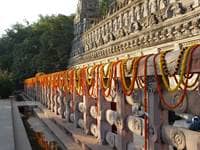
Also Known As:
Bodh Gaya
Bodhgaya
Mahabodhi Temple Complex
Associated Faiths:
Buddhism
To a lesser extent, Hindusim
Accessibility:
Open to visitors. Shoulders should be covered, and long pants should be worn.
Annual visitors: 4,000,000
History
Bodh Gaya is the site of the 12-acre Mahabodhi Temple Complex. It is also the location at which tradition claims (some 2,500 hundred years ago) Sidhartha Gautama—the Buddha—achieved enlightenment, while sitting under a bodhi tree. While the tree located on the site today is not the original tree under which Buddhists believe Sidhartha sat, it is claimed to be a “descendant” of that original tree. Legend has it that the wife of Ashoka, India’s first Buddhist ruler, destroyed the original tree because she was upset at the amount of time her husband spent at the tree (out of his devotion to the Buddha).
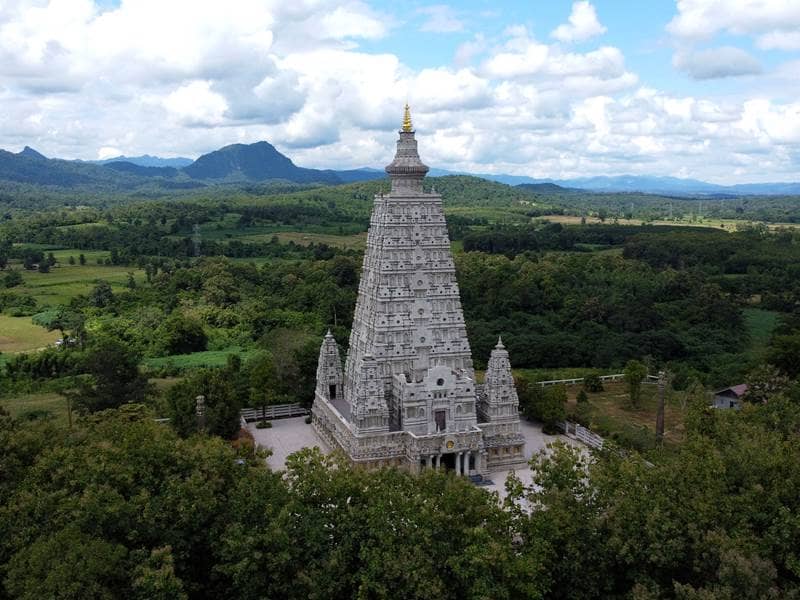
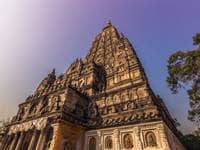
As the first Buddhist emperor, Ashoka built the initial temple erected on this site. It was constructed in the 3rd century BCE. However, the current Mahabodhi Temple is of much later origin. It dates to somewhere around the 5th century CE, possibly earlier. It is one of the oldest brick Buddhist temples still standing anywhere in the world.
This site has long been considered sacred by both Hindus and Buddhists. However, for more than two millennia, the site was under the control of Hindus. Indeed, when one visits the site today, one finds prominently displayed in front of the tree what has been described as “a small altar, bearing images of Hindu gods.” Thus, no less than seven Hindu figures are depicted in stone in front of the tree. However, because the Buddha is more central to the Buddhist tradition than the Hindu tradition, in 1891 the “Mahabodhi Society” was founded in an effort to regain Buddhist control of the site.
Emperor Ashoka is said to have erected a pillar near the tree (in the third century BCE)—a sort of memorial to the significance of the site. In the centuries to follow, a wall was constructed around that pillar and, from there, a small temple was erected within the enclosure. That temple was expanded, taking its current form in the second century CE. However, sometime after the eleventh century, it was neglected and began to deteriorate. Thus, in 1882, Burmese Buddhists rebuilt the temple in the form that it stands currently.
Religious Significance
Because Sidhartha is traditionally seen as the “founder” of Buddhism, Bodh Gaya has been called “the most sacred Buddhist shrine” in the entire world. However, because Hinduism teaches that Sidhartha Gautama was the 9th avatar or incarnation of Vishnu, Bodh Gaya is also a sacred site in Hinduism—often called the “second holiest city after Varanasi.” Devotees of both Hinduism and Buddhism regularly make pilgrimages to this location.
This site is particularly holy because of the events which are traditionally believed to have transpired there. For Buddhist, the lost understanding of how to achieve enlightenment, the forgotten path to Nirvana, were rediscovered on this very spot in the 6th century BCE. As a consequence, many would hold that there can be no more hallowed location on the face of the planet. The very purpose of mortality, according to Buddhist thinking, was revealed at the site of the bodhi tree in Bodh Gaya. Consequently, all subsequent experiences of enlightenment tie back to this very spot and the events which took place there more than 2,500 years ago.
For many practitioners of Buddhism, Bodh Gaya’s ancient bodhi tree and associated Mahabodhi Temple (or “Great Awakening Temple”) are the exact center of the world and the very place at which all true Buddhas attain their enlightenment or awakening. Thus, for those earnestly seeking Samadhi and release from the cycle of rebirths, a pilgrimage to Bodh Gaya seems almost requisite. It is for this very reason that, approximately 300 years after the Buddha’s enlightenment, Emperor Ashoka made his own pilgrimage to the site.
There are numerous components to the Complex which draw tourists and seekers of enlightenment, including the various votive stupas, three monasteries, the lotus pond, and the on-site museum (which contains to ancient relics associated with the site). However, the most important things pilgrims come to see at the Temple Complex are the 164-foot tall Mahabodhi Temple itself, the Vajrasana (or throne of enlightenment, marking the spot where the Buddha sat when he achieved enlightenment), and the bodhi tree—a direct descendant of the original tree he is said to have sat under while seeking “bodhi” (or a spiritually awakened state). For practicing Buddhists, these are spiritually provocative sites which flood the practitioner with emotions and spiritual motivation.
Certainly, for those of Buddhist and Hindu traditions, and for those who are inquisitive in other traditions, visiting Bodh Gaya and its Mahabodhi Temple complex is a powerful and impactful experience. However, whether one is a Buddhist, Hindu, or practitioner of one of the non-Dharmic religions, if you know anything about the life and teachings of the Buddha, a trip to Bodh Gaya can be an impactful experience. Visiting the site where one of the most spiritually enlightened humans ever to exist once walked the earth can provoke both introspection and a sense of awe. Thus, it is a “sacred site” for any openminded and contemplative soul.
Related
Video of Dalai Lama Asking a Child to Suck His Tongue is a Cry for Torah
Is "Jewish" a Race or Religion?



How to Prepare a Zen Dharma Talk: Thirteen Points
Movie on Neem Karoli Baba’s life is a miraculous success

The History of Budai, the Laughing Buddha
Spiritual Long Beach: The Catholic Shrine to Mary Cared for by Buddhist Monks
Patheos Explore the world's faith through different perspectives on religion and spirituality! Patheos has the views of the prevalent religions and spiritualities of the world.
Ad-Free & Subscriber Log-In Subscription Support
- About Us
- 2026 Calendar
- Videos
- Podcasts
- Library of World Religions
- Faith In Media Tracker
- Advertise With Us
- Write for Us
- Privacy Policy
- Terms of Service
- Do Not Sell My Data
- Contact Us
- Radiant Digital
- Manage Newsletter Subscriptions
- Unsubscribe From Notifications
- Sitemap
Copyright 2008-2026, Patheos. All rights reserved.
Subscription Support Ad-Free & Subscriber Log-In
Follow Patheos