
BuddhistCatholicContemplativeEvangelicalGeneral ChristianHinduJewishLatter-day SaintMuslimNew VisionsProgressive Christian
Beliefs
- Buddhist
- Catholic
- Contemplative
- Evangelical
- General Christian
- Hindu
- Jewish
- Latter-day Saint
- More Voices
- Muslim
- New Visions
- Pagan
- Progressive Christian
Topics
- Religion News
- Food and Religion
- Sports and Religion
- Religious Art
- Religious Music and Entertainment
- Religious Events
- History and Religion
- Style and Religion
- Politics and Religion
- Women in Religion
- Recreation Outdoors and Religion
- Business Finance and Religion
- Careers Workplace and Religion
- Education and Religion
- Family Parenting and Religion
- Health Fitness and Religion
- Home and Religion
- Relationships and Religion
- Technology and Religion
- Travel and Religion
Columnists
- Buddhist Columnists
- Business Finance and Religion Columnists
- Careers Workplace and Religion Columnists
- Catholic Columnists
- Contemplative Columnists
- Education and Religion Columnists
- Evangelists Columnists
- Family Parenting and Religion Columnists
- General Christian Columnists
- Health Fitness and Religion Columnists
- Hindu Columnists
- History and Religion Columnists
- Home and Religion Columnists
- Jewish Columnists
- More Voices Columnists
- Latter Day Columnists
- Muslim Columnists
- New Visions Columnists
- Nonreligious Columnists
- Pagan Columnists
- Politics and Religion Columnists
- Progressive Columnists
- Recreation Outdoors and Religion Columnists
- Relationships and Religion Columnists
- Religion News Columnists
- Religious Art Columnists
- Religious Events Columnists
- Religious Music and Entertainment Columnists
- Sports and Religion Columnists
- Style and Religion Columnists
- Technology and Religion Columnists
- Travel and Religion Columnists
- Women in Religion Columnists
Resource Library
- 2026 Calendar
- Library of World Religions
- The 100 Most Holy Places on Earth
- Patheos Answers
- Podcasts
- Videos
- Faith Leaders Database
- Anglican Episcopalian
- Bahai
- Baptist
- Buddhism
- Christianity
- Confucianism
- Eastern Orthodoxy
- Hinduism
- Holiness and Pentecostal
- ISKCON
- Islam
- Judaism
- Lutheran
- Methodist
- The Church of Jesus Christ of Latter-day Saints
- New Age
- Paganism
- Presbytarian and Reformed
- Protestantism
- Religion Behind the Scenes
- Roman Catholic
- Scientology
- Shia Islam
- Sikhism
- Sufism
- Sunni Islam
- Taoism
- Zen
- See all religions
Research Tools
 Ad-Free & Subscriber Log-In Subscription Support
Ad-Free & Subscriber Log-In Subscription Support
Follow Patheos 

- Trending:
- Forgiveness
- |
- Marriage
- |
- Consciousness
- |
- Death Penalty
- |
- Election
- |
- Halloween
patheos presents

The 100 Most Holy Places On Earth
number
30
Lotus Temple
Delhi, India 


By Alonzo Gaskill | Updated: March 19, 2026 | Published: March 23, 2023
Associated Faiths:
Baháʼí
While it does draw some from traditions outside of the Baháʼí faith, most non-Baháʼís who visit are either non-religious tourists, practitioners of one of the dharmic tradition, or new-age Christians
Accessibility:
Open to visitors.
Annual visitors: 3,700,000
History
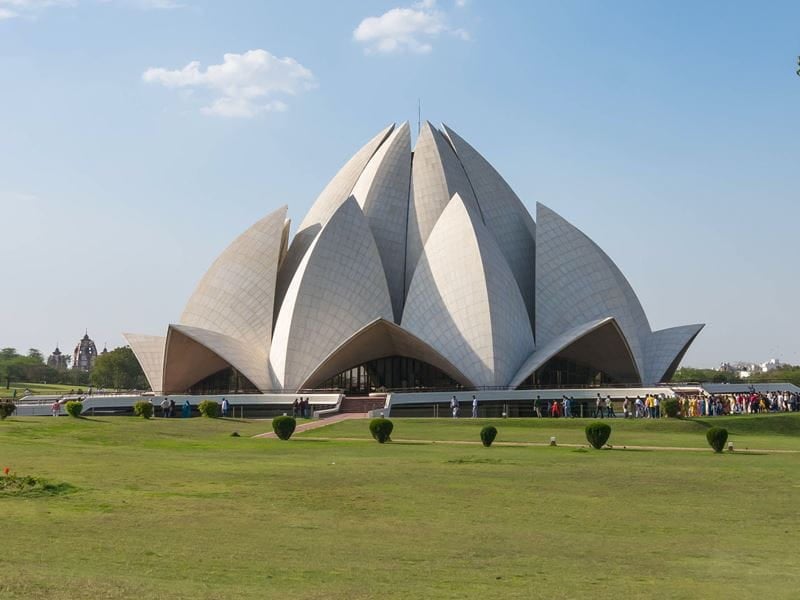
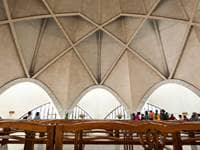
The Lotus Temple in Delhi, India is a Baháʼí house of worship dedicated in 1986, and one of the jewels of Delhi’s architectural landscape. Amazingly, the bulk of the cost to build this 10-million-dollar temple was donated by Ardishír Rustampúr, an affluent resident of Hyderabad, Pakistan and a practitioner of the Baháʼí faith. Rustampúr instructed that, upon his death, his entire fortune should go to build this temple. While the temple is not dedicated to Rustampúr, it certainly stands as a memorial to his generosity and his faith in Baháʼí and its teachings.
The temple itself was designed to look like a lotus flower, largely because of that plant’s symbolism and association with, among other things, unity. The Baháʼí faith is open to all truth and embraces all truth—seeking an eventual unification of all faiths, governments, and wisdom. Thus, like all Baháʼí houses of worship, Delhi’s Lotus Temple is open to anyone from any tradition—and all are welcomed to gather therein, to meditate, reflect, and worship. Baháʼís traditionally accept the validity of the holy books of other religious traditions. Thus, visitors are allowed to read or chant in the temple (though the reading of non-canonical or non-scriptural texts is forbidden within the sacred edifice).
While choral music drawn from the scriptural texts or prayers of various religious traditions is allowed in the Lotus Temple, musical instruments are not. The Baháʼí faith does not demand any particular form or style of worship though, in the Temple, sacraments are not performed, and ritualistic ceremonies are also considered inappropriate for that sacred space.
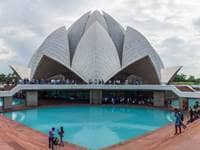
The traditional symbol of the Baháʼí faith is the nine-pointed star, which represents “completement” and the “fulfillment” of the intentions and design of all previous religious traditions (which have led to the founding of Baháʼí). Thus, the Lotus Temple (in Delhi) is composed of 27 free-standing marble clad panels which represent lotus petals. These “petals” are arranged in groupings of three to form a nine-sided building—the number nine being a feature of all Baháʼí temples, and a representation of the aforementioned belief that Baháʼí is the total fulfillment of all God has revealed through the various religions which came prior to Baháʼí.
The marble used for the surface of the Lotus Temple is a white marble from Greece. It is the same marble that was used in the construction of the ancient Parthenon (or Athenian Temple). However, as with so many white or light-colored buildings in India, the intense pollution has taken its toll on the building—which has turned grey and yellow as a result.
While CNN was likely wrong in its 2001 claim that the Lotus Temple was the “most visited building in the world,” nevertheless, millions visit it every year. It is certainly one of the “most visited” of all “sacred sites.” As many as 100,000 pilgrims, worshipers, and curious tourists come to the temple on any given Hindu holiday.
Religious Significance
The lotus flower has long been a symbol (in numerous dharmic traditions, among others) of both purity and enlightenment. For practitioners of Baháʼí, it is also a symbol of the divine, who is pure and enlightened. Because so many of the religions in India use the lotus as a symbol associated with their tradition, this emblem acts as a unifier between the various faith traditions—something that is an ultimate goal for the Baháʼí tradition (namely, the eventual unification of all religions).
It has been said that the purpose of the Lotus Temple is the same as any Baháʼí building; namely to serve as a testament to all peoples that the various religions of the world have a great deal in common. Most promote some of the same spiritual teachings and ethics. As a consequence, this, and other Baháʼí houses of worship, are intended to invite unity instead of division, respect instead of condescension, and to spread love instead of hate.
In a world so filled with turmoil, division, hatred, and rejection, this “sacred space” of the Baháʼí tradition—open to peoples of all traditions—invites personal holiness, kindness, love, forgiveness, and reconciliation. It is an edifice dedicated to bringing about unity. As 'Abdu'l-Bahá (the eldest Son of Bahá'u'lláh—who was the founder of the Baháʼí faith) taught: “It is the hour of unity of the sons of men and of the drawing together of all races and all classes. You are loosed from ancient superstitions which have kept men ignorant, destroying the foundation of true humanity. The gift of God to this enlightened age is the knowledge of the oneness of mankind and of the fundamental oneness of religion.”
In so many ways, contemporary Baháʼís would say that the most sacred space is to be found in a human heart, filed with love and unity, acceptance and oneness. While the Lotus Temple is dedicated to that reality and, thus, constitutes a “holy place,” it is only a vehicle to turning the entire world into a “sacred space.” As the members of the human family gain an enlightened understanding of our purpose, our relationship to each other, and the frank recognition that all truth is truly one, then—and only then—will the earth become “sacred space.”
Related
The Golden Rule Demands More than We Think
Spooky Judaism: Did Adam Father Demons?

Yogi Chen & Chinese Vajrayana: A Personal Account
Hildegard as a Pan-Spiritual Saint
Our Divided Hearts: A Zen Meditatioin
Zen and the Dance of Not Knowing

Zen, Unitarian Universalism, and a Writer's Life

Recalling America's Conscience Robert Ingersoll
Patheos Explore the world's faith through different perspectives on religion and spirituality! Patheos has the views of the prevalent religions and spiritualities of the world.
Ad-Free & Subscriber Log-In Subscription Support
- About Us
- 2026 Calendar
- Videos
- Podcasts
- Library of World Religions
- Faith In Media Tracker
- Advertise With Us
- Write for Us
- Privacy Policy
- Terms of Service
- Do Not Sell My Data
- Contact Us
- Radiant Digital
- Manage Newsletter Subscriptions
- Unsubscribe From Notifications
- Sitemap
Copyright 2008-2026, Patheos. All rights reserved.
Subscription Support Ad-Free & Subscriber Log-In
Follow Patheos