
BuddhistCatholicContemplativeEvangelicalGeneral ChristianHinduJewishLatter-day SaintMuslimNew VisionsProgressive Christian
Beliefs
- Buddhist
- Catholic
- Contemplative
- Evangelical
- General Christian
- Hindu
- Jewish
- Latter-day Saint
- More Voices
- Muslim
- New Visions
- Pagan
- Progressive Christian
Topics
- Religion News
- Food and Religion
- Sports and Religion
- Religious Art
- Religious Music and Entertainment
- Religious Events
- History and Religion
- Style and Religion
- Politics and Religion
- Women in Religion
- Recreation Outdoors and Religion
- Business Finance and Religion
- Careers Workplace and Religion
- Education and Religion
- Family Parenting and Religion
- Health Fitness and Religion
- Home and Religion
- Relationships and Religion
- Technology and Religion
- Travel and Religion
Columnists
- Buddhist Columnists
- Business Finance and Religion Columnists
- Careers Workplace and Religion Columnists
- Catholic Columnists
- Contemplative Columnists
- Education and Religion Columnists
- Evangelists Columnists
- Family Parenting and Religion Columnists
- General Christian Columnists
- Health Fitness and Religion Columnists
- Hindu Columnists
- History and Religion Columnists
- Home and Religion Columnists
- Jewish Columnists
- More Voices Columnists
- Latter Day Columnists
- Muslim Columnists
- New Visions Columnists
- Nonreligious Columnists
- Pagan Columnists
- Politics and Religion Columnists
- Progressive Columnists
- Recreation Outdoors and Religion Columnists
- Relationships and Religion Columnists
- Religion News Columnists
- Religious Art Columnists
- Religious Events Columnists
- Religious Music and Entertainment Columnists
- Sports and Religion Columnists
- Style and Religion Columnists
- Technology and Religion Columnists
- Travel and Religion Columnists
- Women in Religion Columnists
Resource Library
- 2026 Calendar
- Library of World Religions
- The 100 Most Holy Places on Earth
- Patheos Answers
- Podcasts
- Videos
- Faith Leaders Database
- Anglican Episcopalian
- Bahai
- Baptist
- Buddhism
- Christianity
- Confucianism
- Eastern Orthodoxy
- Hinduism
- Holiness and Pentecostal
- ISKCON
- Islam
- Judaism
- Lutheran
- Methodist
- The Church of Jesus Christ of Latter-day Saints
- New Age
- Paganism
- Presbytarian and Reformed
- Protestantism
- Religion Behind the Scenes
- Roman Catholic
- Scientology
- Shia Islam
- Sikhism
- Sufism
- Sunni Islam
- Taoism
- Zen
- See all religions
Research Tools
 Ad-Free & Subscriber Log-In Subscription Support
Ad-Free & Subscriber Log-In Subscription Support
Follow Patheos 

- Trending:
- Forgiveness
- |
- Marriage
- |
- Consciousness
- |
- Death Penalty
- |
- Election
- |
- Halloween
patheos presents

The 100 Most Holy Places On Earth
number
84
La Sagrada Familia
Barcelonia, Spain 


By Alonzo Gaskill | Updated: March 19, 2026 | Published: March 23, 2023
Associated Faiths:
Roman Catholicism
Also occasionally visited by Christians of other High and Low-Church traditions.
Accessibility:
Because the basilica is still under construction, parts are open to visitors. Other parts can be viewed by making a reservation. And other parts are simply not open to the public. No hats, see-through clothing, skirts or shorts above mid-thigh, or swimwear are allowed.
Annual Visitors: 5,000,000
History
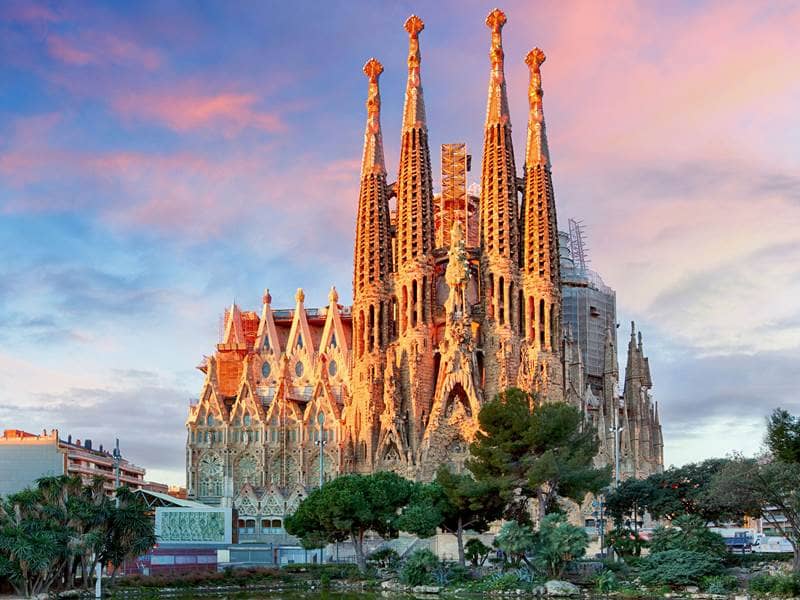
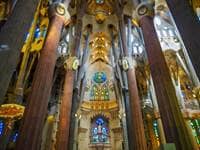
Located in Barcelona, Spain, this is currently the largest “unfinished” Roman Catholic church anywhere in the world. Under construction for more than 130 years, it has been used for the majority of that time, though formally yet unfinished. The Basilica de Sagrada Familia has served as a “minor basilica” since 2010, when Pope Benedict XVI declared it as such.
The construction on the basilica began in 1882 but ran into numerous snags along the way—including the resignation of the architect (only one year into the project), the Spanish Civil War (1936-1939), an act of desecration and arson (which resulted in a partial destruction of the blueprints or plans for the basilica), and even the COVID-19 pandemic. It is expected that the basilica will be completed by the early 2030s. This means that the construction of this holy edifice will have taken nearly 150 years to complete.
As the name of this basilica implies, it was to be built in honor of the “Holy Family” (i.e., Joseph, Mary and Jesus). Its inspiration comes from the Basilica della Santa Casa, which is a shrine dedicated to the Virgin Mary land located in Marches, Italy. A bookseller named José María Bocabella had visited the Vatican (in 1872) and came back to Spain so inspired by what he had experienced at the Marian shrine (in Marches), that he decided to build a Church in Barcelona. While the style of the two buildings is decidedly different, the inspiration to build the one came through a visit to the other.
Because of the destruction of the plans for the basilica and, as a result of the very lengthy construction process, the building has had numerous assigned architects. As a consequence of that, the basilica’s design has been adapted and tweaked on numerous occasions—in some cases, significantly so. The evolution from what was originally envisioned by the building’s first architect (Francisco de Paula del Villar) to where it stands today (about 65% complete), has been significant, to say the least. Various portions of the building reflect the various architects and eras of the Basilica’s lengthy creation process.
Religious Significance
For some, this building is beautiful and inspiring. For example, Louis Sullivan (the architect known as the “Father of Skyscrapers”), called it the “Spirit symbolized in stone!” Others, like the British novelist George Orwell, referred to it as “one of the most hideous buildings in the world.” Thus, the basilica has been polarizing, clearly not having universal appeal. This is largely due to the fact that it has had numerous designers and architects since the structure was begun (in 1882).
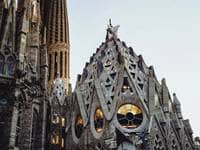
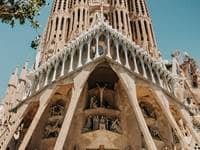
That being said, the symbolism behind the building is important, in that it stands as a testament to the central teachings of the Church. For example, the 18 spires symbolize the 12 apostles, the Virgin Mary, the 4 Evangelists, and Jesus—who is represented by the tallest and central spire. The three façades represent the Nativity, the Passion, and the Celestial Glory of Christ. The latter of these will have seven columns, symbolic of the gifts of the Spirt. At the base of those columns will be symbols of the “seven deadly sins” and, at the top, will be representations of the “seven heavenly virtues.” The Glory façade will also have a total of seven doors, symbolic of the “seven sacraments” of the Church. Thus, the symbolism is the embodiment of sacred truths taught by the Church.
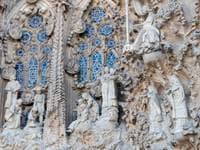
Other aspects of the basilica, which will serve as teaching devices and as inspiration for those who worship therein, include words, such as “Excelsis” or “Hosanna” on the steeples, excerpts from the Passon Narratives on the façade that symbolize the Passon, and words from the Apostles Creed on the Glory façade. The Nativity façade includes a depiction of the “Tree of Life,” and the steeple of the apse bears the text of the Hail Mary in Latin. Each of these are holy messages incorporated into this holy house.
Regardless of whether one finds the architecture of this “work in progress” attractive or disgusting, it serves for millions of visitors each year as a “testament in stone” to the central teachings of the Church, and as a witness to the spirit of endurance and perseverance—as one man’s 19th century vision is carried on by others, for nearly 150 years!
Related
Meditations for Holy Week 2023
Do Christians Believe in Evolution?
Alonzo L. Gaskill PH.D.
Do Christians Celebrate Passover?
Alonzo L. Gaskill PH.D.
What Are The Abrahamic Religions?
Alonzo L Gaskill, PH.D.
Who Wrote Each Book of the Bible?
Alonzo L. Gaskill, PH.D.
Why Are There so Many Different Denominations of Christianity?
Alonzo L. Gaskill, PH.D.
Patheos Explore the world's faith through different perspectives on religion and spirituality! Patheos has the views of the prevalent religions and spiritualities of the world.
Ad-Free & Subscriber Log-In Subscription Support
- About Us
- 2026 Calendar
- Videos
- Podcasts
- Library of World Religions
- Faith In Media Tracker
- Advertise With Us
- Write for Us
- Privacy Policy
- Terms of Service
- Do Not Sell My Data
- Contact Us
- Radiant Digital
- Manage Newsletter Subscriptions
- Unsubscribe From Notifications
- Sitemap
Copyright 2008-2026, Patheos. All rights reserved.
Subscription Support Ad-Free & Subscriber Log-In
Follow Patheos