
BuddhistCatholicContemplativeEvangelicalGeneral ChristianHinduJewishLatter-day SaintMuslimNew VisionsProgressive Christian
Beliefs
- Buddhist
- Catholic
- Contemplative
- Evangelical
- General Christian
- Hindu
- Jewish
- Latter-day Saint
- More Voices
- Muslim
- New Visions
- Pagan
- Progressive Christian
Topics
- Religion News
- Food and Religion
- Sports and Religion
- Religious Art
- Religious Music and Entertainment
- Religious Events
- History and Religion
- Style and Religion
- Politics and Religion
- Women in Religion
- Recreation Outdoors and Religion
- Business Finance and Religion
- Careers Workplace and Religion
- Education and Religion
- Family Parenting and Religion
- Health Fitness and Religion
- Home and Religion
- Relationships and Religion
- Technology and Religion
- Travel and Religion
Columnists
- Buddhist Columnists
- Business Finance and Religion Columnists
- Careers Workplace and Religion Columnists
- Catholic Columnists
- Contemplative Columnists
- Education and Religion Columnists
- Evangelists Columnists
- Family Parenting and Religion Columnists
- General Christian Columnists
- Health Fitness and Religion Columnists
- Hindu Columnists
- History and Religion Columnists
- Home and Religion Columnists
- Jewish Columnists
- More Voices Columnists
- Latter Day Columnists
- Muslim Columnists
- New Visions Columnists
- Nonreligious Columnists
- Pagan Columnists
- Politics and Religion Columnists
- Progressive Columnists
- Recreation Outdoors and Religion Columnists
- Relationships and Religion Columnists
- Religion News Columnists
- Religious Art Columnists
- Religious Events Columnists
- Religious Music and Entertainment Columnists
- Sports and Religion Columnists
- Style and Religion Columnists
- Technology and Religion Columnists
- Travel and Religion Columnists
- Women in Religion Columnists
Resource Library
- 2026 Calendar
- Library of World Religions
- The 100 Most Holy Places on Earth
- Patheos Answers
- Podcasts
- Videos
- Faith Leaders Database
- Anglican Episcopalian
- Bahai
- Baptist
- Buddhism
- Christianity
- Confucianism
- Eastern Orthodoxy
- Hinduism
- Holiness and Pentecostal
- ISKCON
- Islam
- Judaism
- Lutheran
- Methodist
- The Church of Jesus Christ of Latter-day Saints
- New Age
- Paganism
- Presbytarian and Reformed
- Protestantism
- Religion Behind the Scenes
- Roman Catholic
- Scientology
- Shia Islam
- Sikhism
- Sufism
- Sunni Islam
- Taoism
- Zen
- See all religions
Research Tools
 Ad-Free & Subscriber Log-In Subscription Support
Ad-Free & Subscriber Log-In Subscription Support
Follow Patheos 

- Trending:
- Forgiveness
- |
- Marriage
- |
- Consciousness
- |
- Death Penalty
- |
- Election
- |
- Halloween
patheos presents

The 100 Most Holy Places On Earth
number
55
Kedarnath Temple
Kedarnath, Uttarakhand, India 


By Alonzo Gaskill | Updated: March 19, 2026 | Published: March 23, 2023


Associated Faiths:
Hinduism
Accessibility:
Open for visitors, but not all year. The temple is open from Akshay Tritiya (April/May) until Bhai Dooj (October/November).
Annual visitors: 1,500,000
History
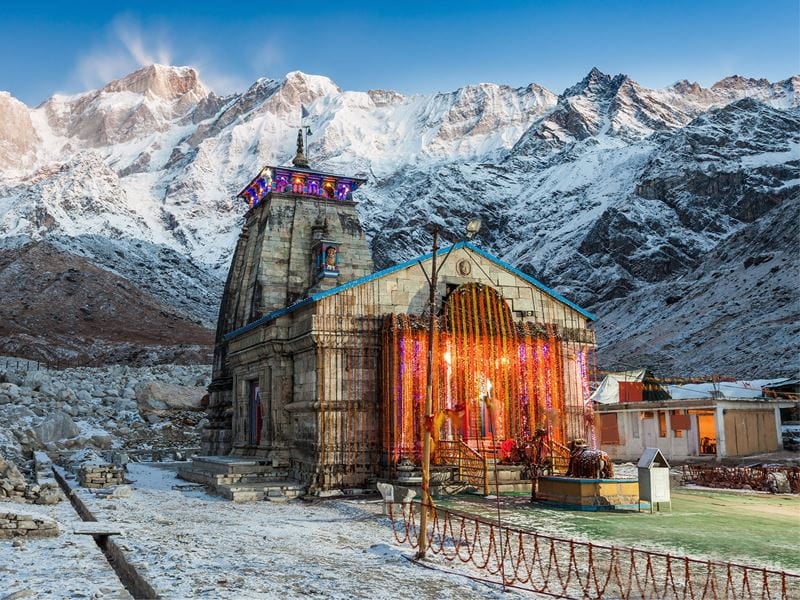
Situated in the Himalayan mountain range, and surrounded by towering and often snow-capped mountainous walls, the Kedarnath Temple is a striking feature in the Indian state of Uttarakhand. By virtue of its location, it is as though it is not a manmade structure, but part of the original divine creation. While the route to the temple is littered with smaller and less important shrines, all of that feels preparatory as one climbs the nearly 12,000 feet to the Kedarnath Temple.
Hindu tradition holds that the Kedarnath Temple was built by the five Pandava brothers (Arjuna, Bhima, Nakula, Sahadeva, and Yudhishthira). These five brothers are important characters in the Hindu scriptural epic known as the Mahabharata. Owing to the fact that the characters in this scriptural text are typically seen as symbolic, there is no known date for the construction of the original Kedarnath Temple, nor is it known who actually constructed the original edifice. Another tradition claims that the Temple was built, not by the Pandava brothers, but by Raja Bhoj of Malwa, an Indian king said to have lived in the 2nd century CE. Tradition aside, the temple which stands on the site today dates to the 8th century of the Common Era and is said to have been constructed by Adi Shankara—the Vedic scholar. (Some date the current temple to the 9th century, which would preclude Adi Shankara from being its creator.)
The current temple has a sister temple in Ukhimat/Okhimath, similar in its architectural style (though smaller). Because of the Kedarnath Temple’s Himalayan location, during the six months of the year it is closed (due to inclement weather), the deity is moved to Ukhimat and worshipped there. In the spring, it is returned to Kedarnath where it is again enshrined and where worship continues until the weather once again makes a pilgrimage to the high elevation untenable.
Dedicated to Lord Shiva, millions visit each year to participate in darshan—or the viewing of the god. The linga or image of Shiva (in this temple) is shaped like the hump on the back of a bull. Thus, it is somewhat unique and less detailed than traditional idols. Nonetheless, of the more than 200 shrines dedicated to Shiva (in this district of India), the Kedarnath temple is the most important and most popular.
Remarkably, the Kedarnath Temple has survived several natural events that probably should have destroyed it but, somehow, the edifice remains. For example, geologists believe that the temple was completely under snow for almost 400 years (circa AD 1300-1900). This was during the era often referred to as the “Little Ice Age.” Some lines on the walls of the temple suggest significant glacial activity. Similarly, in 2013 a massive flashflood swept through the region, claiming nearly 200 lives, and leaving more than 4,000 unaccounted for. More than 11,000 thousand homes were damaged. However, a massive bolder (which rests just to the side of the temple) diverted the path of the raging waters, persevering the temple and adding to its mystique as a “sacred site.
Religious Significance
The Kedarnath Temple is said to be the “abode of Lord Shiva”—one of the most important of Hindu gods. The temple itself is traditionally classed as one of the 12 most important Hinu temples dedicated to Shiva (throughout all of India). While there are various deities represented in this temple (including Ganesh, Parvati, Krishan, and Lakshmi-Narayana), the temple itself is dedicated to Shiva, and contains a Shiva linga or lingam (i.e., a “sign” or “symbol” of the god) which worshipers come to view and circumambulate.
The shape of the Kedarnath Temple’s Shiva linga is unusual. It is in the shape of the hump of a bull. Nandi, the bull, is often associated with Shiva. He symbolizes Shiva’s creative powers and his destructive powers as well—since bulls are known both for their virility and their destructive tendencies. According to tradition, Lord Shiva was disguised as a bull, when he was chased up to the site of the yet future Kedarnath Temple. One of those chasing him grabbed his tail, at which point he “sank into the earth,” leaving nothing of him visible other than the hump of his back. Shiva then appeared and commanded that they worship the hump as his lingam or “sign.” Consequently, those who received the vision built the temple around the lingam, and it became a “sacred site” from that time forward. (Aside from his hump, the remaining portions of Shiva’s bull body appeared in four other locations in India and are worshiped there as manifestations of him.)
Miracles are often the reason certain sites are deemed “sacred.” Indeed, it is usually not the “site” that makes a place sacred, but the events that transpired on a given site that hallows the ground and makes it important. In the case of the Kedarnath Temple, the 2013 flashfloods which whipped out much of the area, its structures, and lives, miraculously left the temple unscathed. Thus, though the temple is hundreds of years old, its sacredness and divine presence were enhanced in the eyes of devotees because of this miracle associated with the structure and its miraculous preservation.
As a place of pilgrimage, devotees come to seek the blessings of Shiva. In doing so, it is common to bathe and then make offerings to the god, often in the form of milk and honey. The belief of many is that Shiva can bless pilgrims occupationally, helping them to find a better job, better paying employment, or resolve other financial issues. Additionally, though Shiva is often associated with his destructive or recreative powers, he is also believed to be a god of wisdom. Worshipers who make the arduous pilgrimage to this remote site can petition this omniscient deity for wisdom. He has the power to endow the believer with “immense knowledge” and also shifts in personal perspective. These blessings, if received from Shiva, are said to make one’s life easier and more meaningful, and also can lead to the end of samsara (or reincarnation).
Related
The One Thing You Have Never Seen: Yourself
Three Days Attempting to Reach Mary Magdalene's Cave

What is the Hindu Festival of Navaratri and How do Hindus Celebrate It?
Alonzo L. Gaskill
Who Are the Hindu Gods and Goddesses?
Kathleen Mulhern, PH.D.
Alonzo L. Gaskill, PH.D.
Why Are Cows Sacred to Hindus?
Patheos Editorial Team
Patheos Explore the world's faith through different perspectives on religion and spirituality! Patheos has the views of the prevalent religions and spiritualities of the world.
Ad-Free & Subscriber Log-In Subscription Support
- About Us
- 2026 Calendar
- Videos
- Podcasts
- Library of World Religions
- Faith In Media Tracker
- Advertise With Us
- Write for Us
- Privacy Policy
- Terms of Service
- Do Not Sell My Data
- Contact Us
- Radiant Digital
- Manage Newsletter Subscriptions
- Unsubscribe From Notifications
- Sitemap
Copyright 2008-2026, Patheos. All rights reserved.
Subscription Support Ad-Free & Subscriber Log-In
Follow Patheos