
BuddhistCatholicContemplativeEvangelicalGeneral ChristianHinduJewishLatter-day SaintMuslimNew VisionsProgressive Christian
Beliefs
- Buddhist
- Catholic
- Contemplative
- Evangelical
- General Christian
- Hindu
- Jewish
- Latter-day Saint
- More Voices
- Muslim
- New Visions
- Pagan
- Progressive Christian
Topics
- Religion News
- Food and Religion
- Sports and Religion
- Religious Art
- Religious Music and Entertainment
- Religious Events
- History and Religion
- Style and Religion
- Politics and Religion
- Women in Religion
- Recreation Outdoors and Religion
- Business Finance and Religion
- Careers Workplace and Religion
- Education and Religion
- Family Parenting and Religion
- Health Fitness and Religion
- Home and Religion
- Relationships and Religion
- Technology and Religion
- Travel and Religion
Columnists
- Buddhist Columnists
- Business Finance and Religion Columnists
- Careers Workplace and Religion Columnists
- Catholic Columnists
- Contemplative Columnists
- Education and Religion Columnists
- Evangelists Columnists
- Family Parenting and Religion Columnists
- General Christian Columnists
- Health Fitness and Religion Columnists
- Hindu Columnists
- History and Religion Columnists
- Home and Religion Columnists
- Jewish Columnists
- More Voices Columnists
- Latter Day Columnists
- Muslim Columnists
- New Visions Columnists
- Nonreligious Columnists
- Pagan Columnists
- Politics and Religion Columnists
- Progressive Columnists
- Recreation Outdoors and Religion Columnists
- Relationships and Religion Columnists
- Religion News Columnists
- Religious Art Columnists
- Religious Events Columnists
- Religious Music and Entertainment Columnists
- Sports and Religion Columnists
- Style and Religion Columnists
- Technology and Religion Columnists
- Travel and Religion Columnists
- Women in Religion Columnists
Resource Library
- 2026 Calendar
- Library of World Religions
- The 100 Most Holy Places on Earth
- Patheos Answers
- Podcasts
- Videos
- Faith Leaders Database
- Anglican Episcopalian
- Bahai
- Baptist
- Buddhism
- Christianity
- Confucianism
- Eastern Orthodoxy
- Hinduism
- Holiness and Pentecostal
- ISKCON
- Islam
- Judaism
- Lutheran
- Methodist
- The Church of Jesus Christ of Latter-day Saints
- New Age
- Paganism
- Presbytarian and Reformed
- Protestantism
- Religion Behind the Scenes
- Roman Catholic
- Scientology
- Shia Islam
- Sikhism
- Sufism
- Sunni Islam
- Taoism
- Zen
- See all religions
Research Tools
 Ad-Free & Subscriber Log-In Subscription Support
Ad-Free & Subscriber Log-In Subscription Support
Follow Patheos 

- Trending:
- Forgiveness
- |
- Marriage
- |
- Consciousness
- |
- Death Penalty
- |
- Election
- |
- Halloween
patheos presents

The 100 Most Holy Places On Earth
number
32
Itsukushima Shrine
Hatsukaichi, Japan 


By Alonzo Gaskill | Updated: March 19, 2026 | Published: March 23, 2023
Also Known As:
Itsukushima Shrine
Associated Faiths:
Shinto
Also frequented by Buddhists, since (in Japan) it is often difficult to separate Buddhism and Shinto (many Japanese practicing both).
Accessibility:
Open to visitors.
Annual visitors: 4,200,000
History
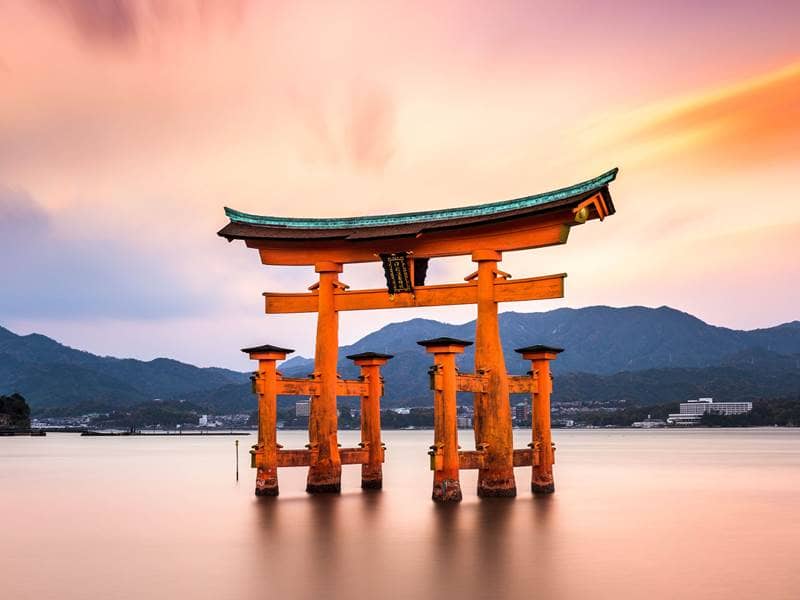
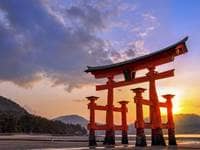
The Itsukushima Shrine (in Hatsukaichi, Japan) is iconic because of its 50-foot red “floating torii.” Those who know nothing about its meaning, nevertheless, are likely to have seen its image—either in a photo or in some popular depiction. The torii gate is an important symbol in Shinto, as it represents a gateway to a sacred space, a line of demarcation between the profane and the holy. As one passes through a torii gate, Shinto teaches, one is entering a realm heavily populated by kami—or divine spirits, sometimes referred to as “gods.”
In Shinto mythology, Japan is a chosen land, and the Japanese are a chosen people. Anciently, the kami (or divine spirits) got together and held a council, deciding to send the god Izanagi and his wife Izanami down to create the islands of Japan. Thus, Japan is a holy land—founded by the gods, not by humans. This holiness extends to all the Japanese islands and to all space, but it is even more pronounced at the more than 100,000 Shinto shrines spread throughout Japan.
The Itsukushima Shrine dates back to 593 CE, when the Empress Suiko first ordered its construction. However, the shrine on the site today is not the original shrine. Nearly 500 years after the initial shrine was constructed (1164 CE) a much larger “main shrine” was built on the site. That second shrine was twice destroyed by fire—once in 1207 and a second time in 1223. The current main shrine, which is the 4th to occupy the site, was constructed in 1571.
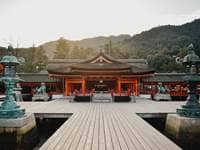
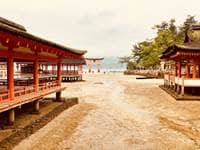
There is currently a complex of structures at the site of the shrine, including the Honsha shrine and the Sessha Marodo-jinja. In addition, there are 17 other structures which are part of the shrine complex, and the “floating torii” that signifies the entrance to the sacred site. (While a torii gate has been part of the shrine since at least as early as 1168 CE, the current gate dates to 1875.)
For centuries, the island on which the Itsukushima Shrine stands was off-limits to visitors and commoners. It was considered too sacred for most humans to broach. Thus, it is claimed that the reason the large red torii gate—through which visitors to the shrine have to pass—was placed in the water was to establish that this sacred site is not to be approached. While visitors now can come to the shrine, to this day, it is only accessible on foot when the tide recedes, or via a boat—which is required to pass beneath the torii gate before approaching the shrine.
Religious Significance
The Japanese word “Itsukushima” is said to mean “island dedicated to the gods.” The Shinto shrine on Itshkushima island is dedicated to three female kami (or goddesses) who are believed to be the granddaughters of Izanagi and Izanami, the founders of Japan. These three are the Shinto goddesses of the sea and storms, and watch over the shrine dedicated to their memory.
In Shinto belief, the kami or godly spirits are more accessible in nature than anywhere else. Thus, Shinto shrines are often built in very natural and rural surroundings—and often out of all natural materials. One attends a shrine to appease the kami, and thereby gain their protection and divine favor. Offerings are commonly made to the kami, and prayers are thought or sometimes written to them in an effort to the gain a blessing from these divine spirits.
Because of the Shinto belief that there are innumerable gods or kami present at the shrine, it is by its very nature “sacred space.” Practitioners do all that they can to not defile the site or its surrounding area. Before entering the shrine, one is expected to participate in a ritual washing of the face and mouth. It is common for priests to wave a purification wand over those who visit the shrine, removing any lingering impurities which might defile the sacred space and offend the kami present.
For those influenced by Shinto beliefs, entering a shrine such as the Itsukushima Shrine is like entering the presence of God. There is a reverence felt for the space, for the unseen spirits which reside there, and for the power and blessings offered to those who appropriately approach and petition the kami. In many ways, the Itsukushima Shrine is approached by practitioners of Shinto with the same spirit or reverence that a Roman Catholic might approach the shrine at Lourdes or another Christian might approach the Garden Tomb. While Shinto shrines, like this important one at Itsukushima, don’t mean much to those who are not Japanese, they hold great meaning for the people of Japan, and are very influential in the way the Japanese people live their lives and take care of their nation.
Related


Which Is the True Qian? A Koan About Our Undivided Nature



Keizan Jokin: The Zen Master Ancestor You Don't Know

A Zen teacher writes a novel describing the Spiritual life
Patheos Explore the world's faith through different perspectives on religion and spirituality! Patheos has the views of the prevalent religions and spiritualities of the world.
Ad-Free & Subscriber Log-In Subscription Support
- About Us
- 2026 Calendar
- Videos
- Podcasts
- Library of World Religions
- Faith In Media Tracker
- Advertise With Us
- Write for Us
- Privacy Policy
- Terms of Service
- Do Not Sell My Data
- Contact Us
- Radiant Digital
- Manage Newsletter Subscriptions
- Unsubscribe From Notifications
- Sitemap
Copyright 2008-2026, Patheos. All rights reserved.
Subscription Support Ad-Free & Subscriber Log-In
Follow Patheos