
BuddhistCatholicContemplativeEvangelicalGeneral ChristianHinduJewishLatter-day SaintMuslimNew VisionsProgressive Christian
Beliefs
- Buddhist
- Catholic
- Contemplative
- Evangelical
- General Christian
- Hindu
- Jewish
- Latter-day Saint
- More Voices
- Muslim
- New Visions
- Pagan
- Progressive Christian
Topics
- Religion News
- Food and Religion
- Sports and Religion
- Religious Art
- Religious Music and Entertainment
- Religious Events
- History and Religion
- Style and Religion
- Politics and Religion
- Women in Religion
- Recreation Outdoors and Religion
- Business Finance and Religion
- Careers Workplace and Religion
- Education and Religion
- Family Parenting and Religion
- Health Fitness and Religion
- Home and Religion
- Relationships and Religion
- Technology and Religion
- Travel and Religion
Columnists
- Buddhist Columnists
- Business Finance and Religion Columnists
- Careers Workplace and Religion Columnists
- Catholic Columnists
- Contemplative Columnists
- Education and Religion Columnists
- Evangelists Columnists
- Family Parenting and Religion Columnists
- General Christian Columnists
- Health Fitness and Religion Columnists
- Hindu Columnists
- History and Religion Columnists
- Home and Religion Columnists
- Jewish Columnists
- More Voices Columnists
- Latter Day Columnists
- Muslim Columnists
- New Visions Columnists
- Nonreligious Columnists
- Pagan Columnists
- Politics and Religion Columnists
- Progressive Columnists
- Recreation Outdoors and Religion Columnists
- Relationships and Religion Columnists
- Religion News Columnists
- Religious Art Columnists
- Religious Events Columnists
- Religious Music and Entertainment Columnists
- Sports and Religion Columnists
- Style and Religion Columnists
- Technology and Religion Columnists
- Travel and Religion Columnists
- Women in Religion Columnists
Resource Library
- 2026 Calendar
- Library of World Religions
- The 100 Most Holy Places on Earth
- Patheos Answers
- Podcasts
- Videos
- Faith Leaders Database
- Anglican Episcopalian
- Bahai
- Baptist
- Buddhism
- Christianity
- Confucianism
- Eastern Orthodoxy
- Hinduism
- Holiness and Pentecostal
- ISKCON
- Islam
- Judaism
- Lutheran
- Methodist
- The Church of Jesus Christ of Latter-day Saints
- New Age
- Paganism
- Presbytarian and Reformed
- Protestantism
- Religion Behind the Scenes
- Roman Catholic
- Scientology
- Shia Islam
- Sikhism
- Sufism
- Sunni Islam
- Taoism
- Zen
- See all religions
Research Tools
 Ad-Free & Subscriber Log-In Subscription Support
Ad-Free & Subscriber Log-In Subscription Support
Follow Patheos 

- Trending:
- Forgiveness
- |
- Marriage
- |
- Consciousness
- |
- Death Penalty
- |
- Election
- |
- Halloween
patheos presents

The 100 Most Holy Places On Earth
number
11
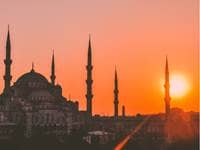
Hagia Sophia
Istanbul, Turkey 


Associated Faiths:
Islam & Eastern Orthodoxy
Because of its historical importance and uniqueness, it draw tourists from many other traditions—but not typically for religious reasons.
Accessibility:
Open to visitors. No shoes, shorts, sleeveless clothing. Women must have legs and arms entirely covered and wear a headscarf. No low or revealing necklines and no tight clothing allowed.
Annual visitors: 6,500,000
History
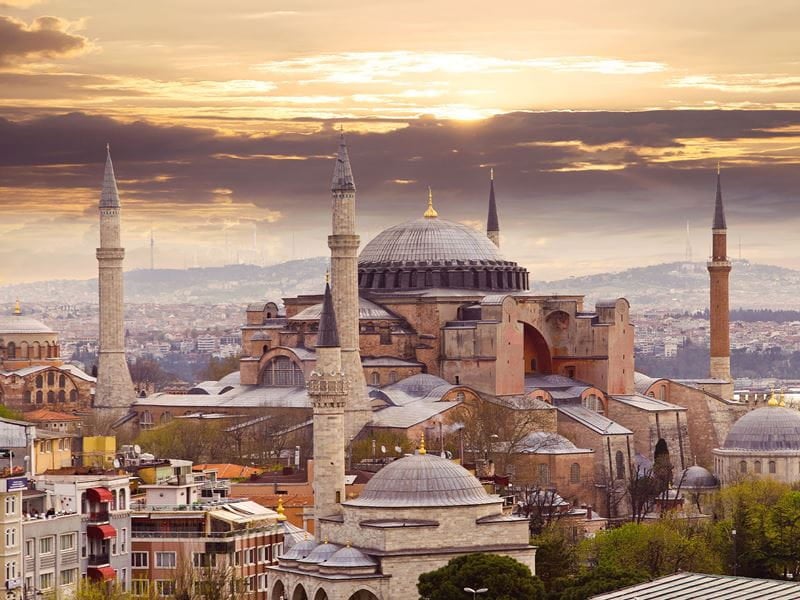
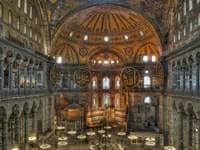
The Hagai Sophia, or “Church of the Holy Wisdom,” has its origins in the 4th century AD. Though there had been a previous church on the site, the current edifice was constructed (by Emperor Justinian) as the Cathedral of Constantinople. It had, at the time of its construction, the world’s largest interior space—utilizing a pendentive dome (now common in Byzantine architecture) to create the significant open space beneath it. It was the largest cathedral in the world for nearly a millennium. And, to this day, is one of the most famous of religious buildings—even with its somewhat controversial history (or, perhaps, because of it).
The Hagai Sophia functioned as the episcopal see of the Ecumenical Patriarch—and the center place of the Eastern Orthodox tradition—for nearly 1,000 years. (The Ecumenical Patriarch is “sort of” the equivalent to the Pope, only for the Eastern Orthodox tradition. While he is considered “first among equals,” he does not have the same universal authority that the Roman Catholic pope does over the Western Church.) Ayasofya (as it is called in Turkish) is the site of the famous “Great Schism” of 1054, when Pope Leo IX (via Cardinal Humbert) excommunicated Patriarch Michael Cerularius and, in effect, the entire Eastern half of the Church—leading to the formal creation of two separate Christian Churches (Roman Catholicism and Eastern Orthodoxy). During the 4th Crusade (AD 1204), it was converted into a Catholic cathedral—and remained such until it reverted back to the Byzantine Empire and Orthodox Church (in AD 1261).
As a consequence of the fall of Constantinople (AD 1453), the building was converted into an Islamic mosque, which required the removal or destruction of the various Eastern Orthodox icons and baptistry. During the 15th-16th centuries, a number of Islamic components were added to the sacred structure. Those included four minarets, the minbar, and the mihrab, each of which are seen on and in the building today. The Hagia Sophia remained a functioning Islamic mosque until the 1930s.
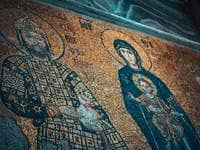
In 1935, the president of Turkey turned the building into a museum. After that, many of the elaborate Byzantine icons that had been plastered over (when the edifice was converted into a mosque) have been uncovered and restored. However, over time—due to neglect—the building deteriorated significantly. In the early 2000s, substantial renovations were begun to preserve and update the structure.
In 2013, Turkey’s deputy prime minister pushed to convert the Haga Sophia from a museum back to a functioning mosque. In 2016, for the first time in 85 years, Muslims were able to use the edifice for Salah (or daily prayers). Since 2020, it has once again served as a mosque, which has brought widespread condemnation from the Christian world and UNESCO. While functioning as a mosque, it is open for tourists outside of the five appointed prayer times each day (during which all of the Christian icons are covered).
Religious Significance
The Hagai Sophi is an ancient symbol for many things. Among others, it is a reminder of the division that exists between Roman Catholics and Eastern Orthodox Christians—a division which became official in that very building. Symbolically, it also stands as a reminder of the fall of the Byzantine Empire—an emblem of what once reigned supreme but is now lost. (Perhaps a forewarning to other powerful nations, empires, and even religious traditions.) In many ways, the Hagai Sopia represents the successful spread of Islam and the struggles of Christianity to survive in a world ever growing more and more secular. But this holy site is also a symbolic testament to the enduring nature of faith—having once been a church, a then mosque, but turned into a secular government run museum, only to survive and resurface once again as a place of worship. For believers, it is a hopeful reminder that faith will endure and religion will triumph over secularism.
The glory and grandeur of this edifice, when it was constructed (in the 4th century), caused a sense of intense awe in those who viewed it and those who worshiped within it. In the biography of Emperor Justinian, there is talk of the Hagai Sophia’s remarkable golden dome as being suspended by “heaven” itself. The implication of this was the widely held belief that God was behind the creation of this remarkable and inspiring edifice (which, for its time, was an unmatched architectural and engineering achievement). And, to this day, one can hardly walk the floors of the Ayasofya without a sense of awe that individuals (without the training of modern engineers) could construct something so grand in the primitive environment of the 4th century CE.
Highlighting the innate spirituality of the Hagai Sophi—which is a sort of shared sacred space for Muslims and Orthodox Christians—is the following legend: During the construction, the crew ran up against a significant challenge and had to leave the site to seek advice. A young boy was given the charge to guard the tools until the workmen returned. Once those constructing the church had left, a “being” appeared to the boy and conveyed to him the very solution to the problem the workmen were struggling with. This divine being then sent the boy to communicate the solution to the problem, promising that He would stay and guard the building and its contents while the boy went to share what he had learned. The workers recognized the ingenious nature of the solution and could only conclude that the “being” that had appeared to the child was no human, but nothing less than the “divine presence” (or an “angel” sent by the divine). Because the boy, after conveying the solution, did not return to the site of the construction, the divine presence (by virtue of His promise to the boy) was obligated to remain there at the site of the holy edifice. Many believe that He watches over it today, guarding it. This is the spirit of the Hagai Sophia, for visitors, for worshipers, and for those who are inspired by the history, art, and architecture of this remarkable house of worship and place of pilgrimage.
Related
5 Verses of the Qur'an That Will Comfort a Broken Heart
Is French Footballer Kylian Mbappe Muslim Or Christian?
The Power of the Hajj: A Sacred Bond Through a Sacred Pilgrimage

5 Verses of the Qur'an That Will Comfort a Broken Heart

Is French Footballer Kylian Mbappe Muslim Or Christian?
The Power of the Hajj: A Sacred Bond Through a Sacred Pilgrimage
Judaism vs. Islam: The Real Reasons Behind the Prohibition of Pork
Should We Believe that Muhammad Split the Moon?
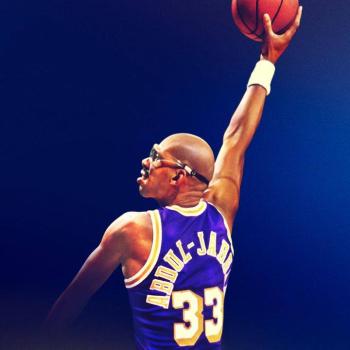
What Players Are Muslim In The NBA?
Patheos Explore the world's faith through different perspectives on religion and spirituality! Patheos has the views of the prevalent religions and spiritualities of the world.
Ad-Free & Subscriber Log-In Subscription Support
- About Us
- 2026 Calendar
- Videos
- Podcasts
- Library of World Religions
- Faith In Media Tracker
- Advertise With Us
- Write for Us
- Privacy Policy
- Terms of Service
- Do Not Sell My Data
- Contact Us
- Radiant Digital
- Manage Newsletter Subscriptions
- Unsubscribe From Notifications
- Sitemap
Copyright 2008-2026, Patheos. All rights reserved.
Subscription Support Ad-Free & Subscriber Log-In
Follow Patheos