
BuddhistCatholicContemplativeEvangelicalGeneral ChristianHinduJewishLatter-day SaintMuslimNew VisionsProgressive Christian
Beliefs
- Buddhist
- Catholic
- Contemplative
- Evangelical
- General Christian
- Hindu
- Jewish
- Latter-day Saint
- More Voices
- Muslim
- New Visions
- Pagan
- Progressive Christian
Topics
- Religion News
- Food and Religion
- Sports and Religion
- Religious Art
- Religious Music and Entertainment
- Religious Events
- History and Religion
- Style and Religion
- Politics and Religion
- Women in Religion
- Recreation Outdoors and Religion
- Business Finance and Religion
- Careers Workplace and Religion
- Education and Religion
- Family Parenting and Religion
- Health Fitness and Religion
- Home and Religion
- Relationships and Religion
- Technology and Religion
- Travel and Religion
Columnists
- Buddhist Columnists
- Business Finance and Religion Columnists
- Careers Workplace and Religion Columnists
- Catholic Columnists
- Contemplative Columnists
- Education and Religion Columnists
- Evangelists Columnists
- Family Parenting and Religion Columnists
- General Christian Columnists
- Health Fitness and Religion Columnists
- Hindu Columnists
- History and Religion Columnists
- Home and Religion Columnists
- Jewish Columnists
- More Voices Columnists
- Latter Day Columnists
- Muslim Columnists
- New Visions Columnists
- Nonreligious Columnists
- Pagan Columnists
- Politics and Religion Columnists
- Progressive Columnists
- Recreation Outdoors and Religion Columnists
- Relationships and Religion Columnists
- Religion News Columnists
- Religious Art Columnists
- Religious Events Columnists
- Religious Music and Entertainment Columnists
- Sports and Religion Columnists
- Style and Religion Columnists
- Technology and Religion Columnists
- Travel and Religion Columnists
- Women in Religion Columnists
Resource Library
- 2026 Calendar
- Library of World Religions
- The 100 Most Holy Places on Earth
- Patheos Answers
- Podcasts
- Videos
- Faith Leaders Database
- Anglican Episcopalian
- Bahai
- Baptist
- Buddhism
- Christianity
- Confucianism
- Eastern Orthodoxy
- Hinduism
- Holiness and Pentecostal
- ISKCON
- Islam
- Judaism
- Lutheran
- Methodist
- The Church of Jesus Christ of Latter-day Saints
- New Age
- Paganism
- Presbytarian and Reformed
- Protestantism
- Religion Behind the Scenes
- Roman Catholic
- Scientology
- Shia Islam
- Sikhism
- Sufism
- Sunni Islam
- Taoism
- Zen
- See all religions
Research Tools
 Ad-Free & Subscriber Log-In Subscription Support
Ad-Free & Subscriber Log-In Subscription Support
Follow Patheos 

- Trending:
- Forgiveness
- |
- Marriage
- |
- Consciousness
- |
- Death Penalty
- |
- Election
- |
- Halloween
patheos presents

The 100 Most Holy Places On Earth
number
100
El Ghriba Synagogue
Hara Sghira Er Riadh, Tunisia 


By Alonzo Gaskill | Updated: March 19, 2026 | Published: March 23, 2023
Also Known As:
Djerba Synagogue
Associated Faiths:
Also visited by Jews of other denominations, and religious tourists of various faith traditions
Accessibility:
Open to visitors, except on Shabbat (i.e., between sundown Friday to sundown Saturday). Passport required to enter. Modest dress required. All visitors are expected to wear head coverings.
Pre-pandemic, approximately 20,000 visited the Synagogue in a given year. Those number have dropped significantly, with an expectation of less than 10,000 visitors in 2023
History
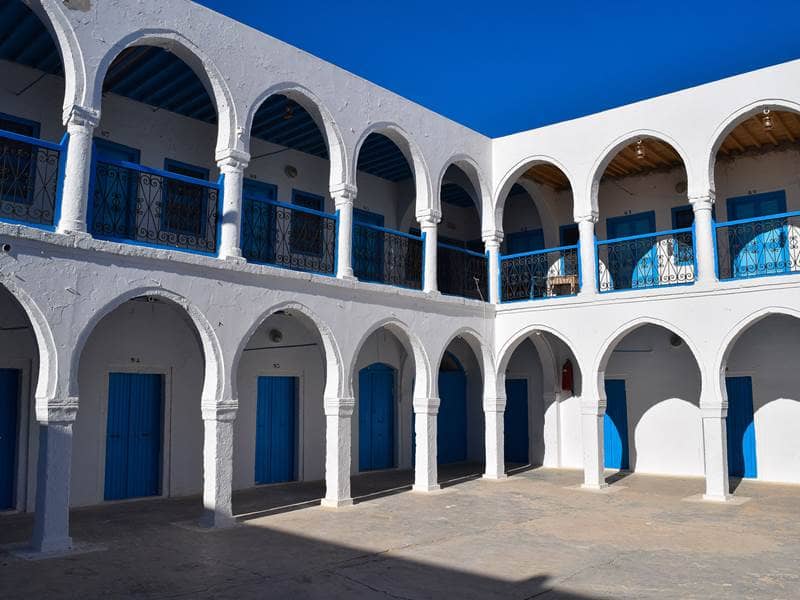
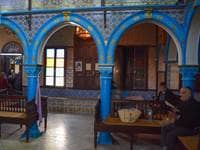
The El Ghriba Synagogue is an Orthodox Jewish house of worship located on the Tunisian island of Djerba. (As a consequence of its location, some simply refer to it as the “Djerba Synagogue.”) This Moorish-style synagogue is the oldest Jewish house of worship in Tunisia—and one of approximately 20 that once existed on the island of Djerba. As a synagogue, it is central to life in er-Riadh—an Orthodox Jewish village formerly known as Hara Seghira, where Jews have lived for 2,500 years.
Though there are numerous other synagogues and Jewish “gathering” places on Djerba, the El Ghriba Synagogue is the only one (in the modern era) that has been allowed to have its own Torah scroll. This is said to be for the purpose of distinguishing this synagogue from all others on the island. Having an “ark” with a Torah scroll therein sets this unique synagogue apart from all other Jewish batei knesset in Djerba—and makes it the center of Jewish life and worship on the island.
The El Ghriba Synagogue is also unique because it has been the site of numerous terrorist attacks over the years. For example, in 1985, a policeman tasked with protecting Jewish celebrants at the site opened fire on them, killing 3 and wounding 15 others. In 2002 a truck bomb was detonated outside of the synagogue, killing 21 people. These and other tragic occurrences at the site of the synagogue have hallowed the ground on which it stands—though for mournful reasons.
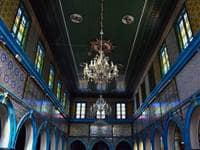
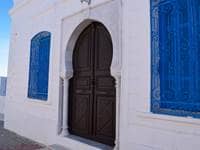
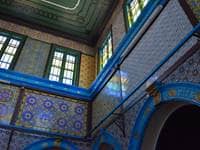
Though there had been a 6th-5th century BCE synagogue which once stood on the same spot as the current El Ghriba Synagogue, it was destroyed in the 1500s when the Spanish made a military incursion into Tunisai. Thus, the current structure—with its modest exterior and rather lavish interior—is fairly modern, dating to the end of the 19th century. It has been expanded several times since its initial construction in order to accommodate the growing number of believers who desire to worship there. There are a number of architectural quirks which make the building appear unfinished. Some observers have conjectured that this is just a reminder that God is the only “perfect” or “complete” being. A number of buildings which surround the synagogue—all dating from the late-19th to mid-20th centuries—are used to house pilgrims who make the annual trek to the historic synagogue.
Religious Significance
The annual pilgrimage to the Djerba Synagogue takes place on a holiday known as Lag B’Omer—which literally means the 33rd day of the holiday known as the “Counting of the Omer.” The “Omer” is an annual commemoration that fills in the gap or days between Pesach (or Passover) and Shavuot (or the Feast of Pentecost). Passover symbolizes the Jewish Exodus from Egypt. The Omer reminds us of ancient Israel’s 40-year trek through the wilderness. And the Feast of Pentecost points to when Moses received God’s law on Mount Sinai. So, on this date—once a year—certain Jews make a trek to the only synagogue on the island that actually has a Torah scroll (which contains the words Moses received from God upon Mount Sinai).
Symbolically, this is an important mental reenactment of God dispensing truth and Israel being the recipient of that truth. Another component of the annual pilgrimage is the pushing of a rather large, wheeled chandelier, which is draped in what look like Jewish bridal veils. This procession—with its veils, music, and dancing—is reminiscent of a Jewish wedding. However, in this case, rather than commemorating the bond between two newlyweds, this part of the pilgrimage symbolizes the bond that exists between the Jewish people and her God. The El Ghriba Synagogue is a uniquely sacred site for Jews of Tunisia for a number of reasons—beyond what has been stated already.
There is a tradition that this synagogue was built in response to the Babylonian destruction of Solomon’s Temple. According to the popularly held lore, when the armies of King Nebuchadnezzar attacked (in 586 BCE), completely destroying the Temple of Solomon, the High Priest and the other priests who served alongside of him escaped but took with them a door from the temple and also a stone from the destroyed temple. Those two items are supposedly incorporated into (or reside in) the current El Ghriba Synagogue, thereby making this a “sacred space” for Jews today. So central is this legend that many of the Jewish residents of er-Riadh (or Erriadh) wear a fabric black band on their clothes to represent and remind those who see it of the destruction of the temple. While Orthodox Jews place a strong distinction between the temple and the synagogue, nevertheless, the fact that the original synagogue on this site dates back approximately 2,600 years, and the fact that it supposedly had a door and building stone from Solomon’s Temple incorporated into the edifice, makes the El Ghirba Synagogue second only to the “Western Wall” (or “kotel”) for some Jews.
Just as every practicing Jew (at Passover) declares in a spirit of hopefulness, “Next year in Jerusalem”—Tunisian Jews have reason to say (during the Omer), “Next year in in Djerba.” Because the temple was the most holy place in Judaism’s more than 4,000-year history, and because the synagogue is the last vestige of the “sacred space” of the ancient Jews, the El Ghriba Synagogue feels a bit like that temple that so many Orthodox Jews long for. While a synagogue can never replace a temple, the fact that this one has a piece or two from Solomon’s Temple—which Jews refer to as the “First Temple”—makes it an important place of pilgrimage for the faithful, particularly those in North Africa.
Related
How and Why Jewish Mikvah’s Are Used
How Jewish Prayer Shawls Are Made and Used
How Jewish Shomers ‘Guard’ Bodies Until They’re Buried
How Torah Scroll Parchment Gets Made
 Overview
Spooky Judaism: Did Adam Father Demons?
The Ark of The Covenant: All Roads Lead to Yemen
Two Arks of the Covenant? The Ancient Case for a Second Ark
The Trumpets of Revelation Blew and No One Noticed
Yom Kippur : Is There Always Room for Forgiveness?
Patheos Explore the world's faith through different perspectives on religion and spirituality! Patheos has the views of the prevalent religions and spiritualities of the world.
Ad-Free & Subscriber Log-In Subscription Support
- About Us
- 2026 Calendar
- Videos
- Podcasts
- Library of World Religions
- Faith In Media Tracker
- Advertise With Us
- Write for Us
- Privacy Policy
- Terms of Service
- Do Not Sell My Data
- Contact Us
- Radiant Digital
- Manage Newsletter Subscriptions
- Unsubscribe From Notifications
- Sitemap
Copyright 2008-2026, Patheos. All rights reserved.
Subscription Support Ad-Free & Subscriber Log-In
Follow Patheos