
BuddhistCatholicContemplativeEvangelicalGeneral ChristianHinduJewishLatter-day SaintMuslimNew VisionsProgressive Christian
Beliefs
- Buddhist
- Catholic
- Contemplative
- Evangelical
- General Christian
- Hindu
- Jewish
- Latter-day Saint
- More Voices
- Muslim
- New Visions
- Pagan
- Progressive Christian
Topics
- Religion News
- Food and Religion
- Sports and Religion
- Religious Art
- Religious Music and Entertainment
- Religious Events
- History and Religion
- Style and Religion
- Politics and Religion
- Women in Religion
- Recreation Outdoors and Religion
- Business Finance and Religion
- Careers Workplace and Religion
- Education and Religion
- Family Parenting and Religion
- Health Fitness and Religion
- Home and Religion
- Relationships and Religion
- Technology and Religion
- Travel and Religion
Columnists
- Buddhist Columnists
- Business Finance and Religion Columnists
- Careers Workplace and Religion Columnists
- Catholic Columnists
- Contemplative Columnists
- Education and Religion Columnists
- Evangelists Columnists
- Family Parenting and Religion Columnists
- General Christian Columnists
- Health Fitness and Religion Columnists
- Hindu Columnists
- History and Religion Columnists
- Home and Religion Columnists
- Jewish Columnists
- More Voices Columnists
- Latter Day Columnists
- Muslim Columnists
- New Visions Columnists
- Nonreligious Columnists
- Pagan Columnists
- Politics and Religion Columnists
- Progressive Columnists
- Recreation Outdoors and Religion Columnists
- Relationships and Religion Columnists
- Religion News Columnists
- Religious Art Columnists
- Religious Events Columnists
- Religious Music and Entertainment Columnists
- Sports and Religion Columnists
- Style and Religion Columnists
- Technology and Religion Columnists
- Travel and Religion Columnists
- Women in Religion Columnists
Resource Library
- 2026 Calendar
- Library of World Religions
- The 100 Most Holy Places on Earth
- Patheos Answers
- Podcasts
- Videos
- Faith Leaders Database
- Anglican Episcopalian
- Bahai
- Baptist
- Buddhism
- Christianity
- Confucianism
- Eastern Orthodoxy
- Hinduism
- Holiness and Pentecostal
- ISKCON
- Islam
- Judaism
- Lutheran
- Methodist
- The Church of Jesus Christ of Latter-day Saints
- New Age
- Paganism
- Presbytarian and Reformed
- Protestantism
- Religion Behind the Scenes
- Roman Catholic
- Scientology
- Shia Islam
- Sikhism
- Sufism
- Sunni Islam
- Taoism
- Zen
- See all religions
Research Tools
 Ad-Free & Subscriber Log-In Subscription Support
Ad-Free & Subscriber Log-In Subscription Support
Follow Patheos 

- Trending:
- Forgiveness
- |
- Marriage
- |
- Consciousness
- |
- Death Penalty
- |
- Election
- |
- Halloween
patheos presents

The 100 Most Holy Places On Earth
number
79
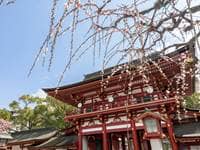
Dazaifu Tenmangu
Dazaifu, Fukuoka, Japan 


By Alonzo Gaskill | Updated: March 19, 2026 | Published: March 23, 2023
Associated Faiths:
Also frequented by Buddhists, since (in Japan) it is often difficult to separate Buddhism and Shinto (many Japanese practicing both)
Accessibility:
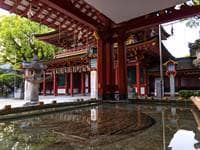
Open to visitors. Ritual washing (at the temizuya or ablution pavilion) encouraged before entering.
Annual Visitors: 10,000,000
History
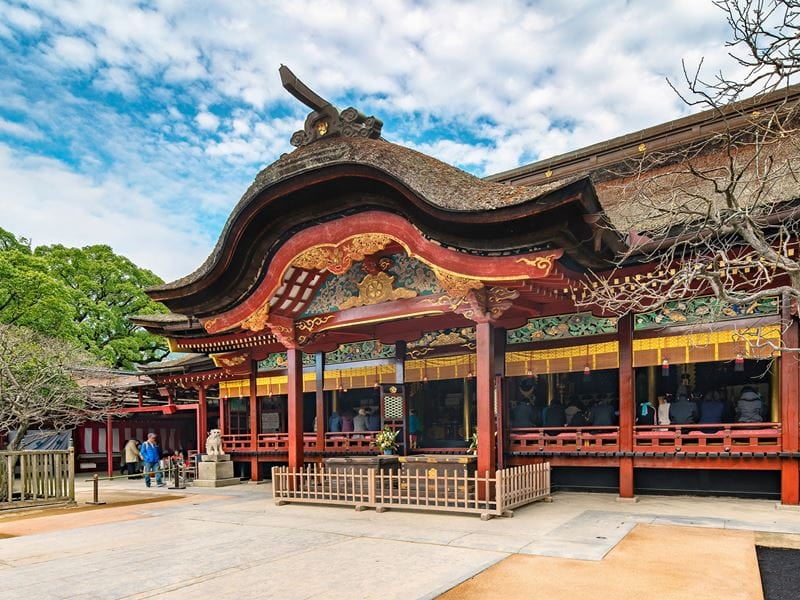
The Dazaifu Tenmangū shrine is a Shinto shrine constructed in the early 10th century. It was built over a site said to be the burial place of the famed Japanese poet and Shinto deity, Sugawara no Michizane (845-903 CE). Michizane was a prestigious scholar in the Japanese Ministry of Civil Affairs, the Ministry of War and, eventually, the Ministry of Popular Affairs. Additionally, he ran the Kanke Rōka school (founded by his Father), where he was a professor of literature—ultimately holding the highest honor affording a historian in his day, Monjō Hakushi (or “Doctorate of Literature”).
Through the political manipulations of a rival, Sugawara no Michizane was stripped of his rank and academic post and he, along with his family, were banished. As a consequence, he died in exile. Shortly after his passing, several tragedies struck the kingdom, including a drought, a plague that killed the sons of the Emperor, several lightning strikes which hit various portions of the Imperial Palace, and extensive floods. All of this was taken as a sign that Michizane’s spirit was angry over the exile that he experienced near the end of his life. Thus, in order to appease his “angry spirit,” the Dazaifu Tenmangū shrine was built over his grave, and his title and office were posthumously restored to him. Some seventy years later, Sugawara no Michizane was declared the Shinto Tenjin-sama or kami (i.e., spirit or god) of storms; and, eventually, the Tenjin or kami of academics.
While there are numerous Shinto shrines (in Japan) dedicated to Sugawara no Michizane, this one is uniquely important. Because of its construction over the place believed to be his grave, and also because this specific shrine was instrumental in transitioning Michizane from a famed academic and civil servant into a vengeful spirit, it stands out as more special and more historic than the other Michizane shrines. Additionally, this shrine represents his being declared the equivalent of a “god” in Shinto tradition. Thus, its sacral nature is also wrapped up in the elevation or deification of its namesake.
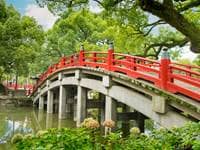
The shine is massive, covering more than 3,000 acres, numerous ponds, approximately 6,000 plumb trees, a bridge, a “treasure house,” and several buildings. Its primary shrine dates to only two years after Michizane’s passing. An additional larger shrine was constructed (in his honor) in 919 CE but was destroyed by fire some years later. In addition to the main shrined dedicated to Tenjin (the kami of academics), there are other lesser shrines on the site dedicated to other “lesser” kami or divine spirits.
Religious Significance
In Shinto tradition, there are kami or spirits everywhere. Trees have kami, bodies of water have associated kami, rocks may have kami, as can human-made things, such as a possession, vehicle, statue, shrine, etcetera. While Shinto kami are not omnipotent or omnipresent, they are perceived as real, divine, and very powerful—particularly by older followers of Shinto. Thus, they are revered, and genuine practitioners consistently do much to ensure that the kami are kept happy and appeased, so that the land and people of Japan will be blessed and fruitful, and so that individual requests (made to kami at Shinto shrines and home shrines, or kamidanas/Butsudans) will be heard and affirmatively answered.
While various Shinto shrines can be dedicated to a specific kami (spirit or god), one can worship and petition various kami at any given shrine or kamidana. That being said, the Dazaifu Tenmangū shrine is unique because of its dedication to Sugawara no Michizane, who now holds a special place in Shinto as it relates to his power over storms, but also his attentiveness to academics and even civil servants. Thus, like patron saints (in Roman Catholicism and Eastern Orthodoxy), Michizane is a kami who has a specific tie to certain professions and national needs.
As noted, Shinto kami are not omnipotent or omnipresent beings. Thus, they are traditionally understood to be restricted or limited in their ability to curse or bless practitioners based on that given kami’s sphere or existence and influence. For example, a kami of the water can only punish people through water (e.g., floods, droughts, etc.) or bless them through water (e.g., ending a drought so that crops grow abundantly, or so that sufficient drinking water is available for worshipers). However, a kami of the water could not cause an earthquake, a fire, an electrical storm, etc. Thus, there are limitations placed upon the kami and what they can do to and for the people of the earth. This is no different for Sugawara no Michizane, and shrines associated with him. Practitioners make pilgrimages to the Dazaifu Tenmangū shrine, not simply to encounter a piece of Japanese history and lore, but also if they have a need that falls under the power or authority of Sugawara no Michizane. Thus, the Dazaifu Tenmangū shrine might be an important place of pilgrimage for those concerned about dangerous weather patterns (which he might influence as a Shinto god of the storms). Similarly, if one is wishing to become a poet, a scholar, or a civil servant, there is no better location to visit, make an offering, leave a prayer request, or flatter the kami, than the Dazaifu Tenmangū shrine. The very Shinto kami associated with each of those elements is believed to be accessible at this location and is inclined to hear and answer the petitions of sincere devotees who come to petition and appease him at this sacred site—traditionally believed to be the location of his death.
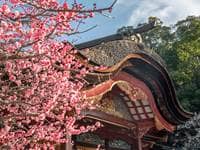
Michizane was fond of plum trees and wrote of them—including in a poem he penned just before his exile. He had plum trees at his residence prior to being demoted and forced to leave Kyoto. As a consequence, the plum tree has become a Shinto symbol of Michizane and the legends surrounding him. According to one such story, when Michizane was banished, his prize plum tree so missed its master that it flew to the location of his exile—which is the spot where the the Dazaifu Tenmangū shrine stands today. That tree is believed, by some, to still exist—and legend has it that it is the first plum tree to bloom in Japan each year. It is for this reason that some 6,000 plum trees are located at this shrine, and for this same reason that grilled azuki bean cakes, with the image of a plum tree flower, are customarily consumed at this sacred site. Some include these snacks (that were supposedly once consumed by Michizane) in their offerings to him at the shrine, hoping that such a gesture will incline him to bless the practitioner by granting his or her request of him.
Related
Three Days Attempting to Reach Mary Magdalene's Cave
America at 250: The Country We Are Still Becoming
Behind an Old House in Laos: How Pii Mai Expands Our Spirituality


What Is the Oldest Religion in the World?
Amrita Singh

How Japanese Religion Influenced Pokemon

The Least Religious Countries in the World
Patheos Explore the world's faith through different perspectives on religion and spirituality! Patheos has the views of the prevalent religions and spiritualities of the world.
Ad-Free & Subscriber Log-In Subscription Support
- About Us
- 2026 Calendar
- Videos
- Podcasts
- Library of World Religions
- Faith In Media Tracker
- Advertise With Us
- Write for Us
- Privacy Policy
- Terms of Service
- Do Not Sell My Data
- Contact Us
- Radiant Digital
- Manage Newsletter Subscriptions
- Unsubscribe From Notifications
- Sitemap
Copyright 2008-2026, Patheos. All rights reserved.
Subscription Support Ad-Free & Subscriber Log-In
Follow Patheos