
BuddhistCatholicContemplativeEvangelicalGeneral ChristianHinduJewishLatter-day SaintMuslimNew VisionsProgressive Christian
Beliefs
- Buddhist
- Catholic
- Contemplative
- Evangelical
- General Christian
- Hindu
- Jewish
- Latter-day Saint
- More Voices
- Muslim
- New Visions
- Pagan
- Progressive Christian
Topics
- Religion News
- Food and Religion
- Sports and Religion
- Religious Art
- Religious Music and Entertainment
- Religious Events
- History and Religion
- Style and Religion
- Politics and Religion
- Women in Religion
- Recreation Outdoors and Religion
- Business Finance and Religion
- Careers Workplace and Religion
- Education and Religion
- Family Parenting and Religion
- Health Fitness and Religion
- Home and Religion
- Relationships and Religion
- Technology and Religion
- Travel and Religion
Columnists
- Buddhist Columnists
- Business Finance and Religion Columnists
- Careers Workplace and Religion Columnists
- Catholic Columnists
- Contemplative Columnists
- Education and Religion Columnists
- Evangelists Columnists
- Family Parenting and Religion Columnists
- General Christian Columnists
- Health Fitness and Religion Columnists
- Hindu Columnists
- History and Religion Columnists
- Home and Religion Columnists
- Jewish Columnists
- More Voices Columnists
- Latter Day Columnists
- Muslim Columnists
- New Visions Columnists
- Nonreligious Columnists
- Pagan Columnists
- Politics and Religion Columnists
- Progressive Columnists
- Recreation Outdoors and Religion Columnists
- Relationships and Religion Columnists
- Religion News Columnists
- Religious Art Columnists
- Religious Events Columnists
- Religious Music and Entertainment Columnists
- Sports and Religion Columnists
- Style and Religion Columnists
- Technology and Religion Columnists
- Travel and Religion Columnists
- Women in Religion Columnists
Resource Library
- 2026 Calendar
- Library of World Religions
- The 100 Most Holy Places on Earth
- Patheos Answers
- Podcasts
- Videos
- Faith Leaders Database
- Anglican Episcopalian
- Bahai
- Baptist
- Buddhism
- Christianity
- Confucianism
- Eastern Orthodoxy
- Hinduism
- Holiness and Pentecostal
- ISKCON
- Islam
- Judaism
- Lutheran
- Methodist
- The Church of Jesus Christ of Latter-day Saints
- New Age
- Paganism
- Presbytarian and Reformed
- Protestantism
- Religion Behind the Scenes
- Roman Catholic
- Scientology
- Shia Islam
- Sikhism
- Sufism
- Sunni Islam
- Taoism
- Zen
- See all religions
Research Tools
 Ad-Free & Subscriber Log-In Subscription Support
Ad-Free & Subscriber Log-In Subscription Support
Follow Patheos 

- Trending:
- Forgiveness
- |
- Marriage
- |
- Consciousness
- |
- Death Penalty
- |
- Election
- |
- Halloween
patheos presents

The 100 Most Holy Places On Earth
number
68
Church of St. George
Lalibela, Ethiopia 


By Alonzo Gaskill | Updated: March 19, 2026 | Published: March 23, 2023
Associated Faiths:
Also frequented by religious people of many traditions, including other Low and High-Church denominations of Christianity.
Accessibility:
Open to visitors, though certain relics in the church (specifically a replica of the Ark of the Covenant and its associated contents) are not allowed to be viewed by visitors. They are kept hidden from visitors, behind a veil or curtain.
History
Starting in the 4th or 5th century AD, Christianity is believed to have entered from various sides and spread throughout Ethiopia. However, when Jerusalem was conquered by the Muslim sultan Saladin (in AD 1187), the then Ethiopian Zagwe emperor (Gebra Maskal Lalibela) decided that he wanted to make Ethiopia the “New Jerusalem.” He set out to do so, starting in the “horn of Africa.” The site, originally known as Roha, was renamed “Lalibella” after the emperor—who hand not only commissioned the series of churches, but who has also been declared a saint in the Ethiopian Orthodox Tweahedo Church. (That tradition constitutes the largest branch of the Oriental Orthodox denominations).
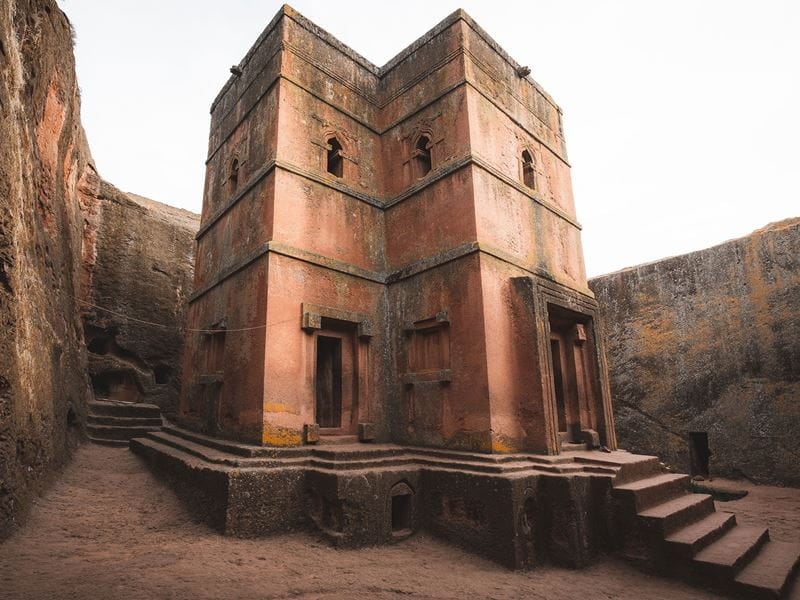
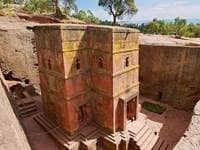
More than 800 years after their construction, the eleven “Holy Rock-Hewn Churches of Lalibela” (covering about 62 acres) still stand—and still provoke a sense of awe in those who see them. These mountain churches, built by unknown stonemasons, are each a monolith. Each one is built out of a single piece of stone, carved into the form of a functional building. Everything—the interior furnishings, decorations, molding, etc.—were all carved out of the same piece of rock. Indeed, the steps, window openings, and even decorative molding (on the outside) would have been carved before the interior was hallowed out. Once the exterior was largely completed, it is believed that craftsmen carved their way into the block of stone to chisel it into a functioning church building. Scholars, engineers, and historians are at a loss as to how these thirteenth-century stonemasons accomplished this incomprehensible engineering achievement. It remains a wonder, on par with Geza’s “Great Pyramids.”
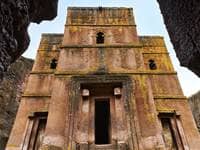
The various “Holy Rock-Hewn Churches” are actually connected to each other through a series of stairs and passageways, constituting a sort of labyrinth through which priests and patrons can move from one building to another, and from one part of the community to another. The Church of Saint George, or Bet Giyorgis (as it is called in Amharic—the official language of Ethiopia), is but one of the eleven stunning Monolith churches lodged in these Ethiopian mountains. Nonetheless, it is one of the best known of the eleven, and even the best known of the four “free-standing” churches, in part because it is perhaps the best built and most detailed. It has been deemed the “8th Wonder of the World”—and, when one visits, one can see why.
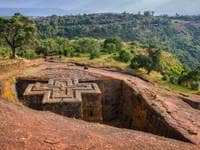
Based on the site and its surrounding rock, it appears that the Church of Saint George was built from above, carving downward into a field of tufa or sedimentary rock (sometimes referred to as “volcanic rock”). In the process, an enormous solid stone cross was created in the middle of a huge manmade pit. Once that was completed, the masons then shaped the exterior, carved openings for doors and windows, and finally began hallowing out the interior of this approximately 40-foot-high church. While it is not known how long it took to carve this specific church, the carving of all eleven “Holy Rock-Hewn Churches” is believed to have taken approximately 120 years—with the Saint George church being the last to be constructed.
Religious Significance
Whether one is Christian or not—and whether one is religious or not—visiting the Church of Saint George is nothing shy of a “spiritual experience.” This is particularly true the first time you encounter it, but even in subsequent visits. The awe, grandeur, and seemingly impossible nature of the edifice leaves one with the distinct impression that—if something like this can exist—there must be a God!
Among Orthodox Christians who make pilgrimages to this site, there is a tradition which states that the masons who constructed Saint George and its sister churches were assisted by angels—as no mortal man in that era could have envisioned the complex of “Holy Rock-Hewn Churches,” nor created them with the technology available at that time. This is particularly true of the four free-standing churches. Not a few scientists have thought the same thing, based on the ostensibly impossible accomplishment. Another related legend is that both God and Saint George appeared to King Lalibela, instructing him to build this particular church, and giving him the details as to how it should be constructed. The king claimed that he was told that (by these divine visitors) that, if he completed this task, it would “bring heaven down to earth.” Supposedly, upon completion of Saint George, an angel—perhaps Saint George himself—appeared and blessed those who were present.
The eleven churches are intentionally grouped together (though over a rather large spread) so as to represent the “earthly Jerusalem” and the “Heavenly Jerusalem.” Running between the two is a trench, said to be symbolic of the River Jordan. There is also a small baptismal font on the exterior of the church, along with some caves in the walls surrounding the building. Some of those caverns function as dwellings for the priests and others as tombs for pilgrims who die in route to the church.
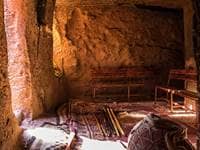
While its rural nature and lack of convenient access might make one think that this unique church is more of a tourist site than it is an actual functioning house of worship, nothing could be further from the truth. In actuality, Oriental Orthodox worship services are held in the church, including the traditional chanting, the iconography, the incense-filled air, and the white-clad priests. Unlike worship services held in modern Eastern Orthodox churches, participating in worship in Saint George’s leaves one with a distinct sense that one is having an experience akin to how those 1,000 years ago would have worshiped their God. It truly is a nearly unparalleled experience, leaving visitors with the strong sense that they are standing amid a miracle and, consequently, visiting hallowed grown.
Related
How Eastern Orthodox Wedding Crowns Are Made and Used
What are Some Fundamental Eastern Orthodox Beliefs or Doctrinal Teachings?
Do Christians Believe in Evolution?
Alonzo L. Gaskill PH.D.
Why Do Christians Celebrate Good Friday?
What is Excommunication, and Who Gets Excommunicated?
Kathleen Mulhern, Ph.D.
How Are Christianity, Judaism, and Islam Connected?
Eastern Orthodox
What are the Biggest Differences Between Eastern Orthodoxy and Mainstream Christianity
Eastern Orthodox

What are Some Fundamental Eastern Orthodox Beliefs or Doctrinal Teachings?
Patheos Explore the world's faith through different perspectives on religion and spirituality! Patheos has the views of the prevalent religions and spiritualities of the world.
Ad-Free & Subscriber Log-In Subscription Support
- About Us
- 2026 Calendar
- Videos
- Podcasts
- Library of World Religions
- Faith In Media Tracker
- Advertise With Us
- Write for Us
- Privacy Policy
- Terms of Service
- Do Not Sell My Data
- Contact Us
- Radiant Digital
- Manage Newsletter Subscriptions
- Unsubscribe From Notifications
- Sitemap
Copyright 2008-2026, Patheos. All rights reserved.
Subscription Support Ad-Free & Subscriber Log-In
Follow Patheos