
BuddhistCatholicContemplativeEvangelicalGeneral ChristianHinduJewishLatter-day SaintMuslimNew VisionsProgressive Christian
Beliefs
- Buddhist
- Catholic
- Contemplative
- Evangelical
- General Christian
- Hindu
- Jewish
- Latter-day Saint
- More Voices
- Muslim
- New Visions
- Pagan
- Progressive Christian
Topics
- Religion News
- Food and Religion
- Sports and Religion
- Religious Art
- Religious Music and Entertainment
- Religious Events
- History and Religion
- Style and Religion
- Politics and Religion
- Women in Religion
- Recreation Outdoors and Religion
- Business Finance and Religion
- Careers Workplace and Religion
- Education and Religion
- Family Parenting and Religion
- Health Fitness and Religion
- Home and Religion
- Relationships and Religion
- Technology and Religion
- Travel and Religion
Columnists
- Buddhist Columnists
- Business Finance and Religion Columnists
- Careers Workplace and Religion Columnists
- Catholic Columnists
- Contemplative Columnists
- Education and Religion Columnists
- Evangelists Columnists
- Family Parenting and Religion Columnists
- General Christian Columnists
- Health Fitness and Religion Columnists
- Hindu Columnists
- History and Religion Columnists
- Home and Religion Columnists
- Jewish Columnists
- More Voices Columnists
- Latter Day Columnists
- Muslim Columnists
- New Visions Columnists
- Nonreligious Columnists
- Pagan Columnists
- Politics and Religion Columnists
- Progressive Columnists
- Recreation Outdoors and Religion Columnists
- Relationships and Religion Columnists
- Religion News Columnists
- Religious Art Columnists
- Religious Events Columnists
- Religious Music and Entertainment Columnists
- Sports and Religion Columnists
- Style and Religion Columnists
- Technology and Religion Columnists
- Travel and Religion Columnists
- Women in Religion Columnists
Resource Library
- 2026 Calendar
- Library of World Religions
- The 100 Most Holy Places on Earth
- Patheos Answers
- Podcasts
- Videos
- Faith Leaders Database
- Anglican Episcopalian
- Bahai
- Baptist
- Buddhism
- Christianity
- Confucianism
- Eastern Orthodoxy
- Hinduism
- Holiness and Pentecostal
- ISKCON
- Islam
- Judaism
- Lutheran
- Methodist
- The Church of Jesus Christ of Latter-day Saints
- New Age
- Paganism
- Presbytarian and Reformed
- Protestantism
- Religion Behind the Scenes
- Roman Catholic
- Scientology
- Shia Islam
- Sikhism
- Sufism
- Sunni Islam
- Taoism
- Zen
- See all religions
Research Tools
 Ad-Free & Subscriber Log-In Subscription Support
Ad-Free & Subscriber Log-In Subscription Support
Follow Patheos 

- Trending:
- Forgiveness
- |
- Marriage
- |
- Consciousness
- |
- Death Penalty
- |
- Election
- |
- Halloween
patheos presents

The 100 Most Holy Places On Earth
number
26
Chartres Cathedral
Chartres Cathedral, France 


By Alonzo Gaskill | Updated: March 19, 2026 | Published: March 23, 2023
Also Known As:
Notre-Dame Cathedral
Chartres Cathedral
Notre-Dame d'Chartres
Associated Faiths:
Roman Catholicism
Also frequented by Christians of other High and Low-Church traditions, in addition to tourists of non-Christian traditions
Accessibility:
Open to visitors.
Annual visitors: 13,600,000
History
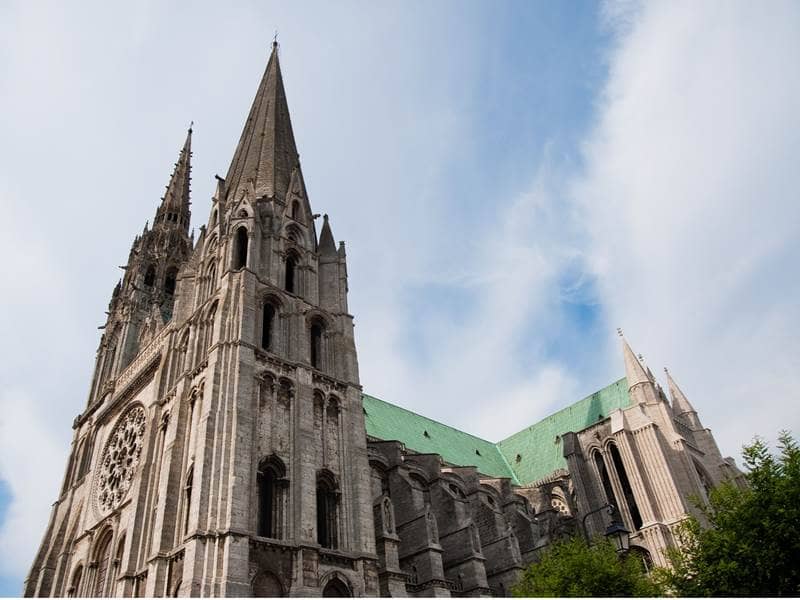
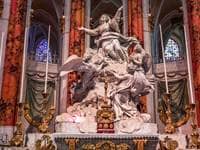
Chartres’ Notre Dame Cathedral is a 12th-13th century High Gothic/Romanesque edifice dedicated to the Virgin Mary—the name “Notre Dame” meaning literally “Our Lady.” (There are more than 100 churches and cathedrals in France dedicated to Notre-Dame.) Located in the northwest of France, Chartres Cathedral (only about 56 miles southwest of Paris) is one of the most iconic of Roman Catholic cathedrals—and certainly one of the most well-known. The 167 famed widows of the cathedral are said to feature more than 5,000 “figures” representing various scenes from the Bible and the lives of Roman Catholic saints. Notre-Dame’s “rose windows” are unparalleled examples of Gothic architecture. Indeed, the windows—which bathe the interior of the cathedral with a bluish light, are said to be “one of the most important collections of stained glass in the world.”
Because of the span of time required to build the cathedral, the architecture is somewhat inconsistent. For example, the façade of the church and its right tower were completed somewhere around 1150 AD and are Romanesque in style. (Those were part of a previous edifice being built, which caught fire in 1194.) However, the left tower was constructed in a lighter Gothic style, noticeably different from its Romanesque predecessor. The “rose window” in the front of the cathedral is decidedly Gothic in its style.
Surprisingly, a variety of dates are often given for the construction of the Notre Dame Cathedral—largely because part of the building is actually the remnant of its predecessor (destroyed by fire in the 12th century). Nevertheless, the current structure was built mostly between 1194-1260 AD—and consecrated in October of 1260 (in the presence of King Louis IX). The Chartres Cathedral rests on a site held sacred even before the Common Era. There is evidence of cultic rites being performed on the cathedral’s hill; ritual activity which dates to pre-Christian times. The location of the current edifice is believed by many to have once been the site of a pagan Druid temple and grotto—the latter being known in antiquity as the “Pregnant Virgin.” (Some contest this wildly held belief.) According to some historians, the Druid temple was eventually replaced by a Roman temple and, from there, numerous Christian buildings.
The Diocese of Chartres was formed (as an episcopal see) in the 4th century AD and Christians have occupied this site since that time. Some sources claim that the first Christin church built on this site dates to the 4th century but was “torched” (by order of the Duke of Aquitaine) in the mid-8th century. We know of five different churches which have been built at this location prior to the current cathedral—which is said to have been constructed over approximately a century by “master monks.” Each of Notre-Dame’s predecessors were damaged or destroyed by fire or during the French Revolutionary War. In a fit of irony, Notre-Dame d’Chartres is often confused with Notre-Dame de Paris (which was nearly destroyed in an April 2019 fire). While less than 60 miles apart, and while both sporting the name “Notre-Dame,” the two cathedrals are not the same. The one is the see of the Bishop of Paris and the other the Bishop of Chartres. Nonetheless, both have sadly had their history of destruction by fire.
Religious Significance
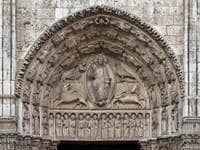
Among those who accept the belief that the site of the Charters Cathedral was once the location of a pagan temple and grotto (known as the “Pregnant Virgin”), this is an ancient “sacred site.” One of the common claims is that, in pre-Christian times, barren women would come to the Druid temple which occupied this site to petition a pagan goddess of fertility, in the hopes that they might conceive. Consequently, if these claims by historians are accurate, then Christianity is not the first religion to sacralize this local. Indeed, some have claimed that the Christian cathedral was built on this very spot specifically because the spot was considered sacred by previous inhabitants. The fact that one of the carvings on the Notre-Dame Cathedral depicts Anne and Joachim (the Virgin Mary’s barren parents) has been seen by some as evidence that those who build the Christian church on this site knew about the preceding pagan legends of fertility miracles happening on this site.
As with all Roman Catholic and Eastern Orthodox churches, the Notre-Dame Cathedral houses sacred relics, thereby making in “sacred space.” While Notre-Dame d'Chartres has multiple relics, its most important is the “Sancta Camisa” (or sacred veil) worn by the Virgin Mary on the night she gave birth to the baby Jesus. According to the traditional account, the Holy Roman emperor, Charles II (known as “Charles the Bald”), discovered and donated the veil to the diocese (in 876 AD), and it was housed in the church which was the immediate predecessor to the current Notre-Dame Cathedral. When that church was struck by lightning (in 1194) and mostly burned to the ground, attempts to squelch the fire failed, and the flames rapidly spread—destroying nearly the entire village. However, as debris was removed (once the fire had been extinguished), the veil of the Virgin was discovered unscathed in a crypt below the rubble of the church, where priests had retreated with it in order to protect the sacred relic. It is now housed in the current Notre-Dame cathedral (at Chartres)—having been on display since medieval times. That specific relic makes this a holy site for pilgrims, as it has been for centuries.
As just noted, while the cathedral was under construction, a fire destroyed much of the building. That catastrophic inferno was understood (at the time) as a sign from the Virgin Mary that she was not happy with the building being constructed in her name. The monks constructing the cathedral believed she was saying (through the lightning provoked fire) that the edifice the monks were constructing needed to be larger and more elegant, because of the nature of the relic it would house (i.e., the “Sancta Camisa”). Thus, in order to properly honor the tunic of the Theotokos (or Mother of God), a more elaborate cathedral was constructed—starting in 1194.
In addition to the relic of the Virgin Mary, Notre-Dame d’Chartres also contains relics of Saint Piatus of Tournai—a 3rd century AD Belgian saint famous for his evangelizing of Chartres and nearby Tournai. Martyred under the order of Maximian, Piatus had the top of his skull chopped off. In the 7th century, Piatus’ relics were found (by Saint Eligius) and a portion of them have been enshrined in a reliquary in Notre Dame since that time.
Christians have been flocking to the site of the Notre-Dame d'Chartres Cathedral since the end of the 12th century AD—making it one of the most important and frequently visited Christian sties in all of Europe. And yet, owing to the location’s pagan beginnings, the suggestion is that Chartres and, more particularly, the hill on which the current cathedral rests has been a place of pilgrimage for more than two millennia. The ancient pilgrims to the site sought physical life (through fertility and the birth of a baby). However, Christian pilgrims flock to the site today to seek eternal life from the birth of the “babe of Bethlehem.”
Related
The One Thing You Have Never Seen: Yourself
Three Days Attempting to Reach Mary Magdalene's Cave

Yogi Chen & Chinese Vajrayana: A Personal Account
Hildegard as a Pan-Spiritual Saint

Our Divided Hearts: A Zen Meditatioin
Zen and the Dance of Not Knowing
Zen, Unitarian Universalism, and a Writer's Life
Recalling America's Conscience Robert Ingersoll
Patheos Explore the world's faith through different perspectives on religion and spirituality! Patheos has the views of the prevalent religions and spiritualities of the world.
Ad-Free & Subscriber Log-In Subscription Support
- About Us
- 2026 Calendar
- Videos
- Podcasts
- Library of World Religions
- Faith In Media Tracker
- Advertise With Us
- Write for Us
- Privacy Policy
- Terms of Service
- Do Not Sell My Data
- Contact Us
- Radiant Digital
- Manage Newsletter Subscriptions
- Unsubscribe From Notifications
- Sitemap
Copyright 2008-2026, Patheos. All rights reserved.
Subscription Support Ad-Free & Subscriber Log-In
Follow Patheos