
BuddhistCatholicContemplativeEvangelicalGeneral ChristianHinduJewishLatter-day SaintMuslimNew VisionsProgressive Christian
Beliefs
- Buddhist
- Catholic
- Contemplative
- Evangelical
- General Christian
- Hindu
- Jewish
- Latter-day Saint
- More Voices
- Muslim
- New Visions
- Pagan
- Progressive Christian
Topics
- Religion News
- Food and Religion
- Sports and Religion
- Religious Art
- Religious Music and Entertainment
- Religious Events
- History and Religion
- Style and Religion
- Politics and Religion
- Women in Religion
- Recreation Outdoors and Religion
- Business Finance and Religion
- Careers Workplace and Religion
- Education and Religion
- Family Parenting and Religion
- Health Fitness and Religion
- Home and Religion
- Relationships and Religion
- Technology and Religion
- Travel and Religion
Columnists
- Buddhist Columnists
- Business Finance and Religion Columnists
- Careers Workplace and Religion Columnists
- Catholic Columnists
- Contemplative Columnists
- Education and Religion Columnists
- Evangelists Columnists
- Family Parenting and Religion Columnists
- General Christian Columnists
- Health Fitness and Religion Columnists
- Hindu Columnists
- History and Religion Columnists
- Home and Religion Columnists
- Jewish Columnists
- More Voices Columnists
- Latter Day Columnists
- Muslim Columnists
- New Visions Columnists
- Nonreligious Columnists
- Pagan Columnists
- Politics and Religion Columnists
- Progressive Columnists
- Recreation Outdoors and Religion Columnists
- Relationships and Religion Columnists
- Religion News Columnists
- Religious Art Columnists
- Religious Events Columnists
- Religious Music and Entertainment Columnists
- Sports and Religion Columnists
- Style and Religion Columnists
- Technology and Religion Columnists
- Travel and Religion Columnists
- Women in Religion Columnists
Resource Library
- 2026 Calendar
- Library of World Religions
- The 100 Most Holy Places on Earth
- Patheos Answers
- Podcasts
- Videos
- Faith Leaders Database
- Anglican Episcopalian
- Bahai
- Baptist
- Buddhism
- Christianity
- Confucianism
- Eastern Orthodoxy
- Hinduism
- Holiness and Pentecostal
- ISKCON
- Islam
- Judaism
- Lutheran
- Methodist
- The Church of Jesus Christ of Latter-day Saints
- New Age
- Paganism
- Presbytarian and Reformed
- Protestantism
- Religion Behind the Scenes
- Roman Catholic
- Scientology
- Shia Islam
- Sikhism
- Sufism
- Sunni Islam
- Taoism
- Zen
- See all religions
Research Tools
 Ad-Free & Subscriber Log-In Subscription Support
Ad-Free & Subscriber Log-In Subscription Support
Follow Patheos 

- Trending:
- Forgiveness
- |
- Marriage
- |
- Consciousness
- |
- Death Penalty
- |
- Election
- |
- Halloween
patheos presents

The 100 Most Holy Places On Earth
number
50
Buddhist Monuments at Sanchi
Sanchi Town, Madhya Pradesh, India 


By Alonzo Gaskill | Updated: March 19, 2026 | Published: March 23, 2023



Also Known As:
Sanchi Stupa
Associated Faiths:
Buddhist
Accessibility:
The exterior complex of the stupa is open to visitors and is an expansive complex. However, visitors cannot enter the actual stupa.
Annual visitors: 200,000
History
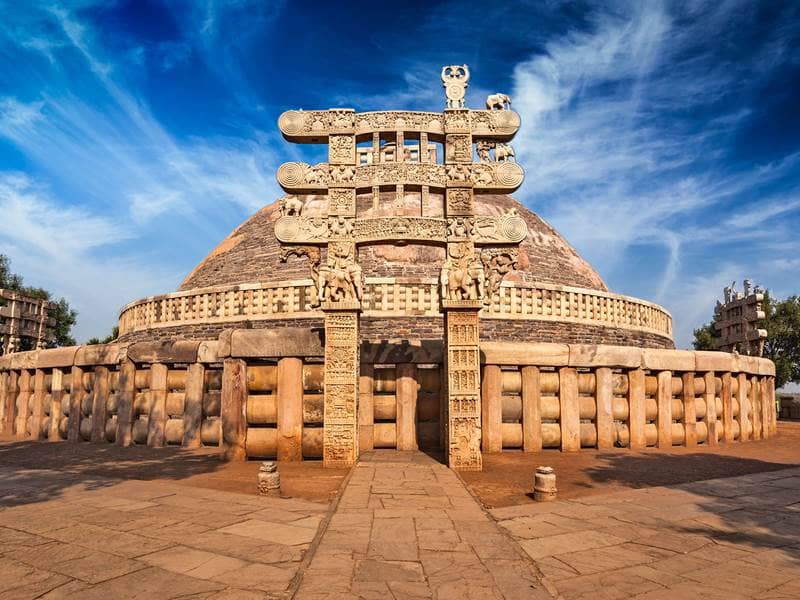
The Sanchi Stupa is an ancient Buddhist site in the small town of Sanchi—in the Indian state of Madhya Pradesh (which is part of central India). While the significance of the site (as a center of pilgrimage) dates to the pre-Christian era, it was lost or forgotten (because of the gradual decline of Buddhism in India). The stupa was only rediscovered in the early 19th century by a British military officer serving in the region. Since then, it has once again become an important site for Buddhists, after laying fallow for approximately 800 years.
On a hilltop that overlooks the little town of Sanchi, are the remains of a once thriving Buddhist place of pilgrimage. Indeed, the walled-in hilltop contains a number of impressive monuments and sculptures—including what is known as the “Great Stupa”—constructed in the 3rd century BCE by Emperor Ashoka (the first Buddhist emperor of India). That stupa is said to encase an earlier structure built on that same site—to house relics associated with the Buddha. In the first century BCE, four elaborate arched gateways were created, containing important carvings which depict scenes from the Buddha’s life, as well as other events important to Buddhist history. Around the site are also two smaller stupas (containing the remains of two of Sidhartha’s most devoted disciples). Also located on the hill are the remnants of various temples and a former Buddhist monastery. The site’s “Great Stupa” is one of the oldest surviving stone structures in all of India.
There is no evidence that Sidhartha Gautama (the historic Buddha) ever visited or spent time in Sanchi. Nevertheless, the “Great Stupa” on the site is said to contain relics of Sidhartha Gautama. This is possible because, more than a century after the cremation of the Buddha, King Ashoka (whose wife was from Sanchi and who held their wedding in the town) had Sidharth’s ashes and other associated relics distributed to 84,000 stupas. Consequently, the Sanchi Stupa—which was commissioned by Ashoka and which had a sentimental place in the heart of the King—naturally would have a portion of those ashes, if not other relics as well.
In addition to being able to view the three stupas atop the Sanchi hill, one can wander the site, seeing the remains of various once important temples, shrines, statues, carvings, and monastic lodgings. A short distance from the base of the hill is an archeological museum. It is said to house various artifacts unearthed when the site was rediscovered (in the 19th century) by General Taylor of the Bengal Cavalry. As the site was renovated, various things found atop the hill were moved to the museum for viewing and safekeeping.
Religious Significance
Stupas are an important part of Buddhism, originally used by Buddhists to house relics associated with the “historical Buddha”—Sidhartha Gautama (circa 563-483 BCE). According to tradition, Emperor Ashoka (circa 268-232 BCE) divided the Buddha’s remains into 84,000 parts, so that a relic of Sidhartha could be placed in 84 thousand places throughout the world. So, initially, all religiously built stupas were somehow connected to the most famous Buddha, Sidhartha Gautama. However, over time, stupas were built to honor other Buddhas and saintly figures as well. This is why the hilltop of Sanchi has two stupas, one in honor of Śāriputra and another in honor of Maudgalyāyana (who lit the Buddha’s funeral pyre, cremating him).
Stupas have become “sacred sites” and “places of pilgrimage” specifically because of what they house. However, they are also perceived as holy because of certain miraculous events which are believed by practitioners to have taken place at the site of their construction, or in the lives of those whom they honor. So, for example, on the four gates to the Sanchi Stupa one finds depicted various miracles associated with the life of the Buddha—including his miraculous birth and seven incarnations. Sidhartha’s life has many components which would qualify as “miraculous” and which provoke awe from and veneration by practitioners of Buddhism.
Worship at stupas traditionally consists of believers circumambulating the stupa in a clockwise direction, recognizing that the central relic of the stupa is enshrined therein. For some Buddhists, the relic—in whatever form it may be—holds the powers of the deceased holy person to whom the relic is attached. Thus, visits to that stupa can activate the power of the deceased in the life of the believer.
The presence of an actual piece of the “historical” Buddha’s remains—or the remains of another Buddha (as in the case of the two smaller stupas on this site)—creates “sacred space” for those who visit a stupa. Not only do pilgrims traditionally believe that they can tap into the power present therein, but they also feel that they are walking on “holy ground” during their pilgrimage to one of the 84,000 stupas throughout the world.
Related


Patheos Explore the world's faith through different perspectives on religion and spirituality! Patheos has the views of the prevalent religions and spiritualities of the world.
Ad-Free & Subscriber Log-In Subscription Support
- About Us
- 2026 Calendar
- Videos
- Podcasts
- Library of World Religions
- Faith In Media Tracker
- Advertise With Us
- Write for Us
- Privacy Policy
- Terms of Service
- Do Not Sell My Data
- Contact Us
- Radiant Digital
- Manage Newsletter Subscriptions
- Unsubscribe From Notifications
- Sitemap
Copyright 2008-2026, Patheos. All rights reserved.
Subscription Support Ad-Free & Subscriber Log-In
Follow Patheos