
BuddhistCatholicContemplativeEvangelicalGeneral ChristianHinduJewishLatter-day SaintMuslimNew VisionsProgressive Christian
Beliefs
- Buddhist
- Catholic
- Contemplative
- Evangelical
- General Christian
- Hindu
- Jewish
- Latter-day Saint
- More Voices
- Muslim
- New Visions
- Pagan
- Progressive Christian
Topics
- Religion News
- Food and Religion
- Sports and Religion
- Religious Art
- Religious Music and Entertainment
- Religious Events
- History and Religion
- Style and Religion
- Politics and Religion
- Women in Religion
- Recreation Outdoors and Religion
- Business Finance and Religion
- Careers Workplace and Religion
- Education and Religion
- Family Parenting and Religion
- Health Fitness and Religion
- Home and Religion
- Relationships and Religion
- Technology and Religion
- Travel and Religion
Columnists
- Buddhist Columnists
- Business Finance and Religion Columnists
- Careers Workplace and Religion Columnists
- Catholic Columnists
- Contemplative Columnists
- Education and Religion Columnists
- Evangelists Columnists
- Family Parenting and Religion Columnists
- General Christian Columnists
- Health Fitness and Religion Columnists
- Hindu Columnists
- History and Religion Columnists
- Home and Religion Columnists
- Jewish Columnists
- More Voices Columnists
- Latter Day Columnists
- Muslim Columnists
- New Visions Columnists
- Nonreligious Columnists
- Pagan Columnists
- Politics and Religion Columnists
- Progressive Columnists
- Recreation Outdoors and Religion Columnists
- Relationships and Religion Columnists
- Religion News Columnists
- Religious Art Columnists
- Religious Events Columnists
- Religious Music and Entertainment Columnists
- Sports and Religion Columnists
- Style and Religion Columnists
- Technology and Religion Columnists
- Travel and Religion Columnists
- Women in Religion Columnists
Resource Library
- 2026 Calendar
- Library of World Religions
- The 100 Most Holy Places on Earth
- Patheos Answers
- Podcasts
- Videos
- Faith Leaders Database
- Anglican Episcopalian
- Bahai
- Baptist
- Buddhism
- Christianity
- Confucianism
- Eastern Orthodoxy
- Hinduism
- Holiness and Pentecostal
- ISKCON
- Islam
- Judaism
- Lutheran
- Methodist
- The Church of Jesus Christ of Latter-day Saints
- New Age
- Paganism
- Presbytarian and Reformed
- Protestantism
- Religion Behind the Scenes
- Roman Catholic
- Scientology
- Shia Islam
- Sikhism
- Sufism
- Sunni Islam
- Taoism
- Zen
- See all religions
Research Tools
 Ad-Free & Subscriber Log-In Subscription Support
Ad-Free & Subscriber Log-In Subscription Support
Follow Patheos 

- Trending:
- Forgiveness
- |
- Marriage
- |
- Consciousness
- |
- Death Penalty
- |
- Election
- |
- Halloween
patheos presents

The 100 Most Holy Places On Earth
number
49
Batu Caves
Selangor, Malaysia 


By Alonzo Gaskill | Updated: March 19, 2026 | Published: March 23, 2023


Also Known As:
Batu Caves at Gombak
Associated Faiths:
Accessibility:
Open to visitors.
Annual visitors: 2,000,000
History
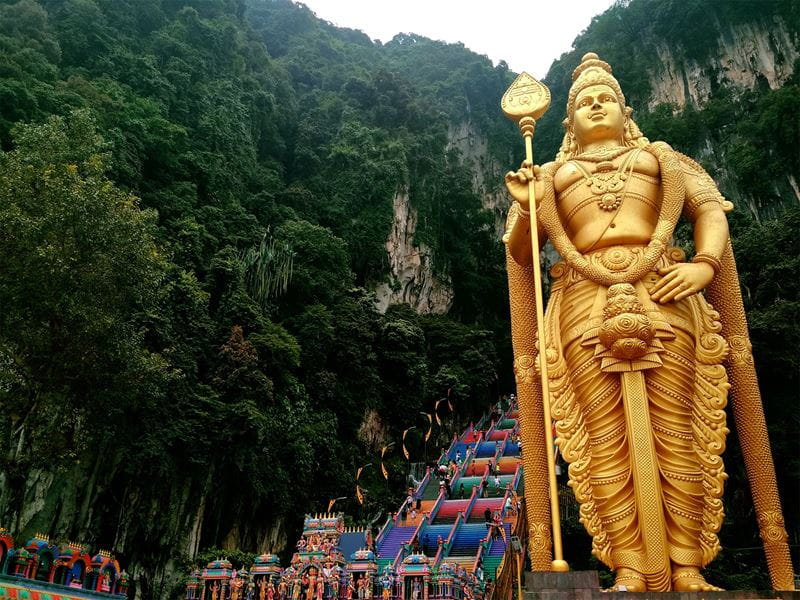
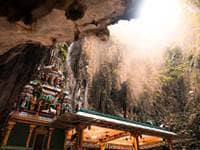
“Batu” is a Malay word, which means “rock.” These caves are so named for no other reason than they are a series of natural limestone caves (in Malyaia). They are believed to be around 400 million years old and are today used by Hindus as “cave temples.” Though the caves are ancient, to say the least, they have only been used as Hindu sanctuaries in modern times.
In the late 19th century, K. Thamboosamy Pillai (an Indian trader) was moved by the shape of the entrance to the main cave, as it reminded him of the “divine javelin” or spear that is typically held by Murugan, one of the Hindu gods associated with warfare. As a consequence of this connection, Pillai dedicated the spot as a temple to Lord Murugan. As part of his hallowing of this spot, he placed within the main cave a mutri (or consecrated image of the god, typically used as the focus of worship in Hinduism). From that time forward (circa 1890), the main cave of the Batu Caverns has been unutilized as a “Temple Cave.”
Only two years after the image of the god was established in the cave, Hindus began to celebrate at that site the annual Thaipusam (or Thaipoosam) festival—which commemorates a legendary series of battles between the Asuras and the Devas, in which Lord Shiva intervened, enabling the Devas to defeat the Asura forces.
The development of the caves into a holy shrine and pilgrimage site has actually impacted the area significantly. Over time, and as a result of pilgrims coming there to worship, a series of housing developments have been created, as have retail stores, a rock-climbing center, a commuter train, and other industrial components. In many ways, for good or ill, this shrine has turned a small rural village into a fairly significant commercial and residential center.
Religious Significance
From pre-historic times, caves have been perceived as “sacred space” by many traditions and many peoples. Aside from the shelter they provided, prior to modern construction, they served as the earliest “sanctuaries” to which practitioners and priests would journey in order to make contact with and worship the divine. The cave was believed by many ancient peoples to be the “womb of Mother Earth.” Thus, caves were traditionally the sites of initiation. Inductees would enter a cave to receive “hidden” or “secret” knowledge. In doing so, they would symbolically let their old self “die,” as they were “reborn” through the sacred rites—leaving the cave as new person just as a baby leaves the womb as a new human.
The Batu Caves—and particularly the central “Temple Cave”—have become an important pilgrimage site for Hindus. It serves those, not just from Malaysia, but from other parts of the world as well. However, this temple dedicated to Lord Murugan, is particularly important to the Tamil people. (Murugan is also known by the names Kartikeya, Skanda, Subrahmanya, and Shanmukha. He is the son of Shiva and Parvati, and the brother of Ganesha.)
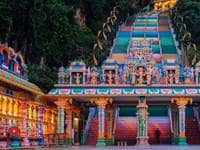
During the Tamil month of Thai (late January/early February), Hindus gather to commemorate the annual Thaipusam festival. Before the sun even arises, pilgrims gather at the Sri Mahamariamman Temple (in Kuala Lumpur) to participate in an approximately three-hour procession to the Batu Caves—the entire procession, worship experience, and return, lasing around eight hours. Offerings to Lord Muruga (the god the temple is dedicated to) are carried along the processional, either in jars, on in a kavadi— which is a sort of “float” used to carry offerings, such as milk, flowers, etc. (Kavadi which means “burden,” and it is called that both because of the heaviness of the carriage and because it has sharpened ends which pierce the torsos of those who carry it.) The offerings are carried and offered to Lord Murugan as a means of gaining healing, achieving release from a spiritual debt incurred, or to remove some physical burden carried by the worshiper. As part of the pilgrimage processional (to the Temple), devotees engage in a ritual washing in the Sungai Batu river, and then make their way up the nearly 300 stairs which lead to the entrance of the main cave in order to engage in darshan (or the viewing of the idol), the making of offerings, and the offering up of their petitions or requests to the deity.
As with any Hindu shrine or temple, the Batu Temple Cave is important because, for believers, entrance into the shrine is equivalent to entrance into the presence of the deity. Many Hindus believe that bakti (or “devotion”) has the ability to short-circuit one’s negative accountability (or “karma”). This leads to forgiveness, enlightenment, and potential freedom from the seemingly endless cycle of rebirths. Thus, the potential blessings of such a pilgrimage are incalculable and precious behind imagination.
Related
How Does Powder For Holi Festivals Get Made?
Hormuz: A Shared Hindu and Zoroastrian Heritage
The Four Comforting Myths Hindus Tell Themselves
From Wall Street to Maha Kumbh: Yakub Mathew’s Bold Debut
The Dhwaja(Flag)Over Ayodhya: A Hindu Civilisational Revival

Conversion Zealots and Interfaith Marriages: A Dharmic Lens

Interfaith Harmony Through a Dharmic Lens: Katrina & Vicky
Patheos Explore the world's faith through different perspectives on religion and spirituality! Patheos has the views of the prevalent religions and spiritualities of the world.
Ad-Free & Subscriber Log-In Subscription Support
- About Us
- 2026 Calendar
- Videos
- Podcasts
- Library of World Religions
- Faith In Media Tracker
- Advertise With Us
- Write for Us
- Privacy Policy
- Terms of Service
- Do Not Sell My Data
- Contact Us
- Radiant Digital
- Manage Newsletter Subscriptions
- Unsubscribe From Notifications
- Sitemap
Copyright 2008-2026, Patheos. All rights reserved.
Subscription Support Ad-Free & Subscriber Log-In
Follow Patheos