
BuddhistCatholicContemplativeEvangelicalGeneral ChristianHinduJewishLatter-day SaintMuslimNew VisionsProgressive Christian
Beliefs
- Buddhist
- Catholic
- Contemplative
- Evangelical
- General Christian
- Hindu
- Jewish
- Latter-day Saint
- More Voices
- Muslim
- New Visions
- Pagan
- Progressive Christian
Topics
- Religion News
- Food and Religion
- Sports and Religion
- Religious Art
- Religious Music and Entertainment
- Religious Events
- History and Religion
- Style and Religion
- Politics and Religion
- Women in Religion
- Recreation Outdoors and Religion
- Business Finance and Religion
- Careers Workplace and Religion
- Education and Religion
- Family Parenting and Religion
- Health Fitness and Religion
- Home and Religion
- Relationships and Religion
- Technology and Religion
- Travel and Religion
Columnists
- Buddhist Columnists
- Business Finance and Religion Columnists
- Careers Workplace and Religion Columnists
- Catholic Columnists
- Contemplative Columnists
- Education and Religion Columnists
- Evangelists Columnists
- Family Parenting and Religion Columnists
- General Christian Columnists
- Health Fitness and Religion Columnists
- Hindu Columnists
- History and Religion Columnists
- Home and Religion Columnists
- Jewish Columnists
- More Voices Columnists
- Latter Day Columnists
- Muslim Columnists
- New Visions Columnists
- Nonreligious Columnists
- Pagan Columnists
- Politics and Religion Columnists
- Progressive Columnists
- Recreation Outdoors and Religion Columnists
- Relationships and Religion Columnists
- Religion News Columnists
- Religious Art Columnists
- Religious Events Columnists
- Religious Music and Entertainment Columnists
- Sports and Religion Columnists
- Style and Religion Columnists
- Technology and Religion Columnists
- Travel and Religion Columnists
- Women in Religion Columnists
Resource Library
- 2026 Calendar
- Library of World Religions
- The 100 Most Holy Places on Earth
- Patheos Answers
- Podcasts
- Videos
- Faith Leaders Database
- Anglican Episcopalian
- Bahai
- Baptist
- Buddhism
- Christianity
- Confucianism
- Eastern Orthodoxy
- Hinduism
- Holiness and Pentecostal
- ISKCON
- Islam
- Judaism
- Lutheran
- Methodist
- The Church of Jesus Christ of Latter-day Saints
- New Age
- Paganism
- Presbytarian and Reformed
- Protestantism
- Religion Behind the Scenes
- Roman Catholic
- Scientology
- Shia Islam
- Sikhism
- Sufism
- Sunni Islam
- Taoism
- Zen
- See all religions
Research Tools
 Ad-Free & Subscriber Log-In Subscription Support
Ad-Free & Subscriber Log-In Subscription Support
Follow Patheos 

- Trending:
- Forgiveness
- |
- Marriage
- |
- Consciousness
- |
- Death Penalty
- |
- Election
- |
- Halloween
patheos presents

The 100 Most Holy Places On Earth
number
87
Shrine Of Our Lady Of Walsingham
Walsingham, England 


By Alonzo Gaskill | Updated: March 19, 2026 | Published: March 23, 2023
Associated Faiths:
Also frequented by Christians of other High and Low-Church traditions.
Accessibility:
Open to visitors.
Annual Visitors: 250,000
History
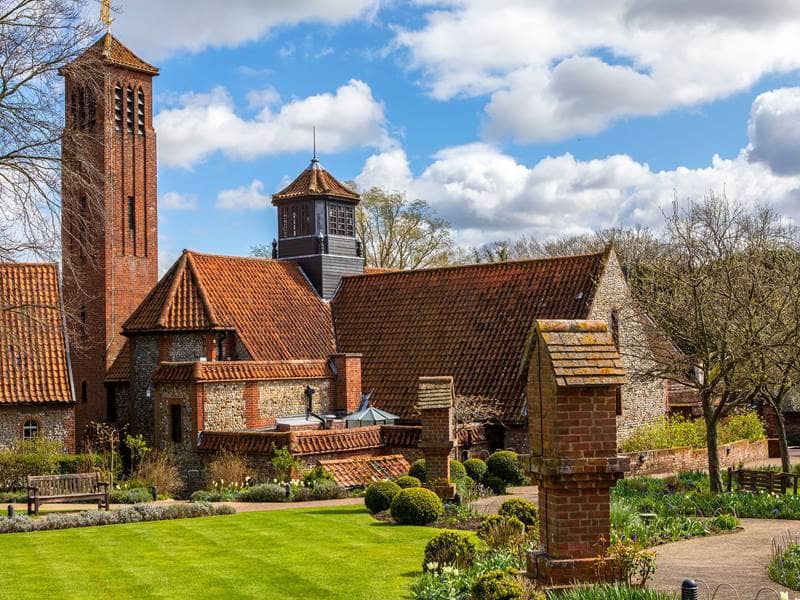
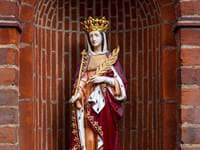
The Shrine Of Our Lady Of Walsingham is an Anglican Church build in 1938. It commemorates a series of 11th or 12th century Marian visitations said to have been received by a member of the British aristocracy. Specifically affiliated with the Church of England, the Marian figure of Our Lady Of Walsingham is also reverenced in Roman Catholicism and in some High Church Eastern Rite traditions as well.
Richeldis de Faverches (sometimes referred to as Rychold) was an English Roman Catholic and noblewoman who, according to tradition, had three visions of the Virgin Mary (sometime in AD 1061). Several historians have called into question this date, saying that Richeldis de Faverches most likely lived and had her purported visions sometime between AD 1130-1153. Rychold had been seeking for some service she could perform to honor the Virgin Mary, whom she had great adoration for. She indicated that the Virgin actually appeared to her and showed her (in vision) the place of the Annunciation (in the city of Nazareth)—where the angel Gabriel appeared to the young virgin, letting her know that she would conceive the Son of God. Rychold was commanded by Mary to fulfill her desire to make an offering to the Virgin by building a replica of the “house of annunciation”—but to do so in Norfolk, England. Mary indicated that this would then serve as a place of pilgrimage for those devoted to her, and that those who sought her aid at the Walsingham shrined “would not go away emptyhanded.”
The shrine has been a place of pilgrimage from at least the early 16th century. We know, for example, that the Dutch Humanist, Erasmus, visited it around 1512. Other noteworthy pilgrims who visited the original shrine include Kings Henry III, Edward II, Edward III, Henry IV, Edward IV, Henry VII and Henry VIII (the latter of which ordered it destroyed in 1538). While the shrine today is in no way the original, nonetheless, that which marks the spot of the Marian visitations and original resulting shrine draws a quarter of a million visitors each year.
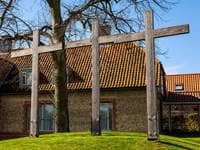
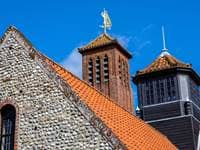
The original 11th or 12th century shrine was small, only around 24’x13’—or just over 300 square feet in size. It had five turrets or towers, with the central one being the tallest. Because of the effect of the weather on the original shrine, it was eventually stone encased to prevent deterioration. However, it was destroyed under the order of Henry VIII (as part of the King’s rejection of Papal encroachment), and the statue of the Virgin Mary housed in the original shrine is said to have been burned. The current church occupying the site was built in 1938, but (during the 1960s) it was expanded into a larger edifice. The current shrine complex includes the shrine-church, several small chapels, a café, the college house (for priests in residence), a fruit cellar (or “orangery”), the gardens, what’s known as the “pilgrims’ hall,” a refectory, a giftshop, a visitor’s center, and lodgings for pilgrims.
Religious Significance
It is always the case that any site associated with a credible claim of an appearance of an angel is sacral—not just in Christianity, but in religious traditions generally speaking. And, in High Church Christian traditions, sites associated with the lives of Mary or Jesus—or visitations by either of those two—are “sacred space” for believing pilgrims. The Shrine Of Our Lady Of Walsingham is no exception. Because of the three visions which are believed to have been received near there, and because of several miracles associated with the site after the visitations, many believe it to be hallowed ground.
One of the most important miracles associated with this shrine—evidencing in the minds of believers that it was the Virgin Mary’s will that it be built—has to do with the miraculous way in which the shrine was completed. As the story is told, well before the project was completed, Rychold was engaged in a late-night prayer vigil. However, her prayers were disturbed by the sound of singing outside of her residence. She followed the sound into her garden, where she found that only yards from the partially built “Annunciation House” replica, there was a completed edifice—which angels had built that very night. Indeed, Rychold indicated that she actually arrived in time to see the angels leaving the spot, as they had finished their construction of the shrine while she had been praying. As a consequence, believers perceived a pilgrimage to the original Walsingham shrine as an opportunity to literally enter a building build by angels—not men. Holy indeed!
As with so many Marian shrines, water—in the form of a lake, stream, or well—is a common feature. The Shrine Of Our Lady Of Walsingham has its own “holy well” which is the source of water many believe to have healing properties. This “holy water” is not the traditional kind one finds at one’s local parish, having been blessed by a priest. Rather, the water of Walshingham’s well is believed to have innate healing properties. Pilgrims are sprinkled with it in processionals. But many also come to acquire some, to drink or to distribute among their loved ones who might be sick or otherwise afflicted. The healing waters are sometimes used to anoint the sick, or used as part of some form of the laying on of hands, as mentioned in the Bible.
Nazareth’s Basilica of the Annunciation is a common pilgrimage site for Christians visiting the Holy Land—and for obvious reasons. However, many are unaware of Norfolk’s Shrine Of Our Lady Of Walsingham. While the latter of the two is not the site where Mary received her vision of the angel Gabriel, it is the site where the Virgin Mary thrice appeared. And both sites commemorate one of the most important events in Christian history—the annunciation of the birth of Christ, which would lead (according to Christian belief) to Christ’s ransom sacrifice, which offers salvation to the entire world. Thus, as sacral as the Holy Land is, the teeny civil parish of Walsingham is a “sacred site” to devotees of the Virgin Mary, because of her appearances there, because of the miracle she commissioned in building the original shrine, and because she continues to heal believing pilgrims through the holy water that she causes to bubble up from the earth..
Related
At Easter, all Christians are witnesses!
On healing, and stepping into the light of God's love...

Do Christians Believe in Evolution?
Alonzo L. Gaskill PH.D.

Do Christians Celebrate Passover?
Alonzo L. Gaskill PH.D.
What Are The Abrahamic Religions?
Alonzo L Gaskill, PH.D.
Who Wrote Each Book of the Bible?
Alonzo L. Gaskill, PH.D.
Why Are There so Many Different Denominations of Christianity?
Alonzo L. Gaskill, PH.D.
Patheos Explore the world's faith through different perspectives on religion and spirituality! Patheos has the views of the prevalent religions and spiritualities of the world.
Ad-Free & Subscriber Log-In Subscription Support
- About Us
- 2026 Calendar
- Videos
- Podcasts
- Library of World Religions
- Faith In Media Tracker
- Advertise With Us
- Write for Us
- Privacy Policy
- Terms of Service
- Do Not Sell My Data
- Contact Us
- Radiant Digital
- Manage Newsletter Subscriptions
- Unsubscribe From Notifications
- Sitemap
Copyright 2008-2026, Patheos. All rights reserved.
Subscription Support Ad-Free & Subscriber Log-In
Follow Patheos