
BuddhistCatholicContemplativeEvangelicalGeneral ChristianHinduJewishLatter-day SaintMuslimNew VisionsProgressive Christian
Beliefs
- Buddhist
- Catholic
- Contemplative
- Evangelical
- General Christian
- Hindu
- Jewish
- Latter-day Saint
- More Voices
- Muslim
- New Visions
- Pagan
- Progressive Christian
Topics
- Religion News
- Food and Religion
- Sports and Religion
- Religious Art
- Religious Music and Entertainment
- Religious Events
- History and Religion
- Style and Religion
- Politics and Religion
- Women in Religion
- Recreation Outdoors and Religion
- Business Finance and Religion
- Careers Workplace and Religion
- Education and Religion
- Family Parenting and Religion
- Health Fitness and Religion
- Home and Religion
- Relationships and Religion
- Technology and Religion
- Travel and Religion
Columnists
- Buddhist Columnists
- Business Finance and Religion Columnists
- Careers Workplace and Religion Columnists
- Catholic Columnists
- Contemplative Columnists
- Education and Religion Columnists
- Evangelists Columnists
- Family Parenting and Religion Columnists
- General Christian Columnists
- Health Fitness and Religion Columnists
- Hindu Columnists
- History and Religion Columnists
- Home and Religion Columnists
- Jewish Columnists
- More Voices Columnists
- Latter Day Columnists
- Muslim Columnists
- New Visions Columnists
- Nonreligious Columnists
- Pagan Columnists
- Politics and Religion Columnists
- Progressive Columnists
- Recreation Outdoors and Religion Columnists
- Relationships and Religion Columnists
- Religion News Columnists
- Religious Art Columnists
- Religious Events Columnists
- Religious Music and Entertainment Columnists
- Sports and Religion Columnists
- Style and Religion Columnists
- Technology and Religion Columnists
- Travel and Religion Columnists
- Women in Religion Columnists
Resource Library
- 2026 Calendar
- Library of World Religions
- The 100 Most Holy Places on Earth
- Patheos Answers
- Podcasts
- Videos
- Faith Leaders Database
- Anglican Episcopalian
- Bahai
- Baptist
- Buddhism
- Christianity
- Confucianism
- Eastern Orthodoxy
- Hinduism
- Holiness and Pentecostal
- ISKCON
- Islam
- Judaism
- Lutheran
- Methodist
- The Church of Jesus Christ of Latter-day Saints
- New Age
- Paganism
- Presbytarian and Reformed
- Protestantism
- Religion Behind the Scenes
- Roman Catholic
- Scientology
- Shia Islam
- Sikhism
- Sufism
- Sunni Islam
- Taoism
- Zen
- See all religions
Research Tools
 Ad-Free & Subscriber Log-In Subscription Support
Ad-Free & Subscriber Log-In Subscription Support
Follow Patheos 

- Trending:
- Forgiveness
- |
- Marriage
- |
- Consciousness
- |
- Death Penalty
- |
- Election
- |
- Halloween
patheos presents

The 100 Most Holy Places On Earth
number
73
Basilica di San Giovanni in Laterano
Rome, Italy 


By Alonzo Gaskill | Updated: March 19, 2026 | Published: March 23, 2023

Associated Faiths:
Also frequented by Christians of other High and Low-Church traditions, as well as non-religous and religious tourists of other faith traditions
Accessibility:
Open to visitors. Modest clothing required: no sleeveless, low-cut garments, shorts that end above the knee, miniskirts, or hats.
Annual Visitors: 3,000,000
History
It is claimed that the Archbasilica of Saint John Lateran was the first “legal Christian church in the world.” Built around the time of the Council of Nicaea (AD 325), and only about a decade after the Edict of Milan (AD 313)—which legalized the Christian faith—the Emperor Constantine is ultimately responsible for its existence. Indeed, Constantine and his Mother (Emperess Helena) are the source of some of the most important and earliest of Christian pilgrimage sites. Helena was known for having a “gift” for identifying Christian artifacts and Christian holy sites.
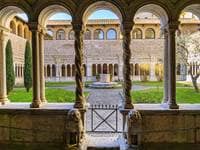
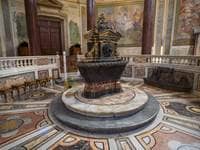
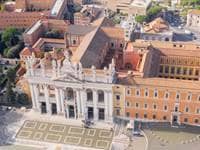
The original name of the Basilica is “Christ the Savior” (sometimes rendered “Most Holy Christ the Savior”)—a name which, to this day, remains engraved on the façade of the building. The structure was almost entirely destroyed by an earthquake in the 9th century. It was rebuilt and finally rededicated in the 10th century. At that time, a baptistry was added to the archbasilica and, thus, Pope Sergius III rededicated the church to Saint John the Baptist. In the 12th century, the archbasilica was rededicated again, this time by Pope Lucius II, who chose to rededicate it to John the Evangelist. Hence the change of the name from the Basilica of “Christ the Savior” to the Basilica of “St. John Lateran.” The “Lateran” portion of the name was added because the archbasilica was built on land once owned by the patrician family of Laterani. To this day, however, “Christ the Savior” is the “true” and proper name of this sacred site.
The building dates to approximately AD 324. However, parts of it predate that. For example, the massive doors were originally part of the pre-Christian Roman Curia or Senate (circa 80 BCE). They were installed in St. John Lateran sometime in the 17th century, having been preserved for nearly two millennia prior to that.
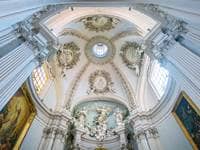
Over the centuries, various popes and wealthy benefactors made donations to the building, creating a rather ornate interior. As a consequence, some began to refer to it as the “Basilica Aurea” or “Golden Basilica.” However, as a consequence of invaders, many of the early donated treasures were plundered, and the interior appearance today is much different than it was when it was originally constructed (in the 4th century). Less elaborate, but no less sacred, the archbasilica is a popular place for pilgrims and tourists alike.
Religious Significance
Technically, Saint John Lateran (rather than the Vatican and St. Peter’s) is the “seat” of the Bishop of Rome, the Roman Catholic Pope. Between the 4th and 14th centuries, it was the residence of every Roman Catholic pope. Thus, in the apse of that Basilica is the cathedra or “throne” of the pope—symbolic of his teaching authority and infallibility (on matters of faith and morals). Thus, when it is said that the pope is speaking ex cathedra (or “from the chair”), it has reference to his throne in Saint John Lateran. As a consequence of this church symbolizing the pope’s authority, five of the Church’s 21 ecumenical councils have been held there (whereas only two have been held at the Vatican). As a consequence of its association with so many popes and so many councils, in addition to housing the papal throne, for believing Catholics this is sacred ground indeed!
Saint John Lateran is sometimes referred to as the “Mother Church of the world”—it being the oldest of the four “Major Basilica” and one “Minor Basilica.” (Each of these were known as “Patriarchal Basilicas” until 2006, when Pope Benedict XVI relinquished the title of “Patriarch of the West” and changed their names to “Papal Basilicas.”) These five churches were originally among the five episcopal sees of the ancient patriarchs—the Pope (or “Patriarch of the West”) at St. John Lateran, the Patriarch of Constantinople at St. Peter’s, the Patriarch of Alexandria at St. Paul Outside the Walls, the Patriarch of Antioch at St. Mary Major, and the Patriarch of Jerusalem at St. Lawrence Outside the Walls. St. John Lateran was the first of these to be built and is considered the “highest ranking” of the five “Patriarchal Basilicas.” This to makes is a “sacred site.”
Saint John Lateran is also one of seven “Pilgrim Churches” in Rome. Starting in the mid-sixteenth century, it became a tradition to visit all seven of these churches, i.e., St. John Lateran, St. Peter’s, St. Paul Outside the Walls, St. Mary Major, St. Lawrence Outside the Walls, Holy Cross in Jerusalem, and St. Sebastian Outside the Walls—which was replaced (by Pope John Paul II) as a pilgrimage site (in 2000) by the Sanctuary of Our Lady of Divine Love. The point of the pilgrimage to these seven churches is to counteract the sinful and raucous behavior promoted by Carnival; using pilgrimage and personal holiness to combat carnality and sin.
The archbasilica is said to house parts of the skulls of Saints Peter and Paul (enclosed in busts of these two apostles). Traditional also claims that it houses the very table used by Jesus for the Last Supper. Present in the archbasilica is also another wooden table on which Pether (and other early popes) consecrated the Eucharist. The combination of these relics and the actual chair (or “throne”) of Peter and his successors, makes this church a “sacred space” and site of pilgrimage for millions of believers each year.
Related
Learning more about a region of which I've known little
From Serbia's "White City," Belgrade
Kathleen Mulhern, PH.D.
Kathleen Mulhern, PH.D.
What are the Cardinal Virtues in Catholicism?
What Do Catholics Believe About Death and the Afterlife?
Alonzo L. Gaskill, PH.D.
What Do Catholics Believe About Purgatory?
What is the Christian Holiday of Pentecost?
Patheos Explore the world's faith through different perspectives on religion and spirituality! Patheos has the views of the prevalent religions and spiritualities of the world.
Ad-Free & Subscriber Log-In Subscription Support
- About Us
- 2026 Calendar
- Videos
- Podcasts
- Library of World Religions
- Faith In Media Tracker
- Advertise With Us
- Write for Us
- Privacy Policy
- Terms of Service
- Do Not Sell My Data
- Contact Us
- Radiant Digital
- Manage Newsletter Subscriptions
- Unsubscribe From Notifications
- Sitemap
Copyright 2008-2026, Patheos. All rights reserved.
Subscription Support Ad-Free & Subscriber Log-In
Follow Patheos