
BuddhistCatholicContemplativeEvangelicalGeneral ChristianHinduJewishLatter-day SaintMuslimNew VisionsProgressive Christian
Beliefs
- Buddhist
- Catholic
- Contemplative
- Evangelical
- General Christian
- Hindu
- Jewish
- Latter-day Saint
- More Voices
- Muslim
- New Visions
- Pagan
- Progressive Christian
Topics
- Religion News
- Food and Religion
- Sports and Religion
- Religious Art
- Religious Music and Entertainment
- Religious Events
- History and Religion
- Style and Religion
- Politics and Religion
- Women in Religion
- Recreation Outdoors and Religion
- Business Finance and Religion
- Careers Workplace and Religion
- Education and Religion
- Family Parenting and Religion
- Health Fitness and Religion
- Home and Religion
- Relationships and Religion
- Technology and Religion
- Travel and Religion
Columnists
- Buddhist Columnists
- Business Finance and Religion Columnists
- Careers Workplace and Religion Columnists
- Catholic Columnists
- Contemplative Columnists
- Education and Religion Columnists
- Evangelists Columnists
- Family Parenting and Religion Columnists
- General Christian Columnists
- Health Fitness and Religion Columnists
- Hindu Columnists
- History and Religion Columnists
- Home and Religion Columnists
- Jewish Columnists
- More Voices Columnists
- Latter Day Columnists
- Muslim Columnists
- New Visions Columnists
- Nonreligious Columnists
- Pagan Columnists
- Politics and Religion Columnists
- Progressive Columnists
- Recreation Outdoors and Religion Columnists
- Relationships and Religion Columnists
- Religion News Columnists
- Religious Art Columnists
- Religious Events Columnists
- Religious Music and Entertainment Columnists
- Sports and Religion Columnists
- Style and Religion Columnists
- Technology and Religion Columnists
- Travel and Religion Columnists
- Women in Religion Columnists
Resource Library
- 2026 Calendar
- Library of World Religions
- The 100 Most Holy Places on Earth
- Patheos Answers
- Podcasts
- Videos
- Faith Leaders Database
- Anglican Episcopalian
- Bahai
- Baptist
- Buddhism
- Christianity
- Confucianism
- Eastern Orthodoxy
- Hinduism
- Holiness and Pentecostal
- ISKCON
- Islam
- Judaism
- Lutheran
- Methodist
- The Church of Jesus Christ of Latter-day Saints
- New Age
- Paganism
- Presbytarian and Reformed
- Protestantism
- Religion Behind the Scenes
- Roman Catholic
- Scientology
- Shia Islam
- Sikhism
- Sufism
- Sunni Islam
- Taoism
- Zen
- See all religions
Research Tools
 Ad-Free & Subscriber Log-In Subscription Support
Ad-Free & Subscriber Log-In Subscription Support
Follow Patheos 

- Trending:
- Forgiveness
- |
- Marriage
- |
- Consciousness
- |
- Death Penalty
- |
- Election
- |
- Halloween
patheos presents

The 100 Most Holy Places On Earth
number
14
Angkor Wat
Siem Reap, Cambodia 


By Alonzo Gaskill | Updated: March 19, 2026 | Published: March 23, 2023

Associated Faiths:
Buddhism, but with its origins in Hinduism.
Accessibility:
Open to visitors. Modest clothing required. Knees and shoulders must be kept covered while in the vicinity of the shrine. 2,600,000.
History
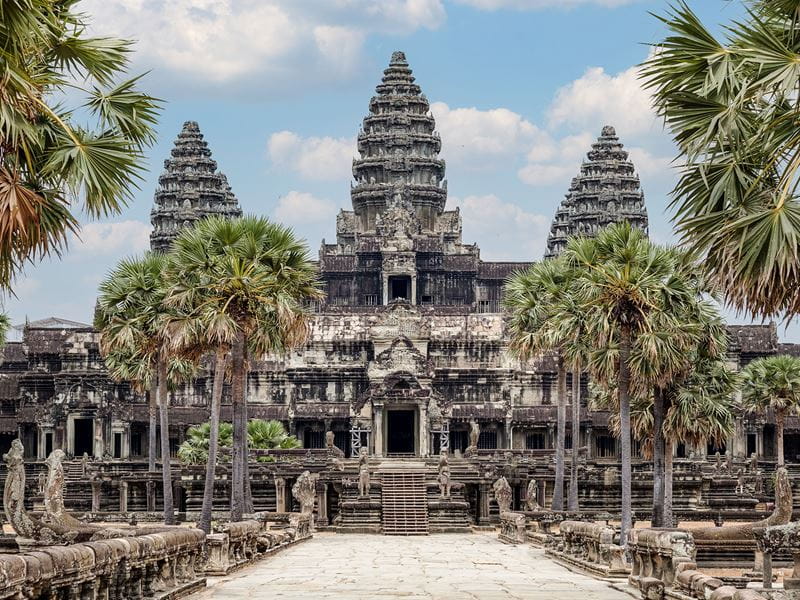
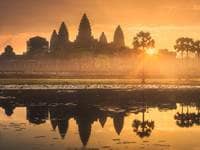
Angkor Wat is one of the most unique sacred spaces in the world. Not only is it traditionally believed to be the largest holy site (or religious monument) in the world—covering approximately 400 acres; but it is also considered a “Hindu-Buddhist” Temple, having “official” associations with both traditions (which is very unique and extremely rare). Also, whereas most temples (in most religious traditions) are constructed to face east, Angkor Wat faces west—which is particularly unusual.
With constructed beginning in the early 12th century (1122-1150 CE), it was designed to symbolize Mahāmeru, the sacred five-peaked mountain of Hindu, Jain, and Buddhist tradition—Mount Meru being the mountain home of the devas (or heavenly beings).
Though the king who commissioned the construction of the Angkor Wat temple was Hindu, upon his death, the kingdom was sacked by a conglomerate of enemy states. When the kingdom was finally restored, the new king converted to Buddhism—believing that the gods of Hinduism had clearly failed him (by allowing his kingdom to be attacked and overrun by its enemies). Thus, within the span of less than a century, the temple was converted from Hindu to Buddhist.
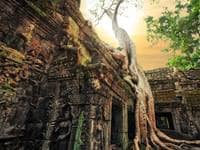
Though never fully abandoned, starting in the 16th century, the Angkor Wat temple fell into disuse and disrepair. However, in the mid-19th century, a French explorer (Alexandre Henri Mouhot) and a German anthropologist (Adolf Philipp Wilhelm Bastian) reintroduced Angkor Wat to the world through their separate visits and subsequent publications about the site. By the 20th century, efforts to restore the site began and, today, it is the pride of Cambodia—so much so that, since approximately 1863, Angkor Wat has been part of the design of each official flag of Cambodia.
Religious Significance
In English, the name “Angkor Wat” means literally “the city temple”—highlighting the fact that (upon its construction) it was the center of a once thriving kingdom. The placement of the temple at the heart of the city evidences the historic reality that many kings and kingdoms of the past relied upon their god (or gods) for their “divine mandate” and their nation’s protection. Cambodia was no exception to this rule.
There are many religious legends surrounding Angkor Wat, including the claim that Indra (the “king of the gods” in the Dravidian and Hindu traditions) ordered its construction so that his son, Precha Ket Mealea, would have it for his palace. According to one legend (dating to as early as the 13th century), the temple was constructed overnight by a “divine architect,” and at the commission of the gods.
Some believers (past and present) have perceived Angkor Wat as a microcosm of the universe; a human copy of the divinely created cosmic world. The central tower of the complex is believed to represent Mount Meru and, thus, is the center of the universe and the abode of the devas or gods. As a consequence, it is also believed by many to be the perch from which the gods observe human activity and offer blessings of protection and sustenance to worthy human devotees.
Among other symbols depicted at the site is the “Churning of the Ocean of Milk”—a Hindu motif representative of the creation of the universe, the beginning of time, and the eternal battle which exists between good and evil (symbolized by the devas and asuras respectively). This is carved as a relief on part of the Angkor Wat temple, and evidences its Hindu origins, even though it is now a Buddhist Temple. (On a related note, Hindus see Buddhism as a sub denomination of Hinduism, though Buddhists seem themselves as a separate religion from Hinduism.)
Aside from attracting millions of tourists each year, the site is sacred to Buddhist generally, and Theravada Buddhist monks and nuns specifically. These practitioners of asceticism come to Angkor Wat for spiritual enhancement, and to facilitate their journey in becoming an arhat—a “solitary saint” or “worthy” who achieves true insight into the nature of existence and, thereby, gains liberation from the cycle of rebirths. For lay Buddhists, Jains, and Hindus, the temple complex is a symbol of the ancient and enduring nature of their related faith traditions—and an awe-inspiring encounter for any pilgrim who makes a trek to this temple in the wilderness. Discover the most extraordinary destinations in Southeast Asia Sponsored
Related
Three Days Attempting to Reach Mary Magdalene's Cave
America at 250: The Country We Are Still Becoming
Behind an Old House in Laos: How Pii Mai Expands Our Spirituality
How Are Hinduism and Buddhism Similar?
Leshan Buddha: The History & Meaning Behind One of the World's Largest Pieces of Religious Art

What Is the Oldest Religion in the World?
Why Do the World's Main Religions Claim the Same Holy Places?
Patheos Explore the world's faith through different perspectives on religion and spirituality! Patheos has the views of the prevalent religions and spiritualities of the world.
Ad-Free & Subscriber Log-In Subscription Support
- About Us
- 2026 Calendar
- Videos
- Podcasts
- Library of World Religions
- Faith In Media Tracker
- Advertise With Us
- Write for Us
- Privacy Policy
- Terms of Service
- Do Not Sell My Data
- Contact Us
- Radiant Digital
- Manage Newsletter Subscriptions
- Unsubscribe From Notifications
- Sitemap
Copyright 2008-2026, Patheos. All rights reserved.
Subscription Support Ad-Free & Subscriber Log-In
Follow Patheos