
BuddhistCatholicContemplativeEvangelicalGeneral ChristianHinduJewishLatter-day SaintMuslimNew VisionsProgressive Christian
Beliefs
- Buddhist
- Catholic
- Contemplative
- Evangelical
- General Christian
- Hindu
- Jewish
- Latter-day Saint
- More Voices
- Muslim
- New Visions
- Pagan
- Progressive Christian
Topics
- Religion News
- Food and Religion
- Sports and Religion
- Religious Art
- Religious Music and Entertainment
- Religious Events
- History and Religion
- Style and Religion
- Politics and Religion
- Women in Religion
- Recreation Outdoors and Religion
- Business Finance and Religion
- Careers Workplace and Religion
- Education and Religion
- Family Parenting and Religion
- Health Fitness and Religion
- Home and Religion
- Relationships and Religion
- Technology and Religion
- Travel and Religion
Columnists
- Buddhist Columnists
- Business Finance and Religion Columnists
- Careers Workplace and Religion Columnists
- Catholic Columnists
- Contemplative Columnists
- Education and Religion Columnists
- Evangelists Columnists
- Family Parenting and Religion Columnists
- General Christian Columnists
- Health Fitness and Religion Columnists
- Hindu Columnists
- History and Religion Columnists
- Home and Religion Columnists
- Jewish Columnists
- More Voices Columnists
- Latter Day Columnists
- Muslim Columnists
- New Visions Columnists
- Nonreligious Columnists
- Pagan Columnists
- Politics and Religion Columnists
- Progressive Columnists
- Recreation Outdoors and Religion Columnists
- Relationships and Religion Columnists
- Religion News Columnists
- Religious Art Columnists
- Religious Events Columnists
- Religious Music and Entertainment Columnists
- Sports and Religion Columnists
- Style and Religion Columnists
- Technology and Religion Columnists
- Travel and Religion Columnists
- Women in Religion Columnists
Resource Library
- 2026 Calendar
- Library of World Religions
- The 100 Most Holy Places on Earth
- Patheos Answers
- Podcasts
- Videos
- Faith Leaders Database
- Anglican Episcopalian
- Bahai
- Baptist
- Buddhism
- Christianity
- Confucianism
- Eastern Orthodoxy
- Hinduism
- Holiness and Pentecostal
- ISKCON
- Islam
- Judaism
- Lutheran
- Methodist
- The Church of Jesus Christ of Latter-day Saints
- New Age
- Paganism
- Presbytarian and Reformed
- Protestantism
- Religion Behind the Scenes
- Roman Catholic
- Scientology
- Shia Islam
- Sikhism
- Sufism
- Sunni Islam
- Taoism
- Zen
- See all religions
Research Tools
 Ad-Free & Subscriber Log-In Subscription Support
Ad-Free & Subscriber Log-In Subscription Support
Follow Patheos 

- Trending:
- Forgiveness
- |
- Marriage
- |
- Consciousness
- |
- Death Penalty
- |
- Election
- |
- Halloween
Hindu
Gurus Wear Different Garb
February 14, 2012 by Ramesh Rao
In India, gurus and Godmen come wearing a variety of garb, for the 1.1 billion Indians neither speak one language, nor worship God in one form. Different class, caste, ethnic, linguistic, regional, cultural, and educational affiliations make Indians one of the most diverse peoples in the world. How could one guru cater to and satisfy them all?
Thus, a book that I finished reading last week, titled Midnights with the Mystic, made me aware once again of the very fertile Indian ground that enables the birth of someone like Jaggi (Jagadish) Vasudev, known now as Sadhguru, who travels the globe, rides BMW motorbikes, and even soothes the anxieties of the very rich and powerful who meet annually at Davos to ponder the future of the world.
Very little of the details of Jaggi Vasudev's early life is available—either in his talks, on the Isha Foundation website, or in the books written about him. In Kannada, the language that Vasudev grew up speaking, which happens to be mine too, there is a saying that one should not inquire into the origins of a river or of a "rishi" or sage. Whether these gurus fight shy of revealing their lives for fear that their mystique will be diminished, or truly because they want their disciples not to get lost in the thickets of the ordinary and the mundane, we don't know. Thus, beyond the fact that he was born in Mysore, that his father was a doctor, and that he came under the influence and tutelage of the well-known Karnataka yogi, Malladihalli Raghavendra Swami, and that one of his grandmothers (or was it great grandmother?) was "God-crazy," we know very little of the many years that Vasudev spent in Mysore. I believe he might have been attending college, while I did too, between 1977 and 1978, because he is just a year younger than me. If indeed he completed his BA in English at the Maharaja College in Mysore, as it is reported, and I was working on my MA in political science on the nearby University of Mysore campus, our paths may have crossed in some nearby coffee shop. He was not Sadhguru then, and I was not a very happy camper at the University of Mysore dorms since some of the young men belonging to the politically powerful Gowda caste were rife on campus twirling their mustaches, stealing and opening letters that they thought contained some juicy boyfriend-girlfriend revelations, and jumping the line for hot water for baths!
Jaggi Vasudev, before he had revelatory experiences, supposedly loved to ride his India-made motorbike fast and furious around Mysore, started a poultry farm which proved very profitable, and even got into the construction business, which we are told is now leveraged for helping well-off disciples design and construct earth-friendly homes. Then, one day, while he was sitting on a rock on the Chamundi Hills that overlooks the city of Mysore, he felt a powerful, expansive feeling that changed him forever.
Cheryl Simone's book does not throw much more light on the life of Jaggi Vasudev. And despite the gushy blurbs on the back cover, I found the tract contained nothing more than a superficial inquiry into the challenges of life and being, in conversations spread over a period of five nights, at the lakeside home that Cheryl owns in North Carolina. Sadhguru does not reveal much about his life, and Cheryl even fails to ask him about his wife, Vijayalakshmi, who died in 1997 and to whom a shrine is devoted at the Isha Yoga Center—the headquarters of the foundation that the Sadhguru has built near Coimbatore, India. Nor does she ask him about his daughter, Radhe, and his relationship with her. So, for any reader interested in dialogues between master and disciple, and about the origins and detours of the master's life, Patrick Levy's Sadhus: Going beyond the Dreadlocks, is more satisfying.
The Sadhguru, however, has caught the imagination of the world, and has logged more miles jetting to different venues than Anand Baba, the guru who still guides Patrick Levy, will ever do traveling by train in India or walking the paths up Himalayan peaks. But this is where I have to revert to my first paragraph: gurus and Godmen come wearing different garb, cater to different kinds of seekers, and live and walk different paths. Jaggi Vasudev wears a flamboyant but unruly beard, from what I can make out from photographs and the many YouTube videos, as well as sporting aviator glasses. He is comfortable wearing blue and tan jeans as he is wearing Indian-style loose, white cotton pants. He is not the "typical" Indian guru, if one imagined an Indian guru as wearing nothing more than a loincloth, or only a little bit more in the form of simple white, or saffron-colored robes. Here again, one has to be cautious about pigeon-holing Indian holy-men: we know that J. Krishnamurti, the very well-known Indian philosopher/teacher who caught the imagination of the West in the early part of 20th century, and who traveled the world for more than six decades till he passed away in 1986, wore Seville-Row suits when he traveled in the West, and wore stylish Indian cotton clothes when he spent time in India.
Article Continued On Next Page
Page: 1 of 2
2/14/2012 5:00:00 AM
Hindu
God in the Age of Kali
Enlightenment
Gurus
India
Jaggi Vasudev
Hinduism
more at patheos
1
How Could Christianity be Different?
2

Tech Should Be a Doorway to the Church, Not the Destination
3

Mary Queen Mother & Queen of Heaven: Biblical?
4
About Ramesh Rao
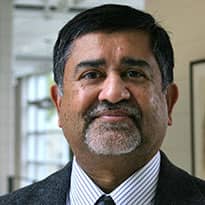
Ramesh Rao, Professor and Chair, DN3 Program, Columbus State University, Columbus, GA, is the author of two books on Indian politics and society and has written numerous op-eds for newspapers and magazines in India, the U.S., and the U.K. Ramesh served as Human Rights Coordinator and Executive Council member at the Hindu American Foundation between 2004-2013. He spent the first twenty-eight years of his life in India where he worked as a bank officer, a school teacher, and a copy editor. He received his MS in Mass Communication from the University of Southern Mississippi, and his PhD in Communication from Michigan State University. He taught at Truman State University in Kirksville, MO, and Longwood University in Farmville, VA, before he joined Columbus State University. He lives with wife Sujaya, and son Sudhanva in Columbus, GA.
Patheos Explore the world's faith through different perspectives on religion and spirituality! Patheos has the views of the prevalent religions and spiritualities of the world.
Ad-Free & Subscriber Log-In Subscription Support
- About Us
- 2026 Calendar
- Videos
- Podcasts
- Library of World Religions
- Faith In Media Tracker
- Advertise With Us
- Write for Us
- Privacy Policy
- Terms of Service
- Do Not Sell My Data
- Contact Us
- Radiant Digital
- Manage Newsletter Subscriptions
- Unsubscribe From Notifications
- Sitemap
Copyright 2008-2026, Patheos. All rights reserved.
Subscription Support Ad-Free & Subscriber Log-In
Follow Patheos