
BuddhistCatholicContemplativeEvangelicalGeneral ChristianHinduJewishLatter-day SaintMuslimNew VisionsProgressive Christian
Beliefs
- Buddhist
- Catholic
- Contemplative
- Evangelical
- General Christian
- Hindu
- Jewish
- Latter-day Saint
- More Voices
- Muslim
- New Visions
- Pagan
- Progressive Christian
Topics
- Religion News
- Food and Religion
- Sports and Religion
- Religious Art
- Religious Music and Entertainment
- Religious Events
- History and Religion
- Style and Religion
- Politics and Religion
- Women in Religion
- Recreation Outdoors and Religion
- Business Finance and Religion
- Careers Workplace and Religion
- Education and Religion
- Family Parenting and Religion
- Health Fitness and Religion
- Home and Religion
- Relationships and Religion
- Technology and Religion
- Travel and Religion
Columnists
- Buddhist Columnists
- Business Finance and Religion Columnists
- Careers Workplace and Religion Columnists
- Catholic Columnists
- Contemplative Columnists
- Education and Religion Columnists
- Evangelists Columnists
- Family Parenting and Religion Columnists
- General Christian Columnists
- Health Fitness and Religion Columnists
- Hindu Columnists
- History and Religion Columnists
- Home and Religion Columnists
- Jewish Columnists
- More Voices Columnists
- Latter Day Columnists
- Muslim Columnists
- New Visions Columnists
- Nonreligious Columnists
- Pagan Columnists
- Politics and Religion Columnists
- Progressive Columnists
- Recreation Outdoors and Religion Columnists
- Relationships and Religion Columnists
- Religion News Columnists
- Religious Art Columnists
- Religious Events Columnists
- Religious Music and Entertainment Columnists
- Sports and Religion Columnists
- Style and Religion Columnists
- Technology and Religion Columnists
- Travel and Religion Columnists
- Women in Religion Columnists
Resource Library
- 2026 Calendar
- Library of World Religions
- The 100 Most Holy Places on Earth
- Patheos Answers
- Podcasts
- Videos
- Faith Leaders Database
- Anglican Episcopalian
- Bahai
- Baptist
- Buddhism
- Christianity
- Confucianism
- Eastern Orthodoxy
- Hinduism
- Holiness and Pentecostal
- ISKCON
- Islam
- Judaism
- Lutheran
- Methodist
- The Church of Jesus Christ of Latter-day Saints
- New Age
- Paganism
- Presbytarian and Reformed
- Protestantism
- Religion Behind the Scenes
- Roman Catholic
- Scientology
- Shia Islam
- Sikhism
- Sufism
- Sunni Islam
- Taoism
- Zen
- See all religions
Research Tools
 Ad-Free & Subscriber Log-In Subscription Support
Ad-Free & Subscriber Log-In Subscription Support
Follow Patheos 

- Trending:
- Forgiveness
- |
- Marriage
- |
- Consciousness
- |
- Death Penalty
- |
- Election
- |
- Halloween
Catholic
Pray, Prepare, Practice: How I Put Together My Homilies
January 30, 2012 by Greg Kandra
"Like" the Patheos Catholic Page on Facebook to receive today's best commentary on Catholic issues.
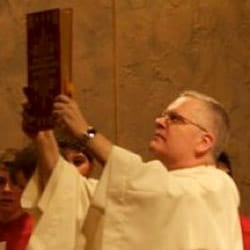 The question caught me a little off-guard, and I hadn't really thought about it until a lector brought it up in the sacristy one Sunday after Mass. "I'm curious," she asked me, as she slipped her missal back onto the shelf, "how long does it take you to write your homilies?"
I was hanging up my alb and I had to stop and think about it.
"I don't know," I said. "I guess it varies. Probably four or five hours a week is average. Sometimes more, sometimes less."
She didn't seem fazed one way or another and just nodded.
But it got me to thinking: what does it mean to write a homily? It's more than stringing words together and it's more than finishing an assignment or meeting a deadline.
It is a process—at times a subconscious one—and some weeks are easier than others. But in a nutshell, I think, it boils down to what I've come to call "The Three P's": Prayer, Preparation, and Practice.
Prayer. Most weeks, I'll begin work on a Sunday homily the week before it's to be delivered. Usually on Sunday night, I'll crack open the missal (or at my computer, click on the USCCB link to the readings online) and spend several minutes poring over all three readings for the following Sunday. I won't delve too deeply. It's a first read, to familiarize myself with what's coming up, and orient myself. I'll also try to read ahead a few weeks, to put the Gospel in context; if there are a series of parables or episodes that seem related, I'll try to discern a theme. (Reading ahead will also help me avoid a mistake I've made a time or two: unpacking the Gospel with a particular anecdote or theme, only to realize that it would have been better to use that story to illustrate a point the following week. D'oh!)
After I've absorbed a first read-through of the Gospel, I like to put it aside and meditate on it for a bit. Where do I see myself in the story? What is it saying to me? And as the week goes on, I'll revisit it every day, usually in the morning, where the Scripture often becomes my Lectio Divina on the subway. As the days go on, I'll find myself "praying over" the Scriptures and asking myself, "What is really being said here? How does this relate to what is happening in my life or what is happening in the news?" I'll keep my eyes, ears, and heart open to stories that might help to tease out some truth from the Gospel, and make it relevant. I revisit the Scripture every morning in this way; as time goes on, I can sometimes be surprised at phrases, words, or images that become stronger and begin to leave a deeper impression. My thoughts about the Scriptures on Friday will often be different from what they were on Monday.
Preparation. After I come up with an idea on how I want to break open the Scripture in my homily, I'll usually do a little digging to see what others are saying about it. William Barclay's studies on Scripture are a favorite resource, and very accessible, and the Jerome Biblical Commentary is also a great tool. I get a lot from the essays by Barbara Reid in America, as well, and I will sometimes go Googling to see what others have to say on particular Scripture passages or parables. I try to avoid reading other people's homilies, because I worry that it will leave me feeling frustrated and depressed and utterly inadequate. (Like a lot of clergy, I suffer from the malady known as Preaching Envy.)
Once I settle on a basic idea and approach, next comes the hard part: actually writing it. I usually try to tackle a first draft on Thursday night.
Different people employ different methods for preaching. Some people use notes. Others work from an outline. Some just wing it. But I'm a writer, and I just have to put the words on the page. Sometimes I'll sketch out a brief outline. But usually I'll just sit down, click on the computer, and start pounding away.
I can hammer out a decent first draft in a little over an hour, maybe 90 minutes. I have a hard time with endings, and will sometimes write only about 75 percent of the text on Thursday, and leave the rest for Friday (hoping and praying I get a good ending by then.)
If I finish the draft Friday night, I'll let it cool off and then look at it with a fresh eye on Saturday morning. Then comes the tweaking and trimming, finessing and fussing. I sometimes cut and paste and move things around for the sake of clarity. One technique I use often is "bookending": beginning a homily with an anecdote and returning to that story at the end, to close it off and make a final point. This is helpful for a couple of reasons: it gives an interesting opening to the homily, and then it signals to the listener that I'm wrapping things up (in other words: wake up, guys, I'm almost finished).
Article Continued On Next Page
Page: 1 of 2
1/30/2012 5:00:00 AM
Catholic
All Things New
Homilies
Prayer
Preaching Resources
Roman Catholicism
more at patheos
1

2

3

Why God Is Not Offended by Gender Diversity
4

The Father the World Still Needs This Fathers Day
About Greg Kandra
Deacon Greg Kandra is a Roman Catholic Deacon serving the Diocese of Brooklyn, NY, and an award-winning journalist.
Patheos Explore the world's faith through different perspectives on religion and spirituality! Patheos has the views of the prevalent religions and spiritualities of the world.
Ad-Free & Subscriber Log-In Subscription Support
- About Us
- 2026 Calendar
- Videos
- Podcasts
- Library of World Religions
- Faith In Media Tracker
- Advertise With Us
- Write for Us
- Privacy Policy
- Terms of Service
- Do Not Sell My Data
- Contact Us
- Radiant Digital
- Manage Newsletter Subscriptions
- Unsubscribe From Notifications
- Sitemap
Copyright 2008-2026, Patheos. All rights reserved.
Subscription Support Ad-Free & Subscriber Log-In
Follow Patheos