
BuddhistCatholicContemplativeEvangelicalGeneral ChristianHinduJewishLatter-day SaintMuslimNew VisionsProgressive Christian
Beliefs
- Buddhist
- Catholic
- Contemplative
- Evangelical
- General Christian
- Hindu
- Jewish
- Latter-day Saint
- More Voices
- Muslim
- New Visions
- Pagan
- Progressive Christian
Topics
- Religion News
- Food and Religion
- Sports and Religion
- Religious Art
- Religious Music and Entertainment
- Religious Events
- History and Religion
- Style and Religion
- Politics and Religion
- Women in Religion
- Recreation Outdoors and Religion
- Business Finance and Religion
- Careers Workplace and Religion
- Education and Religion
- Family Parenting and Religion
- Health Fitness and Religion
- Home and Religion
- Relationships and Religion
- Technology and Religion
- Travel and Religion
Columnists
- Buddhist Columnists
- Business Finance and Religion Columnists
- Careers Workplace and Religion Columnists
- Catholic Columnists
- Contemplative Columnists
- Education and Religion Columnists
- Evangelists Columnists
- Family Parenting and Religion Columnists
- General Christian Columnists
- Health Fitness and Religion Columnists
- Hindu Columnists
- History and Religion Columnists
- Home and Religion Columnists
- Jewish Columnists
- More Voices Columnists
- Latter Day Columnists
- Muslim Columnists
- New Visions Columnists
- Nonreligious Columnists
- Pagan Columnists
- Politics and Religion Columnists
- Progressive Columnists
- Recreation Outdoors and Religion Columnists
- Relationships and Religion Columnists
- Religion News Columnists
- Religious Art Columnists
- Religious Events Columnists
- Religious Music and Entertainment Columnists
- Sports and Religion Columnists
- Style and Religion Columnists
- Technology and Religion Columnists
- Travel and Religion Columnists
- Women in Religion Columnists
Resource Library
- 2026 Calendar
- Library of World Religions
- The 100 Most Holy Places on Earth
- Patheos Answers
- Podcasts
- Videos
- Faith Leaders Database
- Anglican Episcopalian
- Bahai
- Baptist
- Buddhism
- Christianity
- Confucianism
- Eastern Orthodoxy
- Hinduism
- Holiness and Pentecostal
- ISKCON
- Islam
- Judaism
- Lutheran
- Methodist
- The Church of Jesus Christ of Latter-day Saints
- New Age
- Paganism
- Presbytarian and Reformed
- Protestantism
- Religion Behind the Scenes
- Roman Catholic
- Scientology
- Shia Islam
- Sikhism
- Sufism
- Sunni Islam
- Taoism
- Zen
- See all religions
Research Tools
 Ad-Free & Subscriber Log-In Subscription Support
Ad-Free & Subscriber Log-In Subscription Support
Follow Patheos 

- Trending:
- Forgiveness
- |
- Marriage
- |
- Consciousness
- |
- Death Penalty
- |
- Election
- |
- Halloween
Catholic
The Heroic Teen Mentioned in the Eucharistic Prayer
January 19, 2012 by Pat Gohn
"Like" the Patheos Catholic Page on Facebook to receive today's best commentary on Catholic issues.
 You are never too young to make a stand for your principles or defend your faith. You are never too young to "fight the good fight," as St. Paul would say. In fact, St. Paul takes it one better: Don't let anyone belittle your young age.
Let no one despise your youth, but set the believers an example in speech and conduct, in love, in faith, in purity. (1 Tim. 4:12)
One of the treasures of the Catholic Faith is the Communion of Saints, and in particular, the younger saints and blesseds who lived their faith passionately, refusing to be threatened by fear. That includes not letting one's sexual purity and integrity be shouted down or coerced by a noisy culture that has no respect for God or human dignity.
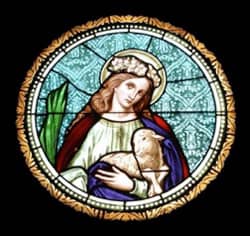
Consider this week's January 21 memorial for St. Agnes—a saint and martyr who typifies how young teens can courageously set the example. A young girl from a Christian family, Agnes died during the early religious persecutions in Rome, perhaps around 304.
Agnes is one of only seven women mentioned in the Martyrology that is prayed within the Roman Canon, otherwise known as Eucharistic Prayer I. (That Canon is one of the oldest prayers we find in the Mass short of the Lord's Prayer that dates back to Jesus himself.)
To us, your servants, who, though sinners, hope in your abundant mercies, graciously grant some share and fellowship with your holy Apostles and Martyrs: With John the Baptist, Stephen, Matthias, Barnabas, Ignatius, Alexander, Marcellinus, Peter, Felicity, Perpetua, Agatha, Lucy, Agnes, Cecilia, Anastasia and all your Saints... (Eucharistic Prayer I)
St. Ambrose places Agnes's death at age 12, and St. Augustine places it age 13. Lively faith at such an age is remarkable, as was her determination to consecrate herself to Christ, alone; a beautiful girl of (given the times) marriageable age, she declared "Jesus Christ is my only Spouse."
The days leading up to her death involved her rejection of a persistent suitor with strong political connections in Rome. Her refusal led to her being publicly identified as a Christian, and she was thrown in prison. But her torture did not stop there.
 Agnes was promised her freedom and many lovely gifts if only she would deny Christ and atone by offering incense at one of the Roman temples. She remained stalwart. She was further humiliated by being sent to a brothel where she was publicly stripped. It is said that an angel protected her. Not to be thwarted, the authorities led Agnes away to die.
At the end, Agnes bowed and prayed and was killed by a stroke of the sword that cut off her head. Her skull is preserved as a relic in St. Agnes Church, near Piazza Navona in Rome.
Agnes lived her faith fearlessly in the public square and in private. She once said: "Christ is my spouse. He chose me first, and His I will be." Her devotion to purity—in spite of the sin embroiled around her—makes her a worthy patron saint of chastity, young girls, engaged couples, and rape victims. She is often depicted with a lamb, recalling her innocence and purity.
The pope invokes Agnes's memory every year by blessing two white lambs on her feast day. And why would that be?
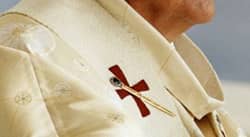
Perhaps you've noticed Pope Benedict wearing the pallium at Mass, a white wool "accessory" that rests over his chasuble.
[T]his band of white wool . . . encircles the shoulders and falls in two strips hanging down in front and back. Its yoke represents the lost sheep that the Good Shepherd seeks out and carries home on his shoulders. Five red crosses signify the wounds of Christ; and three jeweled pins, once used to hold the garment together and attach it to the chasuble beneath, symbolize the nails that fixed Jesus to the cross . .
[E]ach year on the feast of Sts. Peter and Paul (June 29), the pope invests new archbishops . . . with the garment. New pallia are woven in part from the wool of lambs blessed every year on the feast of St. Agnes (Jan. 21) in the church of St. Agnes-Outside-the-Walls in Rome. On the evening before St. Peter's Day, the pope places them overnight in an alcove below the high altar in St. Peter's Basilica. This niche lies directly above the tomb of St. Peter himself, and so the pallia are thought to become contact relics, blessed by the apostle whom Jesus commanded to "tend his sheep" and "feed his lambs," and offering a share in his authority. Reception of the pallium is thus a sign of a bond to the see of Peter and of participation in the pope's universal solicitude as vicar of Christ, the Good Shepherd. ("Bonds of Wool" Steven A. Schoenig, America Magazine, January 16, 2006)
Wearing the pallium of lamb's wool is another reminder of the purity with which Bishops are to carry their office, ready to bear the wounds of Christ, and ready to die, for the sake of their flocks.
I once heard Fr. George Kosicki, CSB, renowned authority on the devotion of the Divine Mercy, teach that the fastest and most direct way to get to heaven is to be a martyr, to die for the faith.
Okay, you say, that might work for the likes of uber-Christians like St. Agnes. What about the rest of us?
The rest of us are to die daily.
St. Agnes of Rome, pray for us.
1/19/2012 5:00:00 AM
Catholic
A Word in Season
Agnes
History
Martyrdom
Youth
Roman Catholicism
more at patheos
1
How the Old Testament Tax Collector Adoram Typifies Christ
2

3

4

Ascension Sacred Artwork for the Liturgy of the Hours 2nd Ed

About Pat Gohn
Pat Gohn is a Catholic writer, speaker, and the host of the Among Women Podcast and blog. Her book Blessed, Beautiful and Bodacious: Celebrating the Gift of Catholic Womanhood is published by Ave Maria Press.
Patheos Explore the world's faith through different perspectives on religion and spirituality! Patheos has the views of the prevalent religions and spiritualities of the world.
Ad-Free & Subscriber Log-In Subscription Support
- About Us
- 2026 Calendar
- Videos
- Podcasts
- Library of World Religions
- Faith In Media Tracker
- Advertise With Us
- Write for Us
- Privacy Policy
- Terms of Service
- Do Not Sell My Data
- Contact Us
- Radiant Digital
- Manage Newsletter Subscriptions
- Unsubscribe From Notifications
- Sitemap
Copyright 2008-2026, Patheos. All rights reserved.
Subscription Support Ad-Free & Subscriber Log-In
Follow Patheos