
BuddhistCatholicContemplativeEvangelicalGeneral ChristianHinduJewishLatter-day SaintMuslimNew VisionsProgressive Christian
Beliefs
- Buddhist
- Catholic
- Contemplative
- Evangelical
- General Christian
- Hindu
- Jewish
- Latter-day Saint
- More Voices
- Muslim
- New Visions
- Pagan
- Progressive Christian
Topics
- Religion News
- Food and Religion
- Sports and Religion
- Religious Art
- Religious Music and Entertainment
- Religious Events
- History and Religion
- Style and Religion
- Politics and Religion
- Women in Religion
- Recreation Outdoors and Religion
- Business Finance and Religion
- Careers Workplace and Religion
- Education and Religion
- Family Parenting and Religion
- Health Fitness and Religion
- Home and Religion
- Relationships and Religion
- Technology and Religion
- Travel and Religion
Columnists
- Buddhist Columnists
- Business Finance and Religion Columnists
- Careers Workplace and Religion Columnists
- Catholic Columnists
- Contemplative Columnists
- Education and Religion Columnists
- Evangelists Columnists
- Family Parenting and Religion Columnists
- General Christian Columnists
- Health Fitness and Religion Columnists
- Hindu Columnists
- History and Religion Columnists
- Home and Religion Columnists
- Jewish Columnists
- More Voices Columnists
- Latter Day Columnists
- Muslim Columnists
- New Visions Columnists
- Nonreligious Columnists
- Pagan Columnists
- Politics and Religion Columnists
- Progressive Columnists
- Recreation Outdoors and Religion Columnists
- Relationships and Religion Columnists
- Religion News Columnists
- Religious Art Columnists
- Religious Events Columnists
- Religious Music and Entertainment Columnists
- Sports and Religion Columnists
- Style and Religion Columnists
- Technology and Religion Columnists
- Travel and Religion Columnists
- Women in Religion Columnists
Resource Library
- 2026 Calendar
- Library of World Religions
- The 100 Most Holy Places on Earth
- Patheos Answers
- Podcasts
- Videos
- Faith Leaders Database
- Anglican Episcopalian
- Bahai
- Baptist
- Buddhism
- Christianity
- Confucianism
- Eastern Orthodoxy
- Hinduism
- Holiness and Pentecostal
- ISKCON
- Islam
- Judaism
- Lutheran
- Methodist
- The Church of Jesus Christ of Latter-day Saints
- New Age
- Paganism
- Presbytarian and Reformed
- Protestantism
- Religion Behind the Scenes
- Roman Catholic
- Scientology
- Shia Islam
- Sikhism
- Sufism
- Sunni Islam
- Taoism
- Zen
- See all religions
Research Tools
 Ad-Free & Subscriber Log-In Subscription Support
Ad-Free & Subscriber Log-In Subscription Support
Follow Patheos 

- Trending:
- Forgiveness
- |
- Marriage
- |
- Consciousness
- |
- Death Penalty
- |
- Election
- |
- Halloween
Pagan
Occupying Sacred Ground: An Open Letter to Michael Lerner
November 17, 2011 by T. Thorn Coyle
"Like" the Patheos Pagan Page on Facebook to receive today's best commentary on Pagan issues.
And, like the '60s, there were also problems.
- In the name of "inclusion" and "non-judgmentalism" the vast majority of nonviolence-oriented people felt unable to stop a comparatively tiny group of masked protesters from breaking windows and introducing a feel of violence that gave the corporate media their pretext for making "violence" the center of the story they reported to the world.
- Due to the movement's aversion to leadership (epitomized by the slogan, "we are all leaders and have no leaders") it has become impossible to develop a coherent vision of what we are for . . .
- A fetishization of the occupied spaces, as though these physical sites were the center of the struggle, rather than the broader pursuit of justice for the 99 percent . . . (Rabbi Michael Lerner)
Rabbi Lerner,
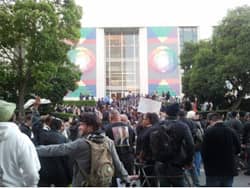 Occupy has captured the attention, the minds, and imaginations of people all over the world. This is not a re-run of what have become standard American Liberal tactics: some marching in the streets, political lobbying in a system increasingly stacked toward those with deep pockets, and a dash of prayer.
I stood with many hundreds of others Monday night, first at the Oakland Main Library and later in the re-opened Oscar Grant/Frank Ogawa Plaza for General Assembly after the second raid on the Oakland encampment. While I did not agree with everything I heard, it felt heartening to see the anarcho-democratic process at work amongst people who have likely never had consensus training in their lives. Because of Occupy, people around the country are getting a taste of consensus process and true participatory democracy.
I have great hope that more direct involvement in participatory politics will evolve over the next decade. Our system, as it stands, is broken and barely workable. At Occupy General Assemblies, at the Oakland General Strike November 2, and during meditation sessions in front of City Hall, I catch the scent of the winds of change. As war correspondent Chris Hedges writes in a heartfelt piece: "This is the beginning of the end." After every ending, comes a chance for something new.
I returned home to frantic twittering of the raiding of Zuccotti Park in New York and the barring of the press. The destruction of the camp was on, as it had been in coordinated strikes across the country, in Oakland, Denver, Portland, and other cities. This alone is proof that camps are important. Those who currently hold power feel threatened enough to use force and violence to displace people, dismantle their kitchens and libraries, and hide from reporters while they do so.
Occupy has deep roots and far-reaching branches. Though reminiscent of the Diggers of the 1600s, of the Paris Commune, and the Haymarket uprisings, it also looks like something we have not seen before. Why doesn't it yet have a list of achievable goals? Because it is working on the long-term process of educating citizens and re-making a country. That is not done in under two months, not when it has taken 200 years for things to go awry, and certainly not when we need to retrain ourselves toward a new system of social organization and the possibility of real justice. Occupy recognizes the importance of conversation, teaching, and time.
While I would like to see General Assemblies accept the mantle of non-violence, I comprehend those who say we don't have a working definition of what violence is. Critiques of violence in Occupy usually center around a few smashed windows—a tactic I find puerile—while failing to note that big banks and multinational corporations commit substantial violence against Earth and humans daily. Children are chained to machines. Water is poisoned. Homes are stolen. A smashed window barely compares. Yes, I feel we would be better off, as one speaker at Monday's GA said, to "fight violence with non-violence," but I'm not scrapping the movement for lack of consensus on this point. It takes time for individuals to step forward into their power. It takes time to build leaders. We need to take that time, or nothing will ever change.
Article Continued On Next Page
Page: 1 of 2
11/17/2011 5:00:00 AM
Pagan
Numinous and Concrete
Violence
Occupy Wall Street
Oakland
politics
Protests
Sukkot
Tent city
Judaism
Paganism
more at patheos
1

The Eden Diet: Returning to The Garden
2

Back to School, Back to God: A Faith-Filled Reset
3

'Project Hail Mary': Thrilling Sci-Fi That's Full of Grace
4
The Good Pastor: Providing Care & Correction For God's Sheep

About T. Thorn Coyle
T. Thorn Coyle is an internationally respected visionary and teacher of the magical and esoteric arts. The author of Make Magic of Your Life, Kissing the Limitless, and Evolutionary Witchcraft, she hosts the Elemental Castings podcast series, writes the blog Know Thyself, and has produced several CDs of sacred music. Follow her on Twitter and Facebook!
Patheos Explore the world's faith through different perspectives on religion and spirituality! Patheos has the views of the prevalent religions and spiritualities of the world.
Ad-Free & Subscriber Log-In Subscription Support
- About Us
- 2026 Calendar
- Videos
- Podcasts
- Library of World Religions
- Faith In Media Tracker
- Advertise With Us
- Write for Us
- Privacy Policy
- Terms of Service
- Do Not Sell My Data
- Contact Us
- Radiant Digital
- Manage Newsletter Subscriptions
- Unsubscribe From Notifications
- Sitemap
Copyright 2008-2026, Patheos. All rights reserved.
Subscription Support Ad-Free & Subscriber Log-In
Follow Patheos