
BuddhistCatholicContemplativeEvangelicalGeneral ChristianHinduJewishLatter-day SaintMuslimNew VisionsProgressive Christian
Beliefs
- Buddhist
- Catholic
- Contemplative
- Evangelical
- General Christian
- Hindu
- Jewish
- Latter-day Saint
- More Voices
- Muslim
- New Visions
- Pagan
- Progressive Christian
Topics
- Religion News
- Food and Religion
- Sports and Religion
- Religious Art
- Religious Music and Entertainment
- Religious Events
- History and Religion
- Style and Religion
- Politics and Religion
- Women in Religion
- Recreation Outdoors and Religion
- Business Finance and Religion
- Careers Workplace and Religion
- Education and Religion
- Family Parenting and Religion
- Health Fitness and Religion
- Home and Religion
- Relationships and Religion
- Technology and Religion
- Travel and Religion
Columnists
- Buddhist Columnists
- Business Finance and Religion Columnists
- Careers Workplace and Religion Columnists
- Catholic Columnists
- Contemplative Columnists
- Education and Religion Columnists
- Evangelists Columnists
- Family Parenting and Religion Columnists
- General Christian Columnists
- Health Fitness and Religion Columnists
- Hindu Columnists
- History and Religion Columnists
- Home and Religion Columnists
- Jewish Columnists
- More Voices Columnists
- Latter Day Columnists
- Muslim Columnists
- New Visions Columnists
- Nonreligious Columnists
- Pagan Columnists
- Politics and Religion Columnists
- Progressive Columnists
- Recreation Outdoors and Religion Columnists
- Relationships and Religion Columnists
- Religion News Columnists
- Religious Art Columnists
- Religious Events Columnists
- Religious Music and Entertainment Columnists
- Sports and Religion Columnists
- Style and Religion Columnists
- Technology and Religion Columnists
- Travel and Religion Columnists
- Women in Religion Columnists
Resource Library
- 2026 Calendar
- Library of World Religions
- The 100 Most Holy Places on Earth
- Patheos Answers
- Podcasts
- Videos
- Faith Leaders Database
- Anglican Episcopalian
- Bahai
- Baptist
- Buddhism
- Christianity
- Confucianism
- Eastern Orthodoxy
- Hinduism
- Holiness and Pentecostal
- ISKCON
- Islam
- Judaism
- Lutheran
- Methodist
- The Church of Jesus Christ of Latter-day Saints
- New Age
- Paganism
- Presbytarian and Reformed
- Protestantism
- Religion Behind the Scenes
- Roman Catholic
- Scientology
- Shia Islam
- Sikhism
- Sufism
- Sunni Islam
- Taoism
- Zen
- See all religions
Research Tools
 Ad-Free & Subscriber Log-In Subscription Support
Ad-Free & Subscriber Log-In Subscription Support
Follow Patheos 

- Trending:
- Forgiveness
- |
- Marriage
- |
- Consciousness
- |
- Death Penalty
- |
- Election
- |
- Halloween
Catholic
The Drummer Boy of Chickamauga
November 29, 2011 by Pat McNamara
"Like" the Patheos Catholic Page on Facebook to receive today's best commentary on Catholic issues.
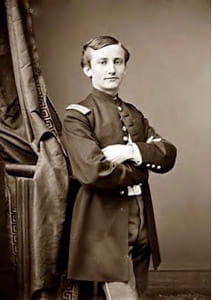 On the afternoon of September 20th, 1863, during the Battle of Chickamauga, as Union troops retreated under hot pursuit, a Confederate colonel spotted a young boy in a blue uniform carrying a sawed-off rifle. "I think the best thing a mite of a chap like you can do," he called out, "is drop that gun." Little Johnny Clem, the twelve-year-old drummer of the 22nd Michigan Infantry, turned around, shot the colonel, and ran safely back to the Union lines.
More than ten thousand soldiers under the age of eighteen served in the Union Army during the American Civil War. Among the youngest, and certainly the most famous of them, was John Lincoln Clem (1851-1937), known as "the Drummer Boy of Chickamauga." A national hero by age twelve, Clem went on to serve nearly fifty years through three wars. When he retired in 1916, he was the last Civil War veteran on active duty with the United States Army.
John Joseph Klem (he changed his middle name to Lincoln in honor of the President) was born in Newark, Ohio, on August 13, 1851, to immigrant parents from Alsace-Lorraine. Raised in a pious Catholic family, he was one of three children. (Somewhere along the way, the family name was changed to Clem.) He was baptized at St. Francis De Sales Church in Newark and studied at the local Catholic school.
In May 1861, as the war began, the nine-year-old boy ran away from home and offered his services as a drummer to an Ohio regiment. But he was rejected on account of his age. However, he eventually joined the 22nd Michigan Infantry as a drummer.
He was called "Johnny Shiloh," based on the belief that he served in that battle. The story was actually a myth. But as the youngest soldier in the Union Army, Clem was a nationally renowned figure. For his actions at Chickamauga, at age twelve he became the youngest noncommissioned officer in history. By the time he was discharged in 1864 at age thirteen, he had been wounded twice.
Back in Ohio, he finished his schooling. He applied to West Point several times, but failed the entrance examination. In 1871, however, President Ulysses S. Grant appointed him a second lieutenant in the United States Army. He would serve on active duty for forty-five years, mainly in the Quartermaster Corps, reaching the rank of Brigadier General. At the time of his retirement, he was promoted to Major General.
When he left home in 1861, Clem hadn't yet received his First Communion, and he drifted away from religion as he got older. In 1875, Lieutenant Clem married Anita French, daughter of Major General William H. French, and joined the Episcopal Church. At age fifty-two, after Anita's death, he married twenty-five-year-old Elizabeth Sullivan, a devout Catholic. Their daughter Elizabeth Ann, born in 1906, was 'the center of his affection and attention and remained so until he died."
As a child Elizabeth had attended the best Catholic schools in Washington, where her father was stationed, and studied abroad in Europe. At age twenty-three, she entered a Carmelite monastery in Indianapolis. In religious life, she took the name Sister Anne of the Trinity. This was the occasion of her father's return to the Catholic Church.
In the summer of 1931, at age eighty, Clem made a retreat with the Jesuits in Maryland. He wrote his niece:
You will be glad to learn that I am again a full fledged "Holy Roman" and feel happy as I know all my family will be pleased . . . took my First Communion yesterday . . . My knees are still sore. I would have fallen if my friend General Lenihan had not supported me at the Communion. After that the Fathers told me not to kneel any more.
A year later he made his Confirmation in Indianapolis while visiting his daughter. An active and devoted Catholic until his death, he was remembered as a "small man, known to be quiet, gentle, and kind." On May 13, 1937, reciting the rosary at his home in San Antonio, Texas, he passed away at age eighty-five. His tombstone at Arlington Cemetery reads, "The Drummer Boy of Chickamauga."
11/29/2011 5:00:00 AM
Catholic
In Ages Past
Johnny Clem
Christianity
Roman Catholicism
more at patheos
1
Don't Misinterpret the Bereans: Berean Principle Reexamined
2
Is Self Absorption The Brain Rot Of Our Culture?
3

Keizan Jokin: The Zen Master Ancestor You Don't Know
4

Despositio Alleluia – Burying the Alleluia for Lent

About Pat McNamara
Dr. Pat McNamara is a published historian. He blogs about American Catholic History at McNamara's Blog.
Patheos Explore the world's faith through different perspectives on religion and spirituality! Patheos has the views of the prevalent religions and spiritualities of the world.
Ad-Free & Subscriber Log-In Subscription Support
- About Us
- 2026 Calendar
- Videos
- Podcasts
- Library of World Religions
- Faith In Media Tracker
- Advertise With Us
- Write for Us
- Privacy Policy
- Terms of Service
- Do Not Sell My Data
- Contact Us
- Radiant Digital
- Manage Newsletter Subscriptions
- Unsubscribe From Notifications
- Sitemap
Copyright 2008-2026, Patheos. All rights reserved.
Subscription Support Ad-Free & Subscriber Log-In
Follow Patheos