
BuddhistCatholicContemplativeEvangelicalGeneral ChristianHinduJewishLatter-day SaintMuslimNew VisionsProgressive Christian
Beliefs
- Buddhist
- Catholic
- Contemplative
- Evangelical
- General Christian
- Hindu
- Jewish
- Latter-day Saint
- More Voices
- Muslim
- New Visions
- Pagan
- Progressive Christian
Topics
- Religion News
- Food and Religion
- Sports and Religion
- Religious Art
- Religious Music and Entertainment
- Religious Events
- History and Religion
- Style and Religion
- Politics and Religion
- Women in Religion
- Recreation Outdoors and Religion
- Business Finance and Religion
- Careers Workplace and Religion
- Education and Religion
- Family Parenting and Religion
- Health Fitness and Religion
- Home and Religion
- Relationships and Religion
- Technology and Religion
- Travel and Religion
Columnists
- Buddhist Columnists
- Business Finance and Religion Columnists
- Careers Workplace and Religion Columnists
- Catholic Columnists
- Contemplative Columnists
- Education and Religion Columnists
- Evangelists Columnists
- Family Parenting and Religion Columnists
- General Christian Columnists
- Health Fitness and Religion Columnists
- Hindu Columnists
- History and Religion Columnists
- Home and Religion Columnists
- Jewish Columnists
- More Voices Columnists
- Latter Day Columnists
- Muslim Columnists
- New Visions Columnists
- Nonreligious Columnists
- Pagan Columnists
- Politics and Religion Columnists
- Progressive Columnists
- Recreation Outdoors and Religion Columnists
- Relationships and Religion Columnists
- Religion News Columnists
- Religious Art Columnists
- Religious Events Columnists
- Religious Music and Entertainment Columnists
- Sports and Religion Columnists
- Style and Religion Columnists
- Technology and Religion Columnists
- Travel and Religion Columnists
- Women in Religion Columnists
Resource Library
- 2026 Calendar
- Library of World Religions
- The 100 Most Holy Places on Earth
- Patheos Answers
- Podcasts
- Videos
- Faith Leaders Database
- Anglican Episcopalian
- Bahai
- Baptist
- Buddhism
- Christianity
- Confucianism
- Eastern Orthodoxy
- Hinduism
- Holiness and Pentecostal
- ISKCON
- Islam
- Judaism
- Lutheran
- Methodist
- The Church of Jesus Christ of Latter-day Saints
- New Age
- Paganism
- Presbytarian and Reformed
- Protestantism
- Religion Behind the Scenes
- Roman Catholic
- Scientology
- Shia Islam
- Sikhism
- Sufism
- Sunni Islam
- Taoism
- Zen
- See all religions
Research Tools
 Ad-Free & Subscriber Log-In Subscription Support
Ad-Free & Subscriber Log-In Subscription Support
Follow Patheos 

- Trending:
- Forgiveness
- |
- Marriage
- |
- Consciousness
- |
- Death Penalty
- |
- Election
- |
- Halloween
Catholic
Betty Smith's Brooklyn
November 22, 2011 by Pat McNamara
"Like" the Patheos Catholic Page on Facebook to receive today's best commentary on Catholic issues.
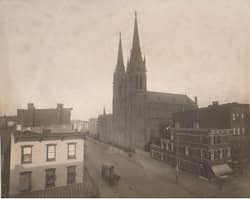 New York City is always reinventing itself. Nowhere is this truer than in Brooklyn's Williamsburg section, now a haven for the young and trendy. Over the years, the neighborhood has been home to many groups: Hispanic, Jewish, Italian, Polish, and many more. For most of the 1800s, German immigrants were the largest group, and their story is worth retelling.
At the center of "Little Germany," on the corner of Montrose and Graham Avenues, stood Most Holy Trinity Church, where author Betty Smith was baptized Elisabeth Wehner. In A Tree Grows in Brooklyn, her protagonist Francie Nolan calls it
. . . the most beautiful church in Brooklyn. It was made of old gray stone and had twin spires that rose cleanly into the sky, high above the tallest tenements. Inside, the high vaulted ceilings, narrow deepset stained-glass windows and elaborately carved altars made it a miniature cathedral.
Stone was imported from Wurzburg, stained glass windows from Innsbruck, and people from Bavaria and Hesse. Together they created the church known as "the German Cathedral."
The parish's story begins in 1830s Manhattan. The Lower East Side was a bustling German community concentrated in crowded tenements. St. Nicholas Church on East Second Street, the city's first German Catholic parish, had 11,000 parishioners. Many missed the open country and fresh air of home. Williamsburg, a largely unsettled area across the river with affordable housing, seemed a pleasant alternative to tenement life.
In the summer of 1841, Father Johann Raffeiner (1785-1861), a priest stationed at St. Nicholas, purchased property there. Ordained at 40, he had been a soldier and a successful surgeon, and paid for the purchase from his own pocket. In October, the Church of the Most Holy Trinity opened, and Raffeiner became pastor. He slept in the basement, which doubled as a schoolhouse. At the time, one parishioner recalled, there wasn't a single house within sight of the new church.
Seventy families, all German, composed the congregation. They recreated a German village in urban America. One Brooklyn historian writes: "the singing societies and the Turnvereins [gymnasiums] and dance halls and beer gardens . . . helped make life pleasant in the good old German way." For more than three generations, language and culture remained German. "Language preserves the faith," was a popular saying among them.
In 1843, a German priest serving in the parish described a typical Sunday as "work all day": morning confessions, Mass, afternoon catechism, evening prayers, and "pastoral conversation." One could reasonably hope, he suggested, for a congregation of "more than one thousand souls." When Father Raffeiner died in 1861, there were over 9,000.
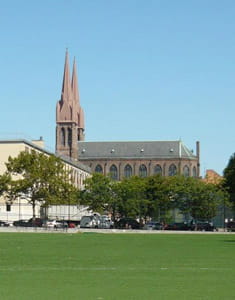 Not everyone welcomed them, however. Protestants calling themselves "Native Americans" joined a group, about which they pledged to reveal nothing. Nothing but its deep hatred of Catholics. (They were called "Know-Nothings.") When Bill "the Butcher" Poole's* gang tried to burn local Catholic churches, Father Raffeiner stationed armed men around the parish grounds:
In these stirring times the martial spirit of the old soldier-pastor of Holy Trinity came back to inspire his devoted flock to take measures to ensure the safety of their lives and property.
In August 1853, four Sisters of St. Dominic from Bavaria stepped off the ship Germania in New York harbor. Their goal was Pennsylvania, but their escort never arrived. Father persuaded them to help him in Williamsburg. They were much needed. If priests were scarce in the 1850s, teaching nuns were scarcer.
That fall, the Dominican Sisters started teaching at the parish school (in German). Soon there were 1,500 students, whose parents paid fifteen cents a week. By the time of the parish's 75th anniversary in 1916, it was estimated that some 150 young women joined the Dominicans. (Until the early 1900s, the community's official correspondence was in German.)
Article Continued On Next Page
Page: 1 of 2
11/22/2011 5:00:00 AM
Catholic
In Ages Past
Brooklyn
Culture
Germans
History
Immigration
Christianity
Roman Catholicism
more at patheos
1

Jesus and Lao Tzu: Seven Striking Parallels
2

LBCF: The Last Temptation of Buck
3

Europe Could Dump Trump/USA and Form a More Perfect Union
4

Chris Johnson: Leaning on Faith to Fight Amid ALS Diagnosis

About Pat McNamara
Dr. Pat McNamara is a published historian. He blogs about American Catholic History at McNamara's Blog.
Patheos Explore the world's faith through different perspectives on religion and spirituality! Patheos has the views of the prevalent religions and spiritualities of the world.
Ad-Free & Subscriber Log-In Subscription Support
- About Us
- 2026 Calendar
- Videos
- Podcasts
- Library of World Religions
- Faith In Media Tracker
- Advertise With Us
- Write for Us
- Privacy Policy
- Terms of Service
- Do Not Sell My Data
- Contact Us
- Radiant Digital
- Manage Newsletter Subscriptions
- Unsubscribe From Notifications
- Sitemap
Copyright 2008-2026, Patheos. All rights reserved.
Subscription Support Ad-Free & Subscriber Log-In
Follow Patheos