
BuddhistCatholicContemplativeEvangelicalGeneral ChristianHinduJewishLatter-day SaintMuslimNew VisionsProgressive Christian
Beliefs
- Buddhist
- Catholic
- Contemplative
- Evangelical
- General Christian
- Hindu
- Jewish
- Latter-day Saint
- More Voices
- Muslim
- New Visions
- Pagan
- Progressive Christian
Topics
- Religion News
- Food and Religion
- Sports and Religion
- Religious Art
- Religious Music and Entertainment
- Religious Events
- History and Religion
- Style and Religion
- Politics and Religion
- Women in Religion
- Recreation Outdoors and Religion
- Business Finance and Religion
- Careers Workplace and Religion
- Education and Religion
- Family Parenting and Religion
- Health Fitness and Religion
- Home and Religion
- Relationships and Religion
- Technology and Religion
- Travel and Religion
Columnists
- Buddhist Columnists
- Business Finance and Religion Columnists
- Careers Workplace and Religion Columnists
- Catholic Columnists
- Contemplative Columnists
- Education and Religion Columnists
- Evangelists Columnists
- Family Parenting and Religion Columnists
- General Christian Columnists
- Health Fitness and Religion Columnists
- Hindu Columnists
- History and Religion Columnists
- Home and Religion Columnists
- Jewish Columnists
- More Voices Columnists
- Latter Day Columnists
- Muslim Columnists
- New Visions Columnists
- Nonreligious Columnists
- Pagan Columnists
- Politics and Religion Columnists
- Progressive Columnists
- Recreation Outdoors and Religion Columnists
- Relationships and Religion Columnists
- Religion News Columnists
- Religious Art Columnists
- Religious Events Columnists
- Religious Music and Entertainment Columnists
- Sports and Religion Columnists
- Style and Religion Columnists
- Technology and Religion Columnists
- Travel and Religion Columnists
- Women in Religion Columnists
Resource Library
- 2026 Calendar
- Library of World Religions
- The 100 Most Holy Places on Earth
- Patheos Answers
- Podcasts
- Videos
- Faith Leaders Database
- Anglican Episcopalian
- Bahai
- Baptist
- Buddhism
- Christianity
- Confucianism
- Eastern Orthodoxy
- Hinduism
- Holiness and Pentecostal
- ISKCON
- Islam
- Judaism
- Lutheran
- Methodist
- The Church of Jesus Christ of Latter-day Saints
- New Age
- Paganism
- Presbytarian and Reformed
- Protestantism
- Religion Behind the Scenes
- Roman Catholic
- Scientology
- Shia Islam
- Sikhism
- Sufism
- Sunni Islam
- Taoism
- Zen
- See all religions
Research Tools
 Ad-Free & Subscriber Log-In Subscription Support
Ad-Free & Subscriber Log-In Subscription Support
Follow Patheos 

- Trending:
- Forgiveness
- |
- Marriage
- |
- Consciousness
- |
- Death Penalty
- |
- Election
- |
- Halloween
Catholic
What Is an Economy? Understanding Rome's Radical Call
October 31, 2011 by Tim Muldoon
"Like" the Patheos Catholic Page on Facebook to receive today's best commentary on Catholic issues.
 Photo Credit: Ed Lockett, Jr.
Petit Goave, Haiti
In human society, there are really only two alternatives: either a struggle for power, pitting miserable human beings against each other in a zero-sum game; or sincere cooperation rooted in a theory of justice. The first is a competition; the second is an economy.
Two events of the past week suggest a need for thinking carefully about what an economy is, and how it contributes to justice. The first is the birth of the seven billionth human being on the planet. The second is the release of a document by the Pontifical Council for Justice and Peace (PCJP), "Towards Reforming the International Financial and Monetary Systems in the Context of Global Public Authority." (I am hereby volunteering my services for the sake of coming up with more interesting titles.)
How is it possible to keep seven billion human beings from competing with each other? It's difficult to imagine our planet having limitless capacity for food and water access, so immediately there's a concern for sharing those resources. There are others, too, like energy and real estate and so on, not to mention human resources like labor and knowledge. At present we function on a macro level with a competition model: nations form alliances, rooted in shared values, to gather the resources they need to secure their way of life. Nations war with each other over resources; this has been the sad story of human history.
At the root of conflict are always two causes: desire for goods and fear of not having them. The archetypal Trojan War was fought over a woman, Helen, but Homer's depiction of the dissention in the ranks of the Greeks focused more on the jealous rage between two of its kings, Achilles and Agamemnon. In both cases the source of rage was a rivalry, a grasping for something that the enemy had and that the protagonist desired.
Today, the stakes are different, but the roots are still the same: desire (for land, for oil, for wealth, for access to water, for minerals, and so on), and the concomitant fear that the other's possession of them will deprive a group of its ability to flourish. Power is the desire par excellence: the power to secure perceived goods has been the objective of kings, emperors, and political parties. But the lust for power is still rooted in the same sinful pattern that gives rise to competition and war, and too often over history we've seen how that desire becomes corrupted and twisted toward selfish ends. Power tends to corrupt, observed Lord Acton, and absolute power corrupts absolutely. Perhaps he had in mind the tyrants of the ancient Greek world, to whom Plato responded in the construction of his ideal Republic, by making the ruling class monk-like ascetics. Perhaps he had in mind the kings of Europe or the likes of Napoleon, or even the emperors of China or the Pharaohs of Egypt. The stories are all too familiar, because all involve human beings and their tendency towards sin.
Today, the story of financial greed run amok is different in scale, but its roots in disordered desire is no different from the past. The PCJP document observes that the errors have been both technical and ethical: "At every stage of the crisis, one might discover particular technical errors intertwined with certain ethical orientations."
In wanting the wrong things, human beings contrive vast financial mechanisms to secure them, and the consequence is breakdown. Further, it observes, there do not exist transnational controls as exist on smaller levels within states, and so problems were left unchecked. The document's call for a global authority over finance is a call for the rule of law where none currently exist to keep financial catastrophe in check.
What the document proposes is ultimately a global economy, rather than a global competition. An economy (Greek oikos nomos, "law of the house") is an agreement to corral individual desires (and their larger-scale versions: tribalism and nationalism) and order them toward a common good: "Recognizing the primacy of being over having and of ethics over the economy, the world's peoples ought to adopt an ethic of solidarity as the animating core of their action."
Article Continued On Next Page
Page: 1 of 2
10/31/2011 4:00:00 AM
Catholic
Culture at the Crossroads
Christianity
Roman Catholicism
more at patheos
1

Will Even Spiders Be on the New Earth?
2

Pope Says Trump Threat "Truly Unacceptable"
3

Reviews of Beyond Deconstruction (and an Easter Excerpt)
4
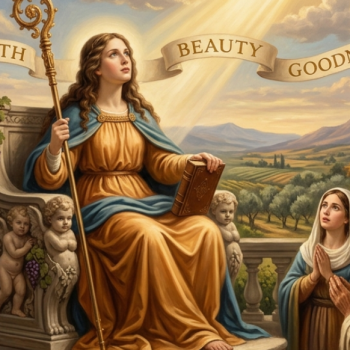
What Are the Transcendentals? A Catholic Guide to Reality

About Tim Muldoon
Tim Muldoon holds a Ph.D. in Catholic systematic theology and is an award-winning author and Catholic theologian of the new evangelization.
Patheos Explore the world's faith through different perspectives on religion and spirituality! Patheos has the views of the prevalent religions and spiritualities of the world.
Ad-Free & Subscriber Log-In Subscription Support
- About Us
- 2026 Calendar
- Videos
- Podcasts
- Library of World Religions
- Faith In Media Tracker
- Advertise With Us
- Write for Us
- Privacy Policy
- Terms of Service
- Do Not Sell My Data
- Contact Us
- Radiant Digital
- Manage Newsletter Subscriptions
- Unsubscribe From Notifications
- Sitemap
Copyright 2008-2026, Patheos. All rights reserved.
Subscription Support Ad-Free & Subscriber Log-In
Follow Patheos