
BuddhistCatholicContemplativeEvangelicalGeneral ChristianHinduJewishLatter-day SaintMuslimNew VisionsProgressive Christian
Beliefs
- Buddhist
- Catholic
- Contemplative
- Evangelical
- General Christian
- Hindu
- Jewish
- Latter-day Saint
- More Voices
- Muslim
- New Visions
- Pagan
- Progressive Christian
Topics
- Religion News
- Food and Religion
- Sports and Religion
- Religious Art
- Religious Music and Entertainment
- Religious Events
- History and Religion
- Style and Religion
- Politics and Religion
- Women in Religion
- Recreation Outdoors and Religion
- Business Finance and Religion
- Careers Workplace and Religion
- Education and Religion
- Family Parenting and Religion
- Health Fitness and Religion
- Home and Religion
- Relationships and Religion
- Technology and Religion
- Travel and Religion
Columnists
- Buddhist Columnists
- Business Finance and Religion Columnists
- Careers Workplace and Religion Columnists
- Catholic Columnists
- Contemplative Columnists
- Education and Religion Columnists
- Evangelists Columnists
- Family Parenting and Religion Columnists
- General Christian Columnists
- Health Fitness and Religion Columnists
- Hindu Columnists
- History and Religion Columnists
- Home and Religion Columnists
- Jewish Columnists
- More Voices Columnists
- Latter Day Columnists
- Muslim Columnists
- New Visions Columnists
- Nonreligious Columnists
- Pagan Columnists
- Politics and Religion Columnists
- Progressive Columnists
- Recreation Outdoors and Religion Columnists
- Relationships and Religion Columnists
- Religion News Columnists
- Religious Art Columnists
- Religious Events Columnists
- Religious Music and Entertainment Columnists
- Sports and Religion Columnists
- Style and Religion Columnists
- Technology and Religion Columnists
- Travel and Religion Columnists
- Women in Religion Columnists
Resource Library
- 2026 Calendar
- Library of World Religions
- The 100 Most Holy Places on Earth
- Patheos Answers
- Podcasts
- Videos
- Faith Leaders Database
- Anglican Episcopalian
- Bahai
- Baptist
- Buddhism
- Christianity
- Confucianism
- Eastern Orthodoxy
- Hinduism
- Holiness and Pentecostal
- ISKCON
- Islam
- Judaism
- Lutheran
- Methodist
- The Church of Jesus Christ of Latter-day Saints
- New Age
- Paganism
- Presbytarian and Reformed
- Protestantism
- Religion Behind the Scenes
- Roman Catholic
- Scientology
- Shia Islam
- Sikhism
- Sufism
- Sunni Islam
- Taoism
- Zen
- See all religions
Research Tools
 Ad-Free & Subscriber Log-In Subscription Support
Ad-Free & Subscriber Log-In Subscription Support
Follow Patheos 

- Trending:
- Forgiveness
- |
- Marriage
- |
- Consciousness
- |
- Death Penalty
- |
- Election
- |
- Halloween
Catholic
A Flame Moving Easy in Harness: Chatting with Heather King
September 05, 2011 by Elizabeth Scalia
I love that at the end of his life St. Thomas Aquinas regarded his gigantic oeuvre and said "All straw." I love that when Christ appeared to him in a vision and said, in effect, "Good job, my son! Tell me your greatest wish and I will grant it. What wouldst thou have?" St. Thomas replied, "Nothing but Thee . . ."
In the end, no matter how much or how well or how truly I write, the most notable thing about me, the only possible account I will be able to give of myself, is that I have been to Mass. I have participated in the Eucharist and I have tried to take Christ's Body and Blood out into the world and share it there. I have loved him as best I can to the limit of my heart, mind, soul, and strength. So yes, obedience -- "listening carefully" -- continuing obedience.
In the book, you describe a kind of Incarnational Mysticism -- the grace of doing everything for God, and seeing everything as coming from God. Without grace, this would seem impossible. Our faulty humanity would constantly distract us, challenge us, get in the way. But is this something one can train oneself to? Because it seems to me if one could, it would remove every obstacle to peace.
Well, I think the grace is a complete unbidden gift and then, as has often been said, we get to cooperate with it. I got the grace of having the obsession to drink removed, for one central example, and for twenty-four years, I've devoted ten or twelve hours a week to cooperating. Directly cooperating with that particular grace, and then there are the many, many more hours when I cooperate with grace in general. I am fairly disciplined, which no doubt stems from my desperate need to manage and control, but make your neuroses work for you, I say! But to be fair, I've simply seen that some kind of rudimentary discipline, which is itself a grace, works. "Moving easy in harness," as Robert Frost described the rules of poetry, and once the harness is in place you find it is guiding you where you wanted to go, perhaps unbeknownst to yourself, all along.
And prayer supplements and sustains all of this?
I try to pray the Office each morning, I write in my journal, I work, I take a walk, I run things by a spiritual director, I often go to daily Mass, or sit before the Blessed Sacrament. I avail myself of the Sacrament of Reconciliation. All that has absolutely formed me. But the discipline is just tilling the ground so I can receive the gift, so the seed can bear fruit. I think that's what you discover on the spiritual path. It is all gift. It is all grace. We take up our cross -- and what I've learned is that the cross is basically myself -- but just as Christ said, it is about living fully and in abundant joy. Christianity is about our daily lives, our lives today, a whole way of looking at and experiencing the world. It's about interior freedom. It's about human relationship.
That said, no amount of training or discipline in and of itself leads to peace. Letting go of every old idea we have about how we're going to fix ourselves leads to peace. Dying to our identities as good people, righteous people, people who need to establish our supremacy, people who need to be perfect, people who need to have all the loose ends tied up, leads to peace. Dying to the notion that we need to do anything but open ourselves to God's inexhaustible love leads to peace.
Peace inside, peace outside?
I wrote a series of posts not long ago on non-violence as the chief characteristic of God's love for us; non-violence as the mystical phenomenon/dynamic that underlies all of existence. I was very careful to emphasize that I wasn't talking about non-violence as a political theory but a mystical phenomenon, starting with our violence toward ourselves. And I was staggered by the number of people who came out jabbing their finger at the Catechism and saying, "Unh, excuse me, it says right here we have the right to defend ourselves!! What, are we supposed to just stand by and let our children be raped and cut up into tiny little pieces? What, are we supposed to just let the Japanese attack us at Pearl Harbor, are we supposed to just let Hitler . . . Why, the just war theory . . ." So you know these people are suffering terribly and that they can't see that by denying mercy to others, they deny it to themselves. And by "they" I of course mean myself as well. In a sense, our inability to love ourselves is my/your/our central problem.
Still, I want to say, Oh if only you were an alcoholic and were able to hit some terrible bottom, if only you were in touch enough with your own thirst that you squandered your whole inheritance in the mire and then came home again and found the table had been laid!
I think that's why Christ said "Blessed are the poor in spirit," because it's a great grace to be so in touch with your own brokenness, so badly in need of mercy -- and then to have found that the mercy is there! The mercy is there even if we don't ask for it! The mercy is there even if we don't know what mercy is! The mercy is there entirely apart from us "deserving" it! That is the very nature of mercy, of love. And then your feeling becomes - oh, who wants to fight? Who cares about building up arms? Let's eat together! Let's have a meal and listen to some music together! You don't disregard the problems of the world; you joyfully participate in the sorrows of the world.
I came into the Church as a sinner, and I remain as a sinner. Now that's grace.
Page: 2 of 2
9/5/2011 4:00:00 AM
Catholic
Books
Blogging
grace
Recovery
Writing
Christianity
Roman Catholicism
more at patheos
1

Bo French Doesn’t Understand Texas
2
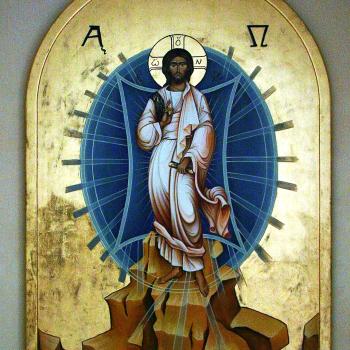
Christ, The Logos, And The Hope That All May Be Saved
3

The Great Commission and Postcolonialism
4

Was This 400-Year-Old Forgery the First Sci-Fi Novel?

About Elizabeth Scalia
Elizabeth Scalia is a weekly columnist at First Things.
Patheos Explore the world's faith through different perspectives on religion and spirituality! Patheos has the views of the prevalent religions and spiritualities of the world.
Ad-Free & Subscriber Log-In Subscription Support
- About Us
- 2026 Calendar
- Videos
- Podcasts
- Library of World Religions
- Faith In Media Tracker
- Advertise With Us
- Write for Us
- Privacy Policy
- Terms of Service
- Do Not Sell My Data
- Contact Us
- Radiant Digital
- Manage Newsletter Subscriptions
- Unsubscribe From Notifications
- Sitemap
Copyright 2008-2026, Patheos. All rights reserved.
Subscription Support Ad-Free & Subscriber Log-In
Follow Patheos