
BuddhistCatholicContemplativeEvangelicalGeneral ChristianHinduJewishLatter-day SaintMuslimNew VisionsProgressive Christian
Beliefs
- Buddhist
- Catholic
- Contemplative
- Evangelical
- General Christian
- Hindu
- Jewish
- Latter-day Saint
- More Voices
- Muslim
- New Visions
- Pagan
- Progressive Christian
Topics
- Religion News
- Food and Religion
- Sports and Religion
- Religious Art
- Religious Music and Entertainment
- Religious Events
- History and Religion
- Style and Religion
- Politics and Religion
- Women in Religion
- Recreation Outdoors and Religion
- Business Finance and Religion
- Careers Workplace and Religion
- Education and Religion
- Family Parenting and Religion
- Health Fitness and Religion
- Home and Religion
- Relationships and Religion
- Technology and Religion
- Travel and Religion
Columnists
- Buddhist Columnists
- Business Finance and Religion Columnists
- Careers Workplace and Religion Columnists
- Catholic Columnists
- Contemplative Columnists
- Education and Religion Columnists
- Evangelists Columnists
- Family Parenting and Religion Columnists
- General Christian Columnists
- Health Fitness and Religion Columnists
- Hindu Columnists
- History and Religion Columnists
- Home and Religion Columnists
- Jewish Columnists
- More Voices Columnists
- Latter Day Columnists
- Muslim Columnists
- New Visions Columnists
- Nonreligious Columnists
- Pagan Columnists
- Politics and Religion Columnists
- Progressive Columnists
- Recreation Outdoors and Religion Columnists
- Relationships and Religion Columnists
- Religion News Columnists
- Religious Art Columnists
- Religious Events Columnists
- Religious Music and Entertainment Columnists
- Sports and Religion Columnists
- Style and Religion Columnists
- Technology and Religion Columnists
- Travel and Religion Columnists
- Women in Religion Columnists
Resource Library
- 2026 Calendar
- Library of World Religions
- The 100 Most Holy Places on Earth
- Patheos Answers
- Podcasts
- Videos
- Faith Leaders Database
- Anglican Episcopalian
- Bahai
- Baptist
- Buddhism
- Christianity
- Confucianism
- Eastern Orthodoxy
- Hinduism
- Holiness and Pentecostal
- ISKCON
- Islam
- Judaism
- Lutheran
- Methodist
- The Church of Jesus Christ of Latter-day Saints
- New Age
- Paganism
- Presbytarian and Reformed
- Protestantism
- Religion Behind the Scenes
- Roman Catholic
- Scientology
- Shia Islam
- Sikhism
- Sufism
- Sunni Islam
- Taoism
- Zen
- See all religions
Research Tools
 Ad-Free & Subscriber Log-In Subscription Support
Ad-Free & Subscriber Log-In Subscription Support
Follow Patheos 

- Trending:
- Forgiveness
- |
- Marriage
- |
- Consciousness
- |
- Death Penalty
- |
- Election
- |
- Halloween
Catholic
Water or Ash: God in the Storm
August 29, 2011 by Tim Muldoon
"Like" the Patheos Catholic Page on Facebook to receive today's best commentary on Catholic issues.
 This past weekend, my family and I were huddled at our home, like so many others along the Eastern seaboard, bracing for the onslaught of Hurricane Irene. (As of this writing, our power is still out.) The prospect of the storm quickly put everything else into perspective: we had to assess what we needed to survive the possibility of days without power or access to basic necessities like food and water. On Saturday evening, we hunkered down together, prepared to go low-tech, secure in the feeling that at the very least we were together as a family.
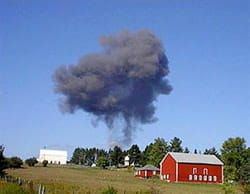
I cannot help but recall a similar feeling of needing to be with my family ten years ago, almost exactly. I was heading to a morning class when a colleague came into my office and described a plane flying into the World Trade Center. I was horrified, and ran to the nearest TV to get information: What was going on? Was there an imminent threat? Where was my family? At the time we were living in Western Pennsylvania, just east of nowhere in particular, but soon I learned that another plane was flying practically over our heads and crashing just down the road in Shanksville. My wife and baby daughter were some sixty miles away at my wife's campus, and never before had I felt such an urgent need to simply be with them, to know where they were, to know they were safe.
Experiences like these always put life into perspective. What is truly needful? Much of the time it seems we manage to find ways to isolate ourselves from each other: we attach ourselves to machines; we withdraw into private spaces, real and virtual. Ironically, in spite of our loss of power, we have enjoyed a delightful time together as a family, making so much of our dependence on electricity seem like distraction.
Last month, traveling around China, I observed a very different attitude toward public space than we radically individual Americans are used to. People don't live in their homes: they live amongst others out-of-doors and sleep in their homes. The streets of both the big city of Beijing and the small town of Yangshuo were teeming with groups of people: eating, playing games, talking, smoking, working in small groups. Of course, much is changing, but my overall impression is that people's lives are defined by their daily relations with others. They do not retreat into private worlds; they share a public world out-of-doors.
Similarly, just last week, while on pilgrimage at World Youth Day, I lived with some 3000 young people in refugee-camp like conditions on the campus of a Jesuit school. We slept on the ground outside; we lined up for food rations; we splashed ourselves with the cold water available in showers. There too, my experience was radically different from what I am used to at home: daily life was stripped down to its bare necessities. And yet we were no less happy for our lack of luxury. On the contrary: freed from the usual distractions, we could turn our focus to the reason why we were there, and establish bonds of friendship over this shared desire.
I recall these experiences to highlight a basic point: much of the time we live in ways that distract us from the large question of what living is for, and so situations of extremity force us to consider exactly what we think we're doing. What I have found remarkable about these situations—dating back to a serious flood that struck my family's home town when I was a boy—is how they can mobilize neighbors and create bonds of friendship absent in the course of "normal" life. There is logic to living in extremity that we ignore under normal circumstances. We don't generally think about how much we need each other; we don't think about food rationing, or preserving water access, or checking regularly on the elderly and infirm. We in the developed West have become accustomed to isolation, and have in large part forgotten what it's really like to think as a community, helping each other to survive and thrive. Losing this big picture, it is very easy to think of life in small, manageable chunks oriented around the small question of what we think we want.
I find it compelling to think of God questions as those which face us when we emerge from our smallness. Many raise these questions only in times of extremity, as if God's only role is to throw disasters at us every now and again. God becomes the enemy to be overcome with good planning. To be sure, God is in the storm, the earthquake, the tsunami—but God is also in the rescue, the selfless act, the courageous response, the loving community we become aware of when our defenses are down. Against those who would preach a tame, sweet, nice God, I see a God who is master of the winds and rain, time and eternity, to whom we wail upon the death of thousands and praise upon the rescue of a single soul. But most of all, I see a God who, when life is stripped down to its barest minimum, can emerge softly because the noise of the world is no longer in the way.
8/29/2011 4:00:00 AM
Catholic
Culture at the Crossroads
Christianity
Roman Catholicism
more at patheos
1
Operation Epic Fury: A Just War?
2
America at 250: Independence Was Actually July 2
3
Brigham Young, Karl Marx, and Friedrich Engels
4
Bible & Catholicism on Mortal Sin (vs. John Anderson)

About Tim Muldoon
Tim Muldoon holds a Ph.D. in Catholic systematic theology and is an award-winning author and Catholic theologian of the new evangelization.
Patheos Explore the world's faith through different perspectives on religion and spirituality! Patheos has the views of the prevalent religions and spiritualities of the world.
Ad-Free & Subscriber Log-In Subscription Support
- About Us
- 2026 Calendar
- Videos
- Podcasts
- Library of World Religions
- Faith In Media Tracker
- Advertise With Us
- Write for Us
- Privacy Policy
- Terms of Service
- Do Not Sell My Data
- Contact Us
- Radiant Digital
- Manage Newsletter Subscriptions
- Unsubscribe From Notifications
- Sitemap
Copyright 2008-2026, Patheos. All rights reserved.
Subscription Support Ad-Free & Subscriber Log-In
Follow Patheos