
BuddhistCatholicContemplativeEvangelicalGeneral ChristianHinduJewishLatter-day SaintMuslimNew VisionsProgressive Christian
Beliefs
- Buddhist
- Catholic
- Contemplative
- Evangelical
- General Christian
- Hindu
- Jewish
- Latter-day Saint
- More Voices
- Muslim
- New Visions
- Pagan
- Progressive Christian
Topics
- Religion News
- Food and Religion
- Sports and Religion
- Religious Art
- Religious Music and Entertainment
- Religious Events
- History and Religion
- Style and Religion
- Politics and Religion
- Women in Religion
- Recreation Outdoors and Religion
- Business Finance and Religion
- Careers Workplace and Religion
- Education and Religion
- Family Parenting and Religion
- Health Fitness and Religion
- Home and Religion
- Relationships and Religion
- Technology and Religion
- Travel and Religion
Columnists
- Buddhist Columnists
- Business Finance and Religion Columnists
- Careers Workplace and Religion Columnists
- Catholic Columnists
- Contemplative Columnists
- Education and Religion Columnists
- Evangelists Columnists
- Family Parenting and Religion Columnists
- General Christian Columnists
- Health Fitness and Religion Columnists
- Hindu Columnists
- History and Religion Columnists
- Home and Religion Columnists
- Jewish Columnists
- More Voices Columnists
- Latter Day Columnists
- Muslim Columnists
- New Visions Columnists
- Nonreligious Columnists
- Pagan Columnists
- Politics and Religion Columnists
- Progressive Columnists
- Recreation Outdoors and Religion Columnists
- Relationships and Religion Columnists
- Religion News Columnists
- Religious Art Columnists
- Religious Events Columnists
- Religious Music and Entertainment Columnists
- Sports and Religion Columnists
- Style and Religion Columnists
- Technology and Religion Columnists
- Travel and Religion Columnists
- Women in Religion Columnists
Resource Library
- 2026 Calendar
- Library of World Religions
- The 100 Most Holy Places on Earth
- Patheos Answers
- Podcasts
- Videos
- Faith Leaders Database
- Anglican Episcopalian
- Bahai
- Baptist
- Buddhism
- Christianity
- Confucianism
- Eastern Orthodoxy
- Hinduism
- Holiness and Pentecostal
- ISKCON
- Islam
- Judaism
- Lutheran
- Methodist
- The Church of Jesus Christ of Latter-day Saints
- New Age
- Paganism
- Presbytarian and Reformed
- Protestantism
- Religion Behind the Scenes
- Roman Catholic
- Scientology
- Shia Islam
- Sikhism
- Sufism
- Sunni Islam
- Taoism
- Zen
- See all religions
Research Tools
 Ad-Free & Subscriber Log-In Subscription Support
Ad-Free & Subscriber Log-In Subscription Support
Follow Patheos 

- Trending:
- Forgiveness
- |
- Marriage
- |
- Consciousness
- |
- Death Penalty
- |
- Election
- |
- Halloween
Catholic
Shining Light on Our Obligation to the Poor
August 18, 2011 by Joseph Susanka
"Like" the Patheos Catholic Page on Facebook to receive today's best commentary on Catholic issues.
Then they also shall answer him, saying: Lord, when did we see thee hungry, or thirsty, or a stranger, or naked, or sick, or in prison, and did not minister to thee?
Then he shall answer them, saying: Amen I say to you, as long as you did it not to one of these least, neither did you do it to me.
—Matthew 25:44-45
 Last month's turmoil over America's once-and-future financial turmoil (along with its unsurprising attempts to redefine well-known terms) ended not a moment too soon. The difference between "cutting" and "reducing one's rate of acceleration" was too obvious (and too important) for the inflammatory speechifying that wafted through Washington, and the uninspiring compromise that eventually emerged left many astonished at how far removed from everyday reality our government has grown.
Unsurprisingly, the poor played a key rhetorical role in the debate. The crippling consequences governmental belt-tightening might have upon anti-poverty programs appeared regularly in the arguments of those who opposed drastic budget reductions. Efforts to claim the "pro-poor" high ground resulted in a series of unpleasant skirmishes, symptomatically represented by an unhelpful misinterpretation depicting the eventual USCCB statement (pdf) as a direct criticism of Boehner's plan.
Yet such disagreements, while unfortunate, are also enlightening. "When the chips are down," as they say, "you discover what other folks at the table really think." The overwhelming focus on the monetary consequences of deficit reduction makes one wonder: why have we grown so accustomed to the notion that the best thing one can do for the poor is to give them money? Is that the response of a society concerned with upholding human dignity? Does it really help them and make things better? Or does it hold them everlastingly at arm's-length instead, pushing them farther away from those made most uncomfortable by their suffering? Isn't it simply the easiest way for us to salve our consciences, paying them to go away and trouble us no more?
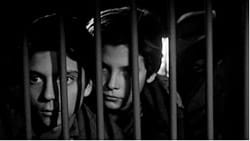
Shoeshine (Sciuscià), the first major work from legendary Italian director Vittorio De Sica, deals with these very questions, showing the sad, dehumanizing consequences of a society convinced that the realities of the poor present problems rather than an opportunities. It recounts the story of Giuseppe and Pasquale, two young bootblacks wandering the streets of Rome, eking out a meager existence by shining the boots of the occupying GIs.
Driven by their love of a local horse (and the dream of one day purchasing it for themselves), the youngsters agree to sell some black-market items for a local fence. But when the transaction goes south, they find themselves apprehended by the local constabulary and whisked away to a juvenile detention center without a word to their parents. There, they are largely dismissed by an institution already filled-to-bursting with troubled youths; the unkindness they experience is driven less by violence and evil than it is by a profound and crippling lack of interest. Time and again, they and their fellow prisoners are thrust into close contact with the detention center's personnel. And each time, they are rebuffed by a stifling wall of indifference. (The lone exception to this disinterest, a young assistant director who takes a genuine interest in his charges, is eventually driven away by the suffering he sees on a daily basis. "This isn't the right place for me," he says as he departs. "You need someone stronger.")
The boys respond to this apathy with false bravado. But the actions of these wayward children are clearly shown for what they are: hollow attempts to defend their fragile emotions and frailer psyches. Giuseppe, Pasquale, and their fellow cellmates are most definitely children; their swaggering, calloused behavior merely an effort to hide their childhood before someone destroys it. As the film works towards its tragic conclusion, the audience is left behind to flounder in the inevitability of it all—lamenting the lack of a single kind word or genuine human interaction that could have prevented so much sorrow.
The film's similarities to Bicycle Thieves (Ladri di biciclette)—the paradigm of Italian Neo-Realism that won De Sica international fame only two years later—are obvious. Both stories are immersed in Italy's relentlessly harsh post-war struggles; both feature casts comprised almost entirely of non-professionals; and both revolve around the profound loss of innocence experienced by the tattered, exploited youth of a once-great country. Yet while Thieves focuses on the relationship between a desperate father and his son, Shoeshine is a full-throated denunciation of an entire society's unwillingness to embrace its poor.
Article Continued On Next Page
Page: 1 of 2
8/18/2011 4:00:00 AM
Catholic
Through a Lens Darkly
Vittorio De Sica
Debt Ceiling
Christianity
Roman Catholicism
more at patheos
1

"Faith Alone" Disproven by 30 Church Fathers
2

20 Questions to Ask Before an Interfaith Marriage, Not After
3
The Gospel of John: The New Torah, Part II
4
Chapter 11: The Continued Quest for the Systemic Fix

About Joseph Susanka
Joseph Susanka has been doing development work for institutions of Catholic higher education since his graduation from Thomas Aquinas College in 1999. He blogs at Crisis Magazine, where he also contributes feature articles on a variety of topics.
Patheos Explore the world's faith through different perspectives on religion and spirituality! Patheos has the views of the prevalent religions and spiritualities of the world.
Ad-Free & Subscriber Log-In Subscription Support
- About Us
- 2026 Calendar
- Videos
- Podcasts
- Library of World Religions
- Faith In Media Tracker
- Advertise With Us
- Write for Us
- Privacy Policy
- Terms of Service
- Do Not Sell My Data
- Contact Us
- Radiant Digital
- Manage Newsletter Subscriptions
- Unsubscribe From Notifications
- Sitemap
Copyright 2008-2026, Patheos. All rights reserved.
Subscription Support Ad-Free & Subscriber Log-In
Follow Patheos