
BuddhistCatholicContemplativeEvangelicalGeneral ChristianHinduJewishLatter-day SaintMuslimNew VisionsProgressive Christian
Beliefs
- Buddhist
- Catholic
- Contemplative
- Evangelical
- General Christian
- Hindu
- Jewish
- Latter-day Saint
- More Voices
- Muslim
- New Visions
- Pagan
- Progressive Christian
Topics
- Religion News
- Food and Religion
- Sports and Religion
- Religious Art
- Religious Music and Entertainment
- Religious Events
- History and Religion
- Style and Religion
- Politics and Religion
- Women in Religion
- Recreation Outdoors and Religion
- Business Finance and Religion
- Careers Workplace and Religion
- Education and Religion
- Family Parenting and Religion
- Health Fitness and Religion
- Home and Religion
- Relationships and Religion
- Technology and Religion
- Travel and Religion
Columnists
- Buddhist Columnists
- Business Finance and Religion Columnists
- Careers Workplace and Religion Columnists
- Catholic Columnists
- Contemplative Columnists
- Education and Religion Columnists
- Evangelists Columnists
- Family Parenting and Religion Columnists
- General Christian Columnists
- Health Fitness and Religion Columnists
- Hindu Columnists
- History and Religion Columnists
- Home and Religion Columnists
- Jewish Columnists
- More Voices Columnists
- Latter Day Columnists
- Muslim Columnists
- New Visions Columnists
- Nonreligious Columnists
- Pagan Columnists
- Politics and Religion Columnists
- Progressive Columnists
- Recreation Outdoors and Religion Columnists
- Relationships and Religion Columnists
- Religion News Columnists
- Religious Art Columnists
- Religious Events Columnists
- Religious Music and Entertainment Columnists
- Sports and Religion Columnists
- Style and Religion Columnists
- Technology and Religion Columnists
- Travel and Religion Columnists
- Women in Religion Columnists
Resource Library
- 2026 Calendar
- Library of World Religions
- The 100 Most Holy Places on Earth
- Patheos Answers
- Podcasts
- Videos
- Faith Leaders Database
- Anglican Episcopalian
- Bahai
- Baptist
- Buddhism
- Christianity
- Confucianism
- Eastern Orthodoxy
- Hinduism
- Holiness and Pentecostal
- ISKCON
- Islam
- Judaism
- Lutheran
- Methodist
- The Church of Jesus Christ of Latter-day Saints
- New Age
- Paganism
- Presbytarian and Reformed
- Protestantism
- Religion Behind the Scenes
- Roman Catholic
- Scientology
- Shia Islam
- Sikhism
- Sufism
- Sunni Islam
- Taoism
- Zen
- See all religions
Research Tools
 Ad-Free & Subscriber Log-In Subscription Support
Ad-Free & Subscriber Log-In Subscription Support
Follow Patheos 

- Trending:
- Forgiveness
- |
- Marriage
- |
- Consciousness
- |
- Death Penalty
- |
- Election
- |
- Halloween
Evangelical
Reading Is Fundamental -- and Fun!
August 12, 2011 by Patton Dodd
"Like" the Patheos Evangelical Page on Facebook to receive today's best commentary on Evangelical issues.
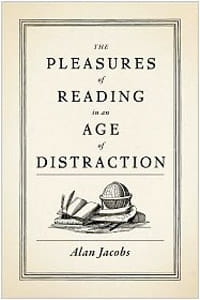 In The Pleasures of Reading in an Age of Distraction, Alan Jacobs gives the lie to many myths about reading in contemporary life. People do read a lot today, both online and off. E-readers and other media technologies do not signal the end of books. And an overabundance of distractions is not a problem unique to our time—people who read have always struggled to find time and space to read, and have always worried about how well they are reading.
Jacobs, author of The Narnian and a professor of English at Wheaton College, also comes armed with good news—mainly that our reading lives can and should be governed by whim. I invited Jacobs to reflect on this argument from Pleasures, and on the role religion might play in the life of the reader.
What motivated you to write a book on reading?
It really started with a senior-level seminar on the history of reading I have taught have at Wheaton often over the years. And I started teaching that seminar because it seemed to me that we were sending our English majors out into the world having taught them a good deal about how to be little academics—about writing scholarly papers and engaging in scholarly research—and precious little about what most of them would be doing for the rest of their lives, which is reading for enjoyment whenever they can spare the time. (It's a real shame when English professors have something to say about reading only to those who are themselves going to become professors, but that's often the way it happens.)
So my thinking about how to encourage my graduating students to have healthy reading lives with no teachers around to tell them what to do was the seed from which this book grew.
What's wrong with the idea of a category of books that are "guilty pleasures"?
Mainly the "guilty" part, because the guilt arises from the (often unspoken and even unformulated) sense that we ought to be reading Great Books all the time. But that would be like eating a seven-course French meal every day. Of all the passages I quote in my book, perhaps my favorite one is this, from W. H. Auden: "When one thinks of the attention that a great poem demands, there is something frivolous about the notion of spending every day with one. Masterpieces should be kept for High Holidays of the Spirit."
This book forced me to think about the role that vanity has played in my own reading life. I adore the crime novelist Dennis Lehane, for example, and while I don't feel guilty while reading him—I love his hard-boiled language and his sharp sense of moral outrage—I have felt embarrassed to celebrate him to my readerly friends. How can a reading life guided by whim help me overcome such vanity (and silliness)?
The Auden quote above is key. Also something C. S. Lewis once said: "When I was ten, I read fairy tales in secret and would have been ashamed if I had been found doing so. Now that I am fifty I read them openly. When I became a man I put away childish things, including the fear of childishness and the desire to be very grown up." When we're young our reading—like our choices of clothing and music—tends to be a matter of signaling who we are to the world. And that's not altogether a bad thing, or not always. But at some point we need to become mature enough, and perhaps confident enough in the good will and affection of our friends, to say, "Look, this is among the things I like to read." And then, you know, it's fun to try to get people to share in our enthusiasms, isn't it?
You critique the idea of reading lists and of slogging through canons. But you also advocate aspirational reading: "Some intellectual labors are worth the trouble." How can our reading labors be governed by pleasure?
This has a lot to do with thinking in more serious ways about where the pleasure comes from. Many people who love Tolkien think that what they love is just Tolkien—but Tolkien would tell you that much of what you love in his books stems from his skill in channeling the medieval writers that he loved. Our admiration for certain writers can lead us to pursue what they admired, which can often give a double pleasure: the pleasure of understanding a favorite author better and the pleasure of making a new reading discovery.
Article Continued On Next Page
Page: 1 of 2
8/12/2011 4:00:00 AM
Evangelical
Alan Jacobs
C.S. Lewis
Dennis Lehane
e-readers
W.H. Auden
Christianity
Evangelicalism
more at patheos
1

Metal Magic and the Art of Relationships
2

What Is Christian Zionism and Why Is It So Complex?
3

4

Torah on Immigration: This Purim Take Off the Mask

About Patton Dodd
Patton Dodd's writing on religion and culture has appeared in a wide range of publications, including Newsweek , Slate , the Financial Times , Christianity Today , Cineaste , Books & Culture , The Shambhala Sun , and The Revealer. Patton has also...
Patheos Explore the world's faith through different perspectives on religion and spirituality! Patheos has the views of the prevalent religions and spiritualities of the world.
Ad-Free & Subscriber Log-In Subscription Support
- About Us
- 2026 Calendar
- Videos
- Podcasts
- Library of World Religions
- Faith In Media Tracker
- Advertise With Us
- Write for Us
- Privacy Policy
- Terms of Service
- Do Not Sell My Data
- Contact Us
- Radiant Digital
- Manage Newsletter Subscriptions
- Unsubscribe From Notifications
- Sitemap
Copyright 2008-2026, Patheos. All rights reserved.
Subscription Support Ad-Free & Subscriber Log-In
Follow Patheos