
BuddhistCatholicContemplativeEvangelicalGeneral ChristianHinduJewishLatter-day SaintMuslimNew VisionsProgressive Christian
Beliefs
- Buddhist
- Catholic
- Contemplative
- Evangelical
- General Christian
- Hindu
- Jewish
- Latter-day Saint
- More Voices
- Muslim
- New Visions
- Pagan
- Progressive Christian
Topics
- Religion News
- Food and Religion
- Sports and Religion
- Religious Art
- Religious Music and Entertainment
- Religious Events
- History and Religion
- Style and Religion
- Politics and Religion
- Women in Religion
- Recreation Outdoors and Religion
- Business Finance and Religion
- Careers Workplace and Religion
- Education and Religion
- Family Parenting and Religion
- Health Fitness and Religion
- Home and Religion
- Relationships and Religion
- Technology and Religion
- Travel and Religion
Columnists
- Buddhist Columnists
- Business Finance and Religion Columnists
- Careers Workplace and Religion Columnists
- Catholic Columnists
- Contemplative Columnists
- Education and Religion Columnists
- Evangelists Columnists
- Family Parenting and Religion Columnists
- General Christian Columnists
- Health Fitness and Religion Columnists
- Hindu Columnists
- History and Religion Columnists
- Home and Religion Columnists
- Jewish Columnists
- More Voices Columnists
- Latter Day Columnists
- Muslim Columnists
- New Visions Columnists
- Nonreligious Columnists
- Pagan Columnists
- Politics and Religion Columnists
- Progressive Columnists
- Recreation Outdoors and Religion Columnists
- Relationships and Religion Columnists
- Religion News Columnists
- Religious Art Columnists
- Religious Events Columnists
- Religious Music and Entertainment Columnists
- Sports and Religion Columnists
- Style and Religion Columnists
- Technology and Religion Columnists
- Travel and Religion Columnists
- Women in Religion Columnists
Resource Library
- 2026 Calendar
- Library of World Religions
- The 100 Most Holy Places on Earth
- Patheos Answers
- Podcasts
- Videos
- Faith Leaders Database
- Anglican Episcopalian
- Bahai
- Baptist
- Buddhism
- Christianity
- Confucianism
- Eastern Orthodoxy
- Hinduism
- Holiness and Pentecostal
- ISKCON
- Islam
- Judaism
- Lutheran
- Methodist
- The Church of Jesus Christ of Latter-day Saints
- New Age
- Paganism
- Presbytarian and Reformed
- Protestantism
- Religion Behind the Scenes
- Roman Catholic
- Scientology
- Shia Islam
- Sikhism
- Sufism
- Sunni Islam
- Taoism
- Zen
- See all religions
Research Tools
 Ad-Free & Subscriber Log-In Subscription Support
Ad-Free & Subscriber Log-In Subscription Support
Follow Patheos 

- Trending:
- Forgiveness
- |
- Marriage
- |
- Consciousness
- |
- Death Penalty
- |
- Election
- |
- Halloween
Catholic
Bathsheba: Purpose Veiled in Mystery
August 23, 2011 by Kathy Coffey
"Like" the Patheos Catholic Page on Facebook to receive today's best commentary on Catholic issues.
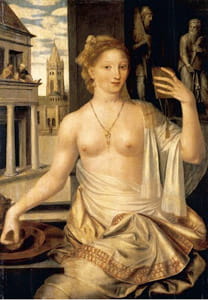 We know little about Bathsheba because her story is overshadowed by King David's. But from her, we do learn this: from strange circumstances, great good can come.
The skeleton of the story is well known: David sees Bathsheba bathing on the roof. As Frederick Buechner describes the scene in Peculiar Treasures: "He saw both that he had to have her at any cost, and that the cost would be exorbitant." Attracted by her beauty, the king sleeps with her and they conceive a child. Then he arranges to have her husband Uriah killed in battle. After his death, they marry, their child dies, and Bathsheba later gives birth to Solomon.
What's stunning is that we know nothing of Bathsheba's reactions to dramatic changes in her life. She is bathing innocently, unaware of who's watching—then suddenly, the king sends for her. That is not an order one can easily disobey. Nor can she resist the king's advances. She becomes a pawn in a royal game and has no say about her own destiny.
Did Bathsheba love her first husband? From the cameo portrait, we know Uriah has integrity, refusing to go home (as David wanted, providing the handy excuse that he's the dad) while his soldiers camped in the field. He has such noble loyalty to David that it provokes the prophet Nathan's famous parable, accusing the king of being like the rich man who steals the only lamb of a poor man. When David is outraged at the injustice, Nathan reminds him, "You are the man."
At Uriah's death, Bathsheba "made lamentation for him." But after the mourning, she marries David and bears his son. Again, we hear of David's prayer for the sick child, but can only imagine hers. We know little of her motherly grief except that the king "consoled" her and she bore Solomon.
When David is dying, Bathsheba acts to ensure that Solomon inherits his throne. By then, the mature woman has taken charge. As the future king's mother, she has an independence she didn't have as a girl.
If we could have a cup of tea with Bathsheba, she might point to her personal drama as a prime example that we can play roles we can't imagine, that our little lives are bits of a vast, divine pattern. In her novel Evensong, Gail Godwin draws on Father Raymond Brown's book, A Coming of Christ in Advent. She notes that none of the upstanding patriarchal wives like Sarah or Rachel are mentioned in Matthew's genealogy. Instead, each one named has "scandal or aspersion attached to her."
Bathsheba takes her place with Tamar and Rahab to prove that Jesus invites "an equal opportunity ministry for crooks and saints." That complex mix of nobodies and hooligans who formed the genealogy of the savior tells us that we play our parts too. God uses our peculiarities and gifts for powerful reasons we never guess. Godwin concludes, "Who of us can say we're not in the process of being used right now...to fulfill some purpose whose grace and goodness would boggle our imagination if we could even begin to get our minds around it?"
From Nathan's criticism of David, we know that God doesn't take kindly to using or possessing people. Indeed, the death of the first child is read as punishment for the king's arrogance. But why must the innocent mother suffer for the father's deed? The unanswered questions raised by Bathsheba's story prepare the way for a Christ who never manipulated nor demeaned anyone. Indeed, he was actively concerned about the welfare of the most apparently insignificant woman.
Buechner in the book mentioned earlier imagines David on his deathbed looking back on the lovely young woman who had inspired such fatal consequences. From that perspective, David realizes that the story wasn't about them. Instead, it was a step towards "the child of their child of their child a thousand years thence who he could only pray would find it in his heart to think kindly someday of the beautiful girl and the improvident king who had so recklessly and long ago been responsible for his birth in a stable and his death just outside the city walls."
Resource: 2 Sam. 11 & 12, I Kings 1 & 2
This piece previously appeared in St. Anthony's Messenger, and is reprinted with permission of the author.
8/23/2011 4:00:00 AM
Catholic
Catholic Being
Bathsheba
David
Christianity
Roman Catholicism
more at patheos
1

Meet Unique Catholic Author Clayton Barnett
2

Never Forget: What 9/11 Should Teach Us 25 Years Later
3

Jesus is Right: Moths and Rust Do Destroy Earthly Treasures
4

How Does Bìn Connect Fort Hood & Isaias?

About Kathy Coffey
Kathy Coffey is a national speaker, retreat leader, and the author of numerous articles in Catholic periodicals. On the web, find Kathy at: kathyjcoffey.wordpress.com
Patheos Explore the world's faith through different perspectives on religion and spirituality! Patheos has the views of the prevalent religions and spiritualities of the world.
Ad-Free & Subscriber Log-In Subscription Support
- About Us
- 2026 Calendar
- Videos
- Podcasts
- Library of World Religions
- Faith In Media Tracker
- Advertise With Us
- Write for Us
- Privacy Policy
- Terms of Service
- Do Not Sell My Data
- Contact Us
- Radiant Digital
- Manage Newsletter Subscriptions
- Unsubscribe From Notifications
- Sitemap
Copyright 2008-2026, Patheos. All rights reserved.
Subscription Support Ad-Free & Subscriber Log-In
Follow Patheos