
BuddhistCatholicContemplativeEvangelicalGeneral ChristianHinduJewishLatter-day SaintMuslimNew VisionsProgressive Christian
Beliefs
- Buddhist
- Catholic
- Contemplative
- Evangelical
- General Christian
- Hindu
- Jewish
- Latter-day Saint
- More Voices
- Muslim
- New Visions
- Pagan
- Progressive Christian
Topics
- Religion News
- Food and Religion
- Sports and Religion
- Religious Art
- Religious Music and Entertainment
- Religious Events
- History and Religion
- Style and Religion
- Politics and Religion
- Women in Religion
- Recreation Outdoors and Religion
- Business Finance and Religion
- Careers Workplace and Religion
- Education and Religion
- Family Parenting and Religion
- Health Fitness and Religion
- Home and Religion
- Relationships and Religion
- Technology and Religion
- Travel and Religion
Columnists
- Buddhist Columnists
- Business Finance and Religion Columnists
- Careers Workplace and Religion Columnists
- Catholic Columnists
- Contemplative Columnists
- Education and Religion Columnists
- Evangelists Columnists
- Family Parenting and Religion Columnists
- General Christian Columnists
- Health Fitness and Religion Columnists
- Hindu Columnists
- History and Religion Columnists
- Home and Religion Columnists
- Jewish Columnists
- More Voices Columnists
- Latter Day Columnists
- Muslim Columnists
- New Visions Columnists
- Nonreligious Columnists
- Pagan Columnists
- Politics and Religion Columnists
- Progressive Columnists
- Recreation Outdoors and Religion Columnists
- Relationships and Religion Columnists
- Religion News Columnists
- Religious Art Columnists
- Religious Events Columnists
- Religious Music and Entertainment Columnists
- Sports and Religion Columnists
- Style and Religion Columnists
- Technology and Religion Columnists
- Travel and Religion Columnists
- Women in Religion Columnists
Resource Library
- 2026 Calendar
- Library of World Religions
- The 100 Most Holy Places on Earth
- Patheos Answers
- Podcasts
- Videos
- Faith Leaders Database
- Anglican Episcopalian
- Bahai
- Baptist
- Buddhism
- Christianity
- Confucianism
- Eastern Orthodoxy
- Hinduism
- Holiness and Pentecostal
- ISKCON
- Islam
- Judaism
- Lutheran
- Methodist
- The Church of Jesus Christ of Latter-day Saints
- New Age
- Paganism
- Presbytarian and Reformed
- Protestantism
- Religion Behind the Scenes
- Roman Catholic
- Scientology
- Shia Islam
- Sikhism
- Sufism
- Sunni Islam
- Taoism
- Zen
- See all religions
Research Tools
 Ad-Free & Subscriber Log-In Subscription Support
Ad-Free & Subscriber Log-In Subscription Support
Follow Patheos 

- Trending:
- Forgiveness
- |
- Marriage
- |
- Consciousness
- |
- Death Penalty
- |
- Election
- |
- Halloween
Catholic
Woman of the Eucharist: Reading "Ecclesia de Eucharistia" (Part 2)
June 29, 2011 by Pat Gohn
"Like" the Patheos Catholic Page on Facebook to receive today's best commentary on Catholic issues.
Note: This article concludes a treatment of John Paul II's final encyclical on the Eucharist, Ecclesia de Eucharistia*. Read Part One here.*
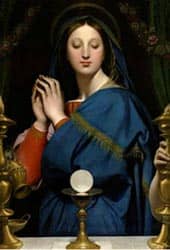 In the Eucharist we have Jesus. For Catholic Christians it is everything and all we need to successfully navigate our lives, and continue the work and mission of the Church. Through it we have access to the power of the Trinity.
Every commitment to holiness, every activity aimed at carrying out the Church's mission, every work of pastoral planning, must draw the strength it needs from the Eucharistic mystery and in turn be directed to that mystery as its culmination. In the Eucharist we have Jesus, we have his redemptive sacrifice, we have his resurrection, we have the gift of the Holy Spirit, we have adoration, obedience and love of the Father. (Ecclesia de Eucharistia, par. 55)
What's more, in Mary, we have a Mother and a model of the Church who points the way, that these extraordinary notions may bear fruit in our lives. So says Blessed John Paul II in his final encyclical, Ecclesia de Eucharistia ("On the Eucharist in its Relationship to the Church"). More to the point, the late pontiff writes, "if we wish to rediscover in all its richness the profound relationship between the Church and the Eucharist," we ought to be enrolled "at the school of Mary, woman of the Eucharist."
While the Gospels make no reference to Mary being present at the Last Supper, the institution of the Eucharist, Mary was part of the early Christian Church that gathered after the Ascension awaiting the Holy Spirit at Pentecost.
Certainly Mary must have been present at the Eucharistic celebrations of the first generation of Christians, who were devoted to "the breaking of bread" (Acts 2:42).
But in addition to her sharing in the Eucharistic banquet, an indirect picture of Mary's relationship with the Eucharist can be had, beginning with her interior disposition. Mary is a "woman of the Eucharist" in her whole life. (Ecclesia de Eucharistia, par. 53)
One of the most quoted utterances of Mary is from the biblical account of Jesus' first miracle at the wedding at Cana. When it is apparent that the hosts are about to run out of wine, Mary nudges Jesus to take action. She also further nudges the wait staff in the direction of Jesus with the words, "Do whatever he tells you" (Jn. 2:5).
The rest of the story revolves around Jesus' miracle of changing water into the best wine the locals have ever tasted. As dramatic as that is, it is still not as amazing as Jesus' turning bread into his body, and his own blood into the New Wine of the Covenant at the Last Supper: "Do this in memory of me!"
John Paul points out Mary's Eucharistic faith—even before the institution of the Eucharist—in Cana. He also explains how it might apply to us today.
With the same maternal concern which she showed at the wedding feast of Cana, Mary seems to say to us: "Do not waver; trust in the words of my Son. If he was able to change water into wine, he can also turn bread and wine into his body and blood, and through this mystery bestow on believers the living memorial of his passover, thus becoming the 'bread of life'". (Ecclesia de Eucharistia, par. 54)
The Cana story, with its wine component, is instructive when it comes to linking Mary and the Eucharist. But John Paul doesn't stop there. He takes another biblical account and draws an earlier Eucharistic connection in Mary's life. He looks all the way back to the Annunciation where Mary "offered her virginal womb for the Incarnation of God's Word."
Article Continued On Next Page
Page: 1 of 2
6/29/2011 4:00:00 AM
Catholic
A Word in Season
Eucharist
History
John Paul II
Sacraments
Christianity
Roman Catholicism
more at patheos
1
How Can We Be Ready to Meet the Lord?
2
Good Omens 3 Finale: A Perfectly Imperfect Ending
3
City where Divine Mercy was born to welcome 5,000 pilgrims
4
By Failing We Learn True Success

About Pat Gohn
Pat Gohn is a Catholic writer, speaker, and the host of the Among Women Podcast and blog. Her book Blessed, Beautiful and Bodacious: Celebrating the Gift of Catholic Womanhood is published by Ave Maria Press.
Patheos Explore the world's faith through different perspectives on religion and spirituality! Patheos has the views of the prevalent religions and spiritualities of the world.
Ad-Free & Subscriber Log-In Subscription Support
- About Us
- 2026 Calendar
- Videos
- Podcasts
- Library of World Religions
- Faith In Media Tracker
- Advertise With Us
- Write for Us
- Privacy Policy
- Terms of Service
- Do Not Sell My Data
- Contact Us
- Radiant Digital
- Manage Newsletter Subscriptions
- Unsubscribe From Notifications
- Sitemap
Copyright 2008-2026, Patheos. All rights reserved.
Subscription Support Ad-Free & Subscriber Log-In
Follow Patheos