
BuddhistCatholicContemplativeEvangelicalGeneral ChristianHinduJewishLatter-day SaintMuslimNew VisionsProgressive Christian
Beliefs
- Buddhist
- Catholic
- Contemplative
- Evangelical
- General Christian
- Hindu
- Jewish
- Latter-day Saint
- More Voices
- Muslim
- New Visions
- Pagan
- Progressive Christian
Topics
- Religion News
- Food and Religion
- Sports and Religion
- Religious Art
- Religious Music and Entertainment
- Religious Events
- History and Religion
- Style and Religion
- Politics and Religion
- Women in Religion
- Recreation Outdoors and Religion
- Business Finance and Religion
- Careers Workplace and Religion
- Education and Religion
- Family Parenting and Religion
- Health Fitness and Religion
- Home and Religion
- Relationships and Religion
- Technology and Religion
- Travel and Religion
Columnists
- Buddhist Columnists
- Business Finance and Religion Columnists
- Careers Workplace and Religion Columnists
- Catholic Columnists
- Contemplative Columnists
- Education and Religion Columnists
- Evangelists Columnists
- Family Parenting and Religion Columnists
- General Christian Columnists
- Health Fitness and Religion Columnists
- Hindu Columnists
- History and Religion Columnists
- Home and Religion Columnists
- Jewish Columnists
- More Voices Columnists
- Latter Day Columnists
- Muslim Columnists
- New Visions Columnists
- Nonreligious Columnists
- Pagan Columnists
- Politics and Religion Columnists
- Progressive Columnists
- Recreation Outdoors and Religion Columnists
- Relationships and Religion Columnists
- Religion News Columnists
- Religious Art Columnists
- Religious Events Columnists
- Religious Music and Entertainment Columnists
- Sports and Religion Columnists
- Style and Religion Columnists
- Technology and Religion Columnists
- Travel and Religion Columnists
- Women in Religion Columnists
Resource Library
- 2026 Calendar
- Library of World Religions
- The 100 Most Holy Places on Earth
- Patheos Answers
- Podcasts
- Videos
- Faith Leaders Database
- Anglican Episcopalian
- Bahai
- Baptist
- Buddhism
- Christianity
- Confucianism
- Eastern Orthodoxy
- Hinduism
- Holiness and Pentecostal
- ISKCON
- Islam
- Judaism
- Lutheran
- Methodist
- The Church of Jesus Christ of Latter-day Saints
- New Age
- Paganism
- Presbytarian and Reformed
- Protestantism
- Religion Behind the Scenes
- Roman Catholic
- Scientology
- Shia Islam
- Sikhism
- Sufism
- Sunni Islam
- Taoism
- Zen
- See all religions
Research Tools
 Ad-Free & Subscriber Log-In Subscription Support
Ad-Free & Subscriber Log-In Subscription Support
Follow Patheos 

- Trending:
- Forgiveness
- |
- Marriage
- |
- Consciousness
- |
- Death Penalty
- |
- Election
- |
- Halloween
Thank God for Desire
June 30, 2011 by Joseph Susanka
One thing have I desired of the LORD, that will I seek; that I may dwell in the house of the LORD all the days of my life—Psalm 27:4
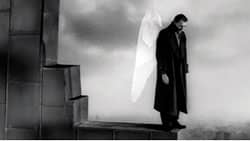 The entertainment industry lost one of its most beloved faces this past week when Peter Falk finally succumbed to dementia at the age of 83.
Most will remember him best as the unassuming yet relentless Lieutenant Columbo, whose scrupulous attention to detail and keen insights into human nature were carefully hidden under a bumbling, disheveled exterior. Others will fondly recall his hilarious turn in The In-Laws or his small (yet charming) role as the narrating grandfather in The Princess Bride. And for art-house aficionados, his longtime collaboration with indie pioneer John Cassavetes is an endless source of improvisational brilliance and courageous acting.
For me, however, the single most thought-provoking performance of his long and highlight-laden career will always be "Der Filmstar," from Wim Wenders' ethereal meditation, Wings of Desire (Der Himmel über Berlin).
The film's premise, while theologically problematic, is a fascinating one: Damiel (the incomparable Bruno Ganz) and Cassiel (Otto Sander) are angels whose sole mission is to wander the streets of West Berlin watching over its inhabitants. But these are no ordinary guardian angels: Damiel and Cassiel (indeed, all angels) are forbidden from directly interfering with the lives of the humans they are observing. While their presence can sometimes influence events in an oblique way—in one of the film's more powerful scenes, Damiel brings comfort to a dying motorist by placing an imperceptible hand on his forehead—their role is primarily that of a witness. "Do no more than look," Cassiel reminds his companion. "Assemble, testify, preserve. Remain spirit. Keep your distance."
Setting aside the implausibility of God placing such a restriction on His angelic cohorts, the consequences of the angels' forced inactivity is unsurprising: they grow increasingly passive and despondent. Once vibrant, active spirits, they have been worn down by constant exposure to sufferings and tribulations they cannot avert. Cassiel, happening across a suicidal young man on a skyscraper rooftop, realizes that the tragedy is inevitable. A harsh "Nein," wrenched from the angel's lips as the young man jumps, shows that it is never easy for him to watch men suffer. But his stoic acceptance of the death is a reminder that one can grow accustomed to all things, even the most sorrowful. (Wenders chose to shoot the angel-centric portions of his film in black and white—the perfect visual vocabulary for conveying his protagonists' apathetic yet profound anguish.)
For Damiel, this ever-growing ennui is banished forever by the arrival of Marion, a young circus performer (Solveig Dommartin) whose beauty and skill is matched only by her deep loneliness. Surprised and confused, the angel finds himself intensely drawn to her. He begins to follow her with particular fervor, recognizing in her the unique place mankind has been given in the universe.
As a trapeze artist, Marion hovers between heaven and earth, her every action filled with great beauty and with great danger; to the angel, she is the perfect symbol of our humanity. Damiel cannot help but recognize the power of her emotions, seeing in them the very vibrancy and life that has eluded his kind for generations. Despite Cassiel's cautions, Damiel grows increasingly dissatisfied with his angelic existence, yearning to experience the highs and lows (and the sheer physicality) of human nature.
He tires of a black and white world, but does he really understand what it means to live in color?
Weaving in, out, and around this story and its unlikely protagonists is Falk's "Der Filmstar," a relatively small yet crucial character. His presence is unexplained and he is never even named, yet as the only adult in the city of Berlin who can actually see the angels, his character is essential to Wenders' efforts. Through him, the film is able to meld the angelic and human realms, providing audiences with a common point of reference between the two. It is he who provides Damiel with the guidance and encouragement necessary to face his dilemma.
 And it is Der Filmstar's inner dialogue and philosophical musings—improvised almost entirely by Falk himself—that provide the work with its most lucid and endearing moments. Wenders even makes use of his audience's familiarity with Columbo in a number of intriguing ways. His use of the diminutive New Yorker's ubiquitous trench coat is particularly charming, and sure to bring a smile to the face of any Falk fan.
Article Continued On Next Page
Page: 1 of 2
6/30/2011 4:00:00 AM
Through a Lens Darkly
Film
Movies
Wings of Desire
Christianity
Roman Catholicism
more at patheos
1

2
Psalm 23: A Poem for the Pilgrimage
3

Emotional Exhaustion in Motherhood
4

The Creative Spirit: Every Soul a Creator

About Joseph Susanka
Joseph Susanka has been doing development work for institutions of Catholic higher education since his graduation from Thomas Aquinas College in 1999. He blogs at Crisis Magazine, where he also contributes feature articles on a variety of topics.
Patheos Explore the world's faith through different perspectives on religion and spirituality! Patheos has the views of the prevalent religions and spiritualities of the world.
Ad-Free & Subscriber Log-In Subscription Support
- About Us
- 2026 Calendar
- Videos
- Podcasts
- Library of World Religions
- Faith In Media Tracker
- Advertise With Us
- Write for Us
- Privacy Policy
- Terms of Service
- Do Not Sell My Data
- Contact Us
- Radiant Digital
- Manage Newsletter Subscriptions
- Unsubscribe From Notifications
- Sitemap
Copyright 2008-2026, Patheos. All rights reserved.
Subscription Support Ad-Free & Subscriber Log-In
Follow Patheos