
BuddhistCatholicContemplativeEvangelicalGeneral ChristianHinduJewishLatter-day SaintMuslimNew VisionsProgressive Christian
Beliefs
- Buddhist
- Catholic
- Contemplative
- Evangelical
- General Christian
- Hindu
- Jewish
- Latter-day Saint
- More Voices
- Muslim
- New Visions
- Pagan
- Progressive Christian
Topics
- Religion News
- Food and Religion
- Sports and Religion
- Religious Art
- Religious Music and Entertainment
- Religious Events
- History and Religion
- Style and Religion
- Politics and Religion
- Women in Religion
- Recreation Outdoors and Religion
- Business Finance and Religion
- Careers Workplace and Religion
- Education and Religion
- Family Parenting and Religion
- Health Fitness and Religion
- Home and Religion
- Relationships and Religion
- Technology and Religion
- Travel and Religion
Columnists
- Buddhist Columnists
- Business Finance and Religion Columnists
- Careers Workplace and Religion Columnists
- Catholic Columnists
- Contemplative Columnists
- Education and Religion Columnists
- Evangelists Columnists
- Family Parenting and Religion Columnists
- General Christian Columnists
- Health Fitness and Religion Columnists
- Hindu Columnists
- History and Religion Columnists
- Home and Religion Columnists
- Jewish Columnists
- More Voices Columnists
- Latter Day Columnists
- Muslim Columnists
- New Visions Columnists
- Nonreligious Columnists
- Pagan Columnists
- Politics and Religion Columnists
- Progressive Columnists
- Recreation Outdoors and Religion Columnists
- Relationships and Religion Columnists
- Religion News Columnists
- Religious Art Columnists
- Religious Events Columnists
- Religious Music and Entertainment Columnists
- Sports and Religion Columnists
- Style and Religion Columnists
- Technology and Religion Columnists
- Travel and Religion Columnists
- Women in Religion Columnists
Resource Library
- 2026 Calendar
- Library of World Religions
- The 100 Most Holy Places on Earth
- Patheos Answers
- Podcasts
- Videos
- Faith Leaders Database
- Anglican Episcopalian
- Bahai
- Baptist
- Buddhism
- Christianity
- Confucianism
- Eastern Orthodoxy
- Hinduism
- Holiness and Pentecostal
- ISKCON
- Islam
- Judaism
- Lutheran
- Methodist
- The Church of Jesus Christ of Latter-day Saints
- New Age
- Paganism
- Presbytarian and Reformed
- Protestantism
- Religion Behind the Scenes
- Roman Catholic
- Scientology
- Shia Islam
- Sikhism
- Sufism
- Sunni Islam
- Taoism
- Zen
- See all religions
Research Tools
 Ad-Free & Subscriber Log-In Subscription Support
Ad-Free & Subscriber Log-In Subscription Support
Follow Patheos 

- Trending:
- Forgiveness
- |
- Marriage
- |
- Consciousness
- |
- Death Penalty
- |
- Election
- |
- Halloween
Catholic
The Sublime Logic of the Trinity
June 15, 2011 by Pat Gohn
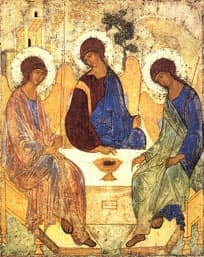 Andrei Rublev's Trinity, early 15th century
Taking a page from Frank Sheed's brilliant classic, Theology for Beginners, "No book on doctrine will teach you as much as the Missal—provided you bring some knowledge with you. Books . . . exist to provide the knowledge which the Missal assumes we have!"
This Sunday is the Solemnity of the Most Holy Trinity. Starting with Sheed's advice, let's try to come to this Mass better prepared, by first attending to the Preface of the Holy Trinity from the Missal.
Father, all powerful and ever-living God,
we do well always and everywhere to give you thanks.
We joyfully proclaim our faith
in the mystery of your Godhead.
You have revealed your glory
as the glory of your Son and of the Holy Spirit:
three Persons equal in majesty,
undivided in splendor,
yet one Lord, one God,
ever to be adored in your everlasting glory.
This Solemnity proclaims the central mystery of our faith: the Most Holy Trinity.
Sometimes we Christians forget that. Sometimes we think Jesus' resurrection, or the Eucharist, or the commandment to love, are central. No doubt, these are all important to Christianity, but God's revelation of Himself as the Blessed Trinity is most important.
The revelation of God as Trinity reveals Who God is and what God does. The Trinity is the core of all Christian beliefs, as the well-known tri-fold structure of the Apostles' Creed or the Nicene Creed illustrates.
In describing the "Who" of the Trinity, the Preface echoes the Creed by naming the Three-in-One Godhead according to the relationships contained therein—the Father, the Son, and the Holy Spirit. Focusing on the relationships between the Persons of the Trinity, in the Creed and the Preface, unlocks its logic.
The Catechism of the Catholic Church calls this logic "the innermost secret" of the Trinity. (And for the record, it seems unlikely that a reference work like the Catechism would come up with pithy verbal gems. Yet, now and then, it does. So if you are looking for a sound bite to define the Trinity at your next cocktail party, you're about to get one.)
God's very being is love. By sending his only Son and the Spirit of Love in the fullness of time, God has revealed his innermost secret: God himself is an eternal exchange of love, Father, Son and Holy Spirit, and he has destined us to share in that exchange. (Catechism of the Catholic Church, [CCC], par. 221)
Did you note the sound bite? God is an eternal exchange of love. This phrase describes the all-encompassing mystery of the Trinity in its purest essence.
What's more, did you catch the corollary at the end? We are destined to share in that exchange. More on that in a moment.
The "Who" of the Trinity is not only descriptive of God's being, but it also gives some indication as to "what" the Trinity does.
Some background: Christians have faith in this Three-in-One God because of God's own revelation to us. God not only created time but entered into time and spoke to us. The primary reason for this divine intervention is that God longed to reveal Himself to us, and did so in ever increasing degrees over the course of human history.
Think about it: This is a God who wants to be known. By us! And loved by us. The most amazing thing about the glory of God is that it is something that God wishes to share with us.
God is not afraid to seek us out and invite us to be joined to Him in everlasting glory. God is our origin and our end.
Reread the Preface above.
That little phrase from the Prefaceabout God "ever to be adored" refers to would-be adorers—that would be us, His children, and all the saints in heaven—the ones who are invited into glory by being baptized in the Name of the Father, and the Son, and the Holy Spirit.
The Church, as Sheed says, assumes you might already have this knowledge.
Article Continued On Next Page
Page: 1 of 2
6/15/2011 4:00:00 AM
Catholic
A Word in Season
Creeds
Sacred Texts
Trinity
Christianity
Roman Catholicism
more at patheos
1
Guadalupe's Pilgrim Image Visits Our Parish School
2
We Must Resist The Demonization Of Others
3
Learning from the Catholics' Worship Wars
4

About Pat Gohn
Pat Gohn is a Catholic writer, speaker, and the host of the Among Women Podcast and blog. Her book Blessed, Beautiful and Bodacious: Celebrating the Gift of Catholic Womanhood is published by Ave Maria Press.
Patheos Explore the world's faith through different perspectives on religion and spirituality! Patheos has the views of the prevalent religions and spiritualities of the world.
Ad-Free & Subscriber Log-In Subscription Support
- About Us
- 2026 Calendar
- Videos
- Podcasts
- Library of World Religions
- Faith In Media Tracker
- Advertise With Us
- Write for Us
- Privacy Policy
- Terms of Service
- Do Not Sell My Data
- Contact Us
- Radiant Digital
- Manage Newsletter Subscriptions
- Unsubscribe From Notifications
- Sitemap
Copyright 2008-2026, Patheos. All rights reserved.
Subscription Support Ad-Free & Subscriber Log-In
Follow Patheos