
BuddhistCatholicContemplativeEvangelicalGeneral ChristianHinduJewishLatter-day SaintMuslimNew VisionsProgressive Christian
Beliefs
- Buddhist
- Catholic
- Contemplative
- Evangelical
- General Christian
- Hindu
- Jewish
- Latter-day Saint
- More Voices
- Muslim
- New Visions
- Pagan
- Progressive Christian
Topics
- Religion News
- Food and Religion
- Sports and Religion
- Religious Art
- Religious Music and Entertainment
- Religious Events
- History and Religion
- Style and Religion
- Politics and Religion
- Women in Religion
- Recreation Outdoors and Religion
- Business Finance and Religion
- Careers Workplace and Religion
- Education and Religion
- Family Parenting and Religion
- Health Fitness and Religion
- Home and Religion
- Relationships and Religion
- Technology and Religion
- Travel and Religion
Columnists
- Buddhist Columnists
- Business Finance and Religion Columnists
- Careers Workplace and Religion Columnists
- Catholic Columnists
- Contemplative Columnists
- Education and Religion Columnists
- Evangelists Columnists
- Family Parenting and Religion Columnists
- General Christian Columnists
- Health Fitness and Religion Columnists
- Hindu Columnists
- History and Religion Columnists
- Home and Religion Columnists
- Jewish Columnists
- More Voices Columnists
- Latter Day Columnists
- Muslim Columnists
- New Visions Columnists
- Nonreligious Columnists
- Pagan Columnists
- Politics and Religion Columnists
- Progressive Columnists
- Recreation Outdoors and Religion Columnists
- Relationships and Religion Columnists
- Religion News Columnists
- Religious Art Columnists
- Religious Events Columnists
- Religious Music and Entertainment Columnists
- Sports and Religion Columnists
- Style and Religion Columnists
- Technology and Religion Columnists
- Travel and Religion Columnists
- Women in Religion Columnists
Resource Library
- 2026 Calendar
- Library of World Religions
- The 100 Most Holy Places on Earth
- Patheos Answers
- Podcasts
- Videos
- Faith Leaders Database
- Anglican Episcopalian
- Bahai
- Baptist
- Buddhism
- Christianity
- Confucianism
- Eastern Orthodoxy
- Hinduism
- Holiness and Pentecostal
- ISKCON
- Islam
- Judaism
- Lutheran
- Methodist
- The Church of Jesus Christ of Latter-day Saints
- New Age
- Paganism
- Presbytarian and Reformed
- Protestantism
- Religion Behind the Scenes
- Roman Catholic
- Scientology
- Shia Islam
- Sikhism
- Sufism
- Sunni Islam
- Taoism
- Zen
- See all religions
Research Tools
 Ad-Free & Subscriber Log-In Subscription Support
Ad-Free & Subscriber Log-In Subscription Support
Follow Patheos 

- Trending:
- Forgiveness
- |
- Marriage
- |
- Consciousness
- |
- Death Penalty
- |
- Election
- |
- Halloween
Jewish
Holiness in Prayer
June 15, 2011 by Eliyahu Yaakov
A common theme in Judaism is the struggle for one's heart. So much so, that the Talmud declares that it is one's heart that God "wants."
Often this struggle can be seen as a tug-of-war between one's head and one's body—one's mind and one's lusts, in which the heart, one's passion, is at stake. If the head is triumphant, rational decisions are made and followed up with a passion. However, if the body is victorious, an impassioned chasing after one's lusts ensues.
Rising Above
For this reason, when we are involved in activities of holiness within Judaism, we stay away from any grossly physical situation because, while we want to be involved in elevating the physical, we want to avoid becoming engrossed in the physical.
As discussed previously in regard to that which is permitted and that which is forbidden in Jewish law, this is the basis of the Torah.
When it is possible to bring about God-clarity through a physical act, that act is permitted. When something is too enveloped in non-God-clarity to reveal God in the act, it is forbidden.
In the Messianic era, there will be a change in that which is forbidden since our level of consciousness will shift. For example, the pig will become permissible to eat, as is hinted to by the Hebrew word for pig, chazir, which shares it root with the word for return, chozer, indicating that the pig will return to its proper "place" as an aspect of the physical world by which the Divine can be actively perceived, and, thus, the pig will be rendered kosher.
(It should be noted that we are not saying here that Judaism will change when the Messianic era arrives. Rather, we are saying that built into the system of Judaism is the possibility for something to go from forbidden to permitted and visa-versa based on the spiritual conditions.)
However, for now, we are to live and function in the unclear reality in which we exist.
All for the Best
Exemplifying this point, we will discuss in a later section that there is a blessing we say on good things that occur, and a blessing we say on bad things that occur. Now, this raises a philosophical question: According to Judaism, which claims that all is from the One Good God and therefore all is truly good, how can there be a blessing for an occurrence that is "bad"? There is no such thing!
The answer to this is that while it is true that all that occurs is truly good, we simply do not function on the plane to naturally and initially react to a difficult or painful occurrence in a way that reflects its inherent goodness. That is just simply not our headspace.
Perhaps we can more properly say that there are two separate blessings for good occurrences—one for good things that appear good, and one for good things that appear bad. This explains the terminology by which we refer to God in the blessing over a "bad" occurrence - "The True Judge."
However, the Talmud teaches that when the Messianic era arrives, there will only be the one blessing for good occurrences—the blessing for good occurrences that appear good. In this blessing we refer to God as "The One Who Is Good and Does Good" since the clarity and consciousness of that time will be one in which all will be initially perceived as good and from God. There will be no discussion necessary in order to come to this conclusion. There will be no philosophizing. It will not be something we know; it will be the reality we live and breathe.
Finding Clarity amidst Confusion
Just as we are presently engrossed in our unclear spiritual state of mind, resulting in naturally perceiving certain events in our lives as bad, there are certain situations that are so affiliated with, and engrossed in, the physicality of our world that it would be inappropriate and detrimental to be involved in holiness and spirituality within those surroundings and under those conditions.
For this reason, according to Jewish law, one is not to pray nor be involved with any holy activity in the bathroom, next to bathroom waste, near a garbage dump, in a place that smells badly, etc. Nor is one permitted to pray when one has to go to the bathroom.
Additionally, one is not to pray naked, nor in front of the nudity of another.
(The term "nudity" requires definition. Judaism understands there to be two forms of nudity—Objective Nudity and Subjective Nudity. Objective Nudity is that which Judaism considers as nudity irrespective of what the societal or communal norms are. Subjective Nudity is anything additional that is normally covered within a particular community. To get more specific on this topic would be to go beyond the scope of this article.)
This is not to absolutely equate the human body with the bathroom or waste material. Rather, since we initially identify both the body and waste as staples of pure physicality, we are to distance ourselves from them as we attempt to ascend beyond the engrossing nature of the physical to achieve holiness.
6/15/2011 4:00:00 AM
Jewish
Kabbalah Korner
Messaiah
Prayer
Sacred Texts
Judaism
more at patheos
1

2

Ready Hearts Await the Return of Christ
3

No More Perfect Icon than a Neighbor
4

The Parable of the Talents: Bury It and Lose It
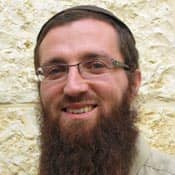
About Eliyahu Yaakov
Rabbi Eliyahu Yaakov is a sought after international speaker on Kabbalah, relationships, parenting, and life. His newly released book, Jewish By Choice: A Kabbalistic Take on Life & Judaism, recently hit #1 on Amazon's Best Seller list.
Patheos Explore the world's faith through different perspectives on religion and spirituality! Patheos has the views of the prevalent religions and spiritualities of the world.
Ad-Free & Subscriber Log-In Subscription Support
- About Us
- 2026 Calendar
- Videos
- Podcasts
- Library of World Religions
- Faith In Media Tracker
- Advertise With Us
- Write for Us
- Privacy Policy
- Terms of Service
- Do Not Sell My Data
- Contact Us
- Radiant Digital
- Manage Newsletter Subscriptions
- Unsubscribe From Notifications
- Sitemap
Copyright 2008-2026, Patheos. All rights reserved.
Subscription Support Ad-Free & Subscriber Log-In
Follow Patheos