
BuddhistCatholicContemplativeEvangelicalGeneral ChristianHinduJewishLatter-day SaintMuslimNew VisionsProgressive Christian
Beliefs
- Buddhist
- Catholic
- Contemplative
- Evangelical
- General Christian
- Hindu
- Jewish
- Latter-day Saint
- More Voices
- Muslim
- New Visions
- Pagan
- Progressive Christian
Topics
- Religion News
- Food and Religion
- Sports and Religion
- Religious Art
- Religious Music and Entertainment
- Religious Events
- History and Religion
- Style and Religion
- Politics and Religion
- Women in Religion
- Recreation Outdoors and Religion
- Business Finance and Religion
- Careers Workplace and Religion
- Education and Religion
- Family Parenting and Religion
- Health Fitness and Religion
- Home and Religion
- Relationships and Religion
- Technology and Religion
- Travel and Religion
Columnists
- Buddhist Columnists
- Business Finance and Religion Columnists
- Careers Workplace and Religion Columnists
- Catholic Columnists
- Contemplative Columnists
- Education and Religion Columnists
- Evangelists Columnists
- Family Parenting and Religion Columnists
- General Christian Columnists
- Health Fitness and Religion Columnists
- Hindu Columnists
- History and Religion Columnists
- Home and Religion Columnists
- Jewish Columnists
- More Voices Columnists
- Latter Day Columnists
- Muslim Columnists
- New Visions Columnists
- Nonreligious Columnists
- Pagan Columnists
- Politics and Religion Columnists
- Progressive Columnists
- Recreation Outdoors and Religion Columnists
- Relationships and Religion Columnists
- Religion News Columnists
- Religious Art Columnists
- Religious Events Columnists
- Religious Music and Entertainment Columnists
- Sports and Religion Columnists
- Style and Religion Columnists
- Technology and Religion Columnists
- Travel and Religion Columnists
- Women in Religion Columnists
Resource Library
- 2026 Calendar
- Library of World Religions
- The 100 Most Holy Places on Earth
- Patheos Answers
- Podcasts
- Videos
- Faith Leaders Database
- Anglican Episcopalian
- Bahai
- Baptist
- Buddhism
- Christianity
- Confucianism
- Eastern Orthodoxy
- Hinduism
- Holiness and Pentecostal
- ISKCON
- Islam
- Judaism
- Lutheran
- Methodist
- The Church of Jesus Christ of Latter-day Saints
- New Age
- Paganism
- Presbytarian and Reformed
- Protestantism
- Religion Behind the Scenes
- Roman Catholic
- Scientology
- Shia Islam
- Sikhism
- Sufism
- Sunni Islam
- Taoism
- Zen
- See all religions
Research Tools
 Ad-Free & Subscriber Log-In Subscription Support
Ad-Free & Subscriber Log-In Subscription Support
Follow Patheos 

- Trending:
- Forgiveness
- |
- Marriage
- |
- Consciousness
- |
- Death Penalty
- |
- Election
- |
- Halloween
Catholic
Where would Dante or Rob Bell, or You, put Bin Laden?
May 09, 2011 by Tim Muldoon
 A couple of days ago I had to send one of my young daughters to a time-out for something mean she did to her sister. She exploded in a fury of rage, even indignation, shrieking, "Injustice! Scandal! Unfairness!!!!" (I am paraphrasing.) She went on to explain all the misdeeds of her enemy: "She gets away with everything! She should go to timeout! She should go there forever!!" Behind my stern I-am-the-parent-and-therefore-the-arbiter-of-justice look, I was barely able to hold back the eruption of a huge laugh, for before me I saw the unfolding of the Human Condition. There but for the grace of God go I.
Is not the thirst for justice embedded in our skins? Is not the sense of fairness passed along in our mothers' milk? And yet we have an immediate paradox: why? Why in the world should we think anything in life is fair? Animals kill and eat each other, and no one balks and calls a pack of hyenas terrorists. Why should we blink an eye at people killing each other?
Yet it is precisely the mystery of our desire for justice that makes it in some ways out of reach. Can we rejoice at a man's death, even a man who is a mass murderer? What do we hope comes of this man to bring about justice? As one relative of a 9/11 victim observed, nothing can bring back her husband. There is no "restoration" in the sense that restorative justice seeks. One who seeks it will forever be disappointed.
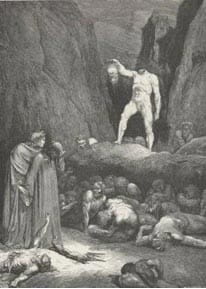
Enter Dante. Hell, for him, was a place of contrapasso, of punishment that directly correlated with sin. False prophets have their heads twisted backwards so they cannot see the road ahead; a man who decapitated a head of state carries his own head around like an oil lamp. Where would Dante put bin Laden? Probably in circle seven, with the violent against neighbors: the murderers and war-makers who, because they wallowed in others' blood during their lives, are condemned to immersion in boiling blood forever.
Abstracting from the medieval theology that provided the architecture for Dante's vision of hell, let's observe that it provides a certain satisfaction for that desire for justice. Imagining one's worst enemy boiling in blood can give some salve to the wounded heart. Dante himself, for example, was probably gleeful at putting Pope Boniface VIII, who sent Dante into exile, in circle eight. Dante finds all sorts of personal and professional acquaintances down there. For when life itself is dramatically unfair, an appeal to a fair afterlife seems satisfying.
Enter Rob Bell. His headline-making book Love Wins moves away from Dante's vision, which—even more than the Bible itself—is the default Western imagination about hell. His question is about what kind of God would condemn people to hell, should they not get on the Jesus bandwagon. His response: God's love is stronger. Maybe God can even redeem bin Laden.
Dante and Bell present very different ways of imagining eternity. Dante gives us a muscular, satisfying eye-for-an-eye, even as he later goes on to explain Purgatory and Heaven as places of purification and joy for those who open their hearts to God. Bell offers an expansive, powerful God of Globalization, almost as hip as Bell himself. Both men reflect a zeitgeist, though Dante has the unfortunate problem of being dead for seven hundred years and therefore unable to tweet and explain himself further.
Dante's magnum opus is arguably more about Christian life itself than about the afterlife, inasmuch as it serves as a way of reflecting on fundamental truths of Christian doctrine: the need to obey the commandments and live a moral life; the salvation offered by Christ and the promise of joy; the misery caused to self and others by sinful choices. Bell's book, similarly, is about reflecting on the ways that Christians life and believe today, exposing inconsistencies that suggest an elitist or exclusivist attitude toward people who are not Christian. Both books call for reflection and commentary on thorny questions, like those presented by the death of a major figure like Osama bin Laden. Neither, of course, is capable of really understanding what happens when people die. But both are part of a trans-historical conversation which itself has shaped and continues to shape our response to a complex world.
I prefer to think of bin Laden in rather more Dantean terms, at least in the sense that my understanding of human freedom suggests that in death we get exactly what we have lived for. To say that is not to exhaust the fundamental conviction that God loves all people: it is to say that some find God's love abhorrent, such that the experience of God's love is so odious as to constitute a hell. The human being is free, but God is also free to love those who find God's love hateful. What that means for the way we live is this: practicing love is the call of every person.
On the flip side, however, it means that there is such a thing as sin, an absolute refusal to do the hard work of love. And a culture that forgets sin is hardly in any place to condemn it when they see it. Maybe that's why many people rejoiced at bin Laden's death, because it reminded them that there is grace and sin, right and wrong, good and evil. And on this occasion, we reduced the amount of evil in the world.
5/9/2011 4:00:00 AM
Catholic
Culture at the Crossroads
hell
Osama bin Laden
Rob Bell
Christianity
Roman Catholicism
more at patheos
1

A Few "Worst" & "Best" Arguments vs. Protestantism
2
Why the Passion Translation Bible Gets So Much Vitriol
3

Cubes, Backrooms, and Staircases
4
Sola or Nuda? Testing the Reformation’s Claim of Authority

About Tim Muldoon
Tim Muldoon holds a Ph.D. in Catholic systematic theology and is an award-winning author and Catholic theologian of the new evangelization.
Patheos Explore the world's faith through different perspectives on religion and spirituality! Patheos has the views of the prevalent religions and spiritualities of the world.
Ad-Free & Subscriber Log-In Subscription Support
- About Us
- 2026 Calendar
- Videos
- Podcasts
- Library of World Religions
- Faith In Media Tracker
- Advertise With Us
- Write for Us
- Privacy Policy
- Terms of Service
- Do Not Sell My Data
- Contact Us
- Radiant Digital
- Manage Newsletter Subscriptions
- Unsubscribe From Notifications
- Sitemap
Copyright 2008-2026, Patheos. All rights reserved.
Subscription Support Ad-Free & Subscriber Log-In
Follow Patheos