
BuddhistCatholicContemplativeEvangelicalGeneral ChristianHinduJewishLatter-day SaintMuslimNew VisionsProgressive Christian
Beliefs
- Buddhist
- Catholic
- Contemplative
- Evangelical
- General Christian
- Hindu
- Jewish
- Latter-day Saint
- More Voices
- Muslim
- New Visions
- Pagan
- Progressive Christian
Topics
- Religion News
- Food and Religion
- Sports and Religion
- Religious Art
- Religious Music and Entertainment
- Religious Events
- History and Religion
- Style and Religion
- Politics and Religion
- Women in Religion
- Recreation Outdoors and Religion
- Business Finance and Religion
- Careers Workplace and Religion
- Education and Religion
- Family Parenting and Religion
- Health Fitness and Religion
- Home and Religion
- Relationships and Religion
- Technology and Religion
- Travel and Religion
Columnists
- Buddhist Columnists
- Business Finance and Religion Columnists
- Careers Workplace and Religion Columnists
- Catholic Columnists
- Contemplative Columnists
- Education and Religion Columnists
- Evangelists Columnists
- Family Parenting and Religion Columnists
- General Christian Columnists
- Health Fitness and Religion Columnists
- Hindu Columnists
- History and Religion Columnists
- Home and Religion Columnists
- Jewish Columnists
- More Voices Columnists
- Latter Day Columnists
- Muslim Columnists
- New Visions Columnists
- Nonreligious Columnists
- Pagan Columnists
- Politics and Religion Columnists
- Progressive Columnists
- Recreation Outdoors and Religion Columnists
- Relationships and Religion Columnists
- Religion News Columnists
- Religious Art Columnists
- Religious Events Columnists
- Religious Music and Entertainment Columnists
- Sports and Religion Columnists
- Style and Religion Columnists
- Technology and Religion Columnists
- Travel and Religion Columnists
- Women in Religion Columnists
Resource Library
- 2026 Calendar
- Library of World Religions
- The 100 Most Holy Places on Earth
- Patheos Answers
- Podcasts
- Videos
- Faith Leaders Database
- Anglican Episcopalian
- Bahai
- Baptist
- Buddhism
- Christianity
- Confucianism
- Eastern Orthodoxy
- Hinduism
- Holiness and Pentecostal
- ISKCON
- Islam
- Judaism
- Lutheran
- Methodist
- The Church of Jesus Christ of Latter-day Saints
- New Age
- Paganism
- Presbytarian and Reformed
- Protestantism
- Religion Behind the Scenes
- Roman Catholic
- Scientology
- Shia Islam
- Sikhism
- Sufism
- Sunni Islam
- Taoism
- Zen
- See all religions
Research Tools
 Ad-Free & Subscriber Log-In Subscription Support
Ad-Free & Subscriber Log-In Subscription Support
Follow Patheos 

- Trending:
- Forgiveness
- |
- Marriage
- |
- Consciousness
- |
- Death Penalty
- |
- Election
- |
- Halloween
Muslim
Saudi Women Want the Freedom to Drive
May 27, 2011 by Dilshad Ali
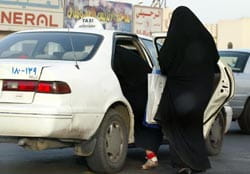 This morning, as usual, after sending the older two kids off to school on their busses, I finished feeding my 3-year-old, put on my headscarf, strapped my son into our car, and drove to his preschool. After I dropped him off, I drove myself to work. On my lunch break, I drove back to preschool and picked up my son and brought him home to his grandparents, grabbed some lunch, drove back to work. Later that evening, I drove home, stopping by the grocery store to pick up a few things on the way.
What's so extraordinary about this? Nothing, really. I drove like I normally do. And I have been driving for many years now, obtaining my license as soon as I hit that magical age of 16. Driving is something I take for granted here in the U.S. But if you are a woman in Saudi Arabia, you might as well forget about driving, since for many years the Saudi government has forbidden females from getting behind the wheel. And if there is one symbol that feminists or basically anyone with a beef against Islam's treatment of women point to, it's the Kingdom's "rule" on no women drivers.
And it's a shame, really, that this rule (which I find rather ridiculous in light of many other things women can and are encouraged to do in Saudi Arabia, like pursue education and work outside of the home) often becomes the red flag for critics to say, "Women are inferior in Islam."
I call it a rule, rather than a law, because there actually is no official law or ban on women driving in Saudi Arabia. But other laws effectively make it impossible for women to drive, as citizens must use locally-issued licenses, which are not issued to women.
Many Saudi women have chafed at this for years, and last week, one woman took matters into her own hands and defied the ban by getting behind the wheel and driving in port city of Jeddah for four days without being stopped. Najla al Hariri, a housewife in her mid-30s, said in an Agents France Presse article that she drove "to defend her belief that Saudi women should be able to drive.
"I don't fear being arrested because I am setting an example that my daughter and her friends are proud of," Hariri told AFP. She also is offering driving lessons for women.
Another Saudi woman, Manal al-Sharif, was arrested after posting videos of herself driving on YouTube. She is urging all Saudi women to drive on June 17. And as with all anti-government protests these days, there is also an active Facebook campaign called "Teach me how to drive so I can protect myself," which has garnered more than 4,300 followers as of May 25 and is in support of al-Sharif's cause. Al-Sharif's original Facebook page drew about 12,000 supporters before it was removed.
I hope the momentum builds around this, and this "non-law" really changes. It's about time. In an interview with NPR, Khaled Al-Maeena, the editor of Saudi News in Jeddah, said there has been a negative effect with her arrest. "There is a counter campaign against it by certain elements in society. There are hardline conservative elements [that] are against participation and women," he said, adding that, "This goes against the grain of what the government is saying. . . . The king and crown prince are on record as saying that they're all for women's emancipation."
Saudi women and Muslim women around the world are watching to see what happens on June 17. More than the protest being a defiant act against Islam (which really has nothing to say about driving) or the current Saudi government (which is trying to usher in reform, albeit in a very controlled and slow place), this protest is against a patriarchal society that doesn't want to give up old ways, a society that believes forbidding women to drive is for their own protection.
Some argue that a woman shouldn't drive, especially alone, because she will be travelling without a mahram. A mahram*,* according to www.islamic-dictionary.com, is a male whom the woman could never marry because of a close relationship, like a brother, father, grandfather, or sibling. If a woman is married, her husband is her mahram. According to various Islamic texts, a woman need not wear a hijab (headscarf) in front of her mahram, and a mahram is usually needed for travelling long distances.
These men are considered a woman's mahram because it says in the Qur'an, "And marry not women whom your fathers married, except what has already passed; indeed it was shameful and most hateful, and an evil way. Forbidden to you (for marriage) are: your mothers, your daughters, your sisters, your father's sisters, your mother's sisters, your brother's daughters, your sister's daughters, your foster mother who gave you suck, your foster milk suckling sisters, your wives' mothers, your step-daughters under your guardianship, born of your wives to whom you have gone in—but there is no sin on you if you have not gone in them (to marry their daughters), . . . the wives of your sons who (spring) from your own loins, and two sisters in wedlock at the same time, except for what has already passed; verily, Allah is Oft-Forgiving, Most Merciful" (An-Nisa 4:22-23).
Article Continued On Next Page
Page: 1 of 2
5/27/2011 4:00:00 AM
Muslim
Driving
Rights
Sacred Texts
Saudi Arabia
Women
Islam
more at patheos
1

2

Can We Choose NOT to Live in Anger and Fear?
3

What Exactly Does Christ Purify?
4

Third Sunday of Easter - Lectionary April 19, 2026
About Dilshad Ali
Dilshad D. Ali is managing editor of the Muslim Portal at Patheos. An experienced journalist, she has covered Islam and Muslims in America for more than ten years for a variety of print and online media outlets, including Beliefnet and Illume, Islamica, and Azizah Magazines.
Patheos Explore the world's faith through different perspectives on religion and spirituality! Patheos has the views of the prevalent religions and spiritualities of the world.
Ad-Free & Subscriber Log-In Subscription Support
- About Us
- 2026 Calendar
- Videos
- Podcasts
- Library of World Religions
- Faith In Media Tracker
- Advertise With Us
- Write for Us
- Privacy Policy
- Terms of Service
- Do Not Sell My Data
- Contact Us
- Radiant Digital
- Manage Newsletter Subscriptions
- Unsubscribe From Notifications
- Sitemap
Copyright 2008-2026, Patheos. All rights reserved.
Subscription Support Ad-Free & Subscriber Log-In
Follow Patheos